➡️ PART 3 ENDING PART ➡️
“Emily,” Liam whispered, “what did you do?”
For the first time in six days, I saw genuine fear in my husband’s eyes.
Not irritation.
Not annoyance.
Not the exhausted expression he had perfected whenever Hailey cried at two in the morning and I asked whether he could hold her for ten minutes.
Fear.
His fingers tightened around the papers.
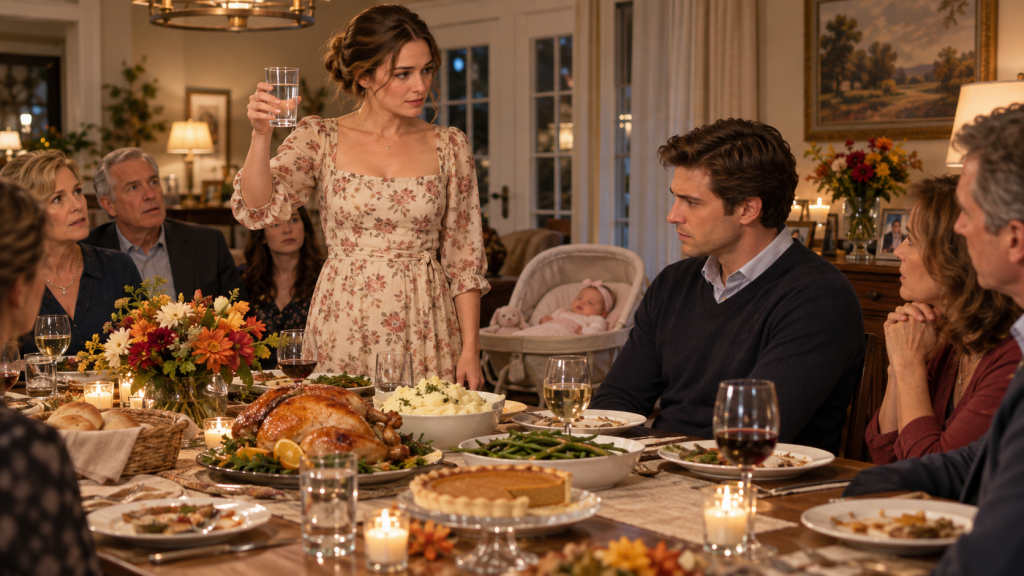
Around the dining table, nobody moved.
His mother, Patricia, sat with one hand pressed over her mouth.
My father stared at Liam with a stillness I recognized from childhood—the kind that meant anger had gone beyond shouting.
My mother was crying silently.
Liam’s younger brother, Nathan, kept looking between us as though he were waiting for someone to announce that the entire evening had been some elaborate misunderstanding.
It wasn’t.
The message from Sophie still glowed on Liam’s phone.
Did you tell her yet? I’m tired of waiting.
And inside the envelope was the document that had frightened him more than the divorce petition.
A financial disclosure request.
Not proof that I had secretly taken his money.
Not proof that I had emptied our accounts.
I hadn’t.
I had done something much simpler.
I had stopped being ignorant.
Six days earlier, less than an hour after hearing my husband tell another woman he hated me, I had called an attorney.
Her name was Rachel Kim.
She had listened without interrupting while I cried so hard I could barely explain what had happened.
When I finally finished, she asked me one question.
“Emily, do you know where your family’s money is?”
I had answered the way too many trusting spouses probably answer.
“Mostly.”
Rachel had been quiet.
“Mostly isn’t enough anymore.”
So I learned.
I learned what accounts existed.
Which were joint.
Which were individual.
Which bills were being paid.
Which credit cards had balances.
What Liam earned.
What I earned before maternity leave.
What we owed on the house.
What belonged to both of us.
What might not.
And most importantly, I learned that there were financial questions I had never thought to ask.
The document in Liam’s hands told him those questions were about to be asked formally.
He looked at me.
“You went through my accounts?”
“No.”
“Then what is this?”
“A request for financial disclosure.”
His face hardened.
“You hired a lawyer?”
“Yes.”
“When?”
“Monday.”
His mother looked at him.
“Monday?”
Our anniversary dinner was Sunday.
The forgotten phone call had happened the Tuesday before.
I had spent almost a week living beside a man who believed I knew nothing.
I changed Hailey’s diapers.
Washed bottles.
Folded Liam’s shirts.
Answered when he asked what was for dinner.
Watched him smile at messages he tilted away from me.
And every night, after he went to sleep, I sat at the kitchen table learning the legal and financial shape of the life I had helped build.
Liam pushed the papers onto the table.
“This is insane.”
I said nothing.
He pointed toward my phone.
“You secretly recorded me.”
“You forgot to end a call.”
“You listened to a private conversation.”
“You were still connected to my phone.”
“That doesn’t give you the right—”
His father, Michael, finally spoke.
“Stop.”
Liam turned.
“Dad.”
“I said stop.”
Michael’s voice was quiet.
That made it stronger.
“You’re sitting at a table with your wife, your newborn daughter, and both families after we just heard you say you hate Emily and intend to marry another woman.”
He pointed toward the phone.
“And somehow your first defense is privacy?”
Liam looked around the table.
Nobody rescued him.
That seemed to offend him more than anything.
“This isn’t what it sounds like.”
Nathan actually laughed.
A single disbelieving sound.
Liam glared at him.
“What?”
Nathan shook his head.
“Nothing.”
“No. Say it.”
Nathan leaned back.
“You kissed someone after saying you were going to divorce your wife and marry her.”
He gestured toward the phone.
“I’m struggling to imagine the context that improves that.”
Patricia started crying harder.
“Liam, how long?”
He looked away.
“How long?”
“Mom, please.”
“How long have you been seeing her?”
“It isn’t—”
“How long?”
He exhaled.
“Four months.”
My stomach twisted.
Four months.
I had given birth to Hailey eleven weeks earlier.
I did the calculation automatically.
“You started before she was born.”
Liam looked at me.
“Emily.”
“Before Hailey was born?”
He did not answer.
That was an answer.
I stared at him.
The room seemed to shrink.
I had spent the final weeks of pregnancy swollen, uncomfortable, frightened, and unable to sleep.
Liam had complained about work.
I had apologized for needing him.
I had once called him at eleven at night because I thought I was going into labor.
He had taken twenty-seven minutes to answer.
He told me he had been in a meeting.
Sophie.
Had he been with Sophie?
I wanted to ask.
I didn’t.
Not there.
Not yet.
Because something Rachel had told me returned.
You do not need every answer before you are allowed to act on the answers you already have.
That sentence had saved me from spending six days trying to become a detective.
I already knew enough.
Liam had betrayed me.
He had lied.
He had mocked my attempts to keep him connected to his daughter.
He had told another woman he hated me.
He had planned a future with her while coming home to mine.
That was enough.
I stood.
“Dinner is over.”
Liam stared.
“You can’t just—”
“This is my parents’ house too.”
“No.”
I said.
“It isn’t.”
That stopped him.
Technically, the house belonged to me.
That was another thing he had apparently forgotten.
My grandmother had left it to me before Liam and I married.
He had moved in after our wedding.
We renovated the kitchen together.
Painted the nursery.
Argued over the living-room rug.
Called it our home.
Emotionally, it had been.
Legally, the situation was more complicated.
Rachel had explained that too.
Liam’s face changed.
“You’re throwing me out?”
“I am asking you to stay somewhere else tonight.”
“You can’t do that.”
Rachel had warned me not to turn the evening into amateur legal theater.
So I didn’t.
“I am not discussing property rights with you over pumpkin pie.”
Nathan covered his mouth.
Wrong moment.
But I almost laughed.
Liam didn’t.
“You planned this.”
“Yes.”
“You humiliated me in front of everyone.”
I looked at him.
For six days, I had imagined this moment.
In some versions, I screamed.
In others, I threw wine.
Once, at three in the morning while feeding Hailey, I imagined dumping the pumpkin pie directly into his lap.
Reality was quieter.
“You humiliated yourself.”
I said.
“I just stopped protecting you from the audience.”
His face reddened.
Sophie texted again.
The screen lit up.
Liam???
Patricia stared at it.
Then at her son.
“Answer her.”
“Mom.”
“Answer her.”
“No.”
“Why?”
“Because this isn’t your business.”
Patricia looked devastated.
“Your wife invited me here.”
She pointed toward Hailey.
“My granddaughter is sleeping six feet away.”
“You made this my business.”
Liam grabbed the phone.
I watched him silence it.
Then he looked at me.
“Can we talk upstairs?”
“No.”
“Emily.”
“No.”
“Please.”
That word.
Please.
I had asked him please so many times.
Please come home.
Please hold the baby while I shower.
Please pick up diapers.
Please don’t speak to me like that.
Please tell me what’s wrong.
Please stay awake with me because I am scared something is wrong with Hailey.
Please.
Please.
Please.
Now he had discovered it.
“No.”
I repeated.
He looked toward my parents.
My father stood.
“She’s answered you.”
Liam’s jaw tightened.
For a moment, I thought he might become aggressive.
He never had before.
But betrayal changes the way you assess familiar people.
Then he grabbed his coat.
“Fine.”
Patricia stood.
“Where are you going?”
“Apparently I’m not welcome.”
His father shook his head.
“Don’t do that.”
“Do what?”
“Turn consequences into persecution.”
Liam stared at him.
Michael looked older than he had at dinner.
“You cheated on your wife.”
“Own the sentence.”
Liam looked at me one final time.
His expression contained anger.
Fear.
Humiliation.
Maybe even grief.
Then he left.
The front door slammed.
Hailey woke.
And started crying.
Of course she did.
For the first time that evening, everybody moved.
Mom reached for her.
I shook my head.
“I’ve got her.”
I lifted my daughter from the bassinet.
She was warm and furious.
Her tiny face wrinkled against my chest.
I kissed her forehead.
“It’s okay.”
I whispered.
But I wasn’t talking only to her.
Patricia approached me.
“I am so sorry.”
I looked at her.
“You didn’t do it.”
“I raised him.”
“That isn’t the same thing.”
Her face crumpled.
“I should have known.”
“No.”
I had spent enough time blaming myself for not knowing.
I was not going to hand that poison to another woman.
“He chose to lie.”
I said.
“He got good at it.”
Michael put an arm around his wife.
My mother began clearing dishes because she had never known what to do with grief except make surfaces clean.
Nathan carried plates.
Dad took out the trash.
And I stood in the middle of the dining room holding Hailey.
The anniversary dinner ended without dessert.
The pumpkin pie remained untouched.
At two in the morning, I ate a slice over the kitchen sink.
It was excellent.
Grief is strange.
Your marriage can collapse at eight-thirty.
You can still be hungry at two.
The next morning, Liam called seventeen times.
I did not answer.
Then came the messages.
We need to talk.
You completely blindsided me.
What you did last night was cruel.
My mother is devastated.
You had no right to involve our families.
Then:
I made a mistake.
Then:
Sophie means nothing to me.
I stared at that one.
Twenty-four hours earlier, he had planned to marry her.
Apparently meaning nothing was exhausting work.
I sent one response.
Please communicate about Hailey and immediate household matters in writing. My attorney will handle the rest.
His answer arrived almost immediately.
You’re really doing this?
I did not respond.
At eleven, Sophie called me.
I recognized the number because Rachel and I had already seen it repeatedly on our phone records.
I let it ring.
She called again.
Then texted.
Emily, please. I think there are things you need to know.
I almost ignored it.
Then another message.
He told me you two were separated.
I stared.
That mattered.
Not because it absolved her automatically.
But because truth mattered even when it complicated the villain I wanted.
I replied:
You can email me.
She did.
Three hours later.
The email was long.
Sophie worked with Liam.
They had become close during my pregnancy.
He told her our marriage had been failing for more than a year.
He said we slept separately.
False.
He said I had told him I no longer loved him.
False.
He said we had agreed to remain in the same house until after Hailey was born.
False.
He said divorce papers were already being prepared.
False.
Sophie admitted she should have verified.
She admitted continuing a relationship with a married man had been wrong even if she believed his version.
She did not ask me to forgive her.
Then came the part that changed everything.
I did not know he was telling you he was working late.
Attached were screenshots.
Dates.
Messages.
Promises.
One was from the night I thought I might be in labor.
Can’t stay long tonight. E is being dramatic about contractions.
I put my phone down.
Walked to the bathroom.
Vomited.
Then sat on the floor.
Hailey was asleep in her crib.
The monitor glowed beside me.
I cried so quietly that even the baby did not wake.
There are betrayals you understand intellectually.
Then there are sentences that enter the body.
E is being dramatic about contractions.
I had been thirty-eight weeks pregnant.
Terrified.
Alone.
He had turned my fear into a joke for another woman.
That hurt more than the kiss.
Maybe more than the affair.
I forwarded the email to Rachel.
Then deleted nothing.
Rachel called.
“Do not respond emotionally.”
“I know.”
“Do not threaten him.”
“I know.”
“Do not post anything.”
“I know.”
“Do not contact his employer.”
“I wasn’t going to.”
“Good.”
Then her voice softened.
“And Emily?”
“Yes?”
“Eat something.”
I laughed through tears.
“How did you know?”
“Because everyone forgets.”
So I made toast.
Divorce began in paperwork.
That surprised me.
There should have been thunder.
Instead:
Forms.
Statements.
Calendars.
Financial records.
Custody proposals.
Lists of assets.
Lists of debts.
Marriage reduced to columns.
House.
Cars.
Retirement.
Savings.
Furniture.
A marriage can contain a thousand kisses and still eventually require someone to determine who owns the sofa.
The financial disclosure revealed why Liam had panicked.
It wasn’t a secret second family.
No offshore millions.
Reality was smaller and uglier.
Over eighteen months, he had spent almost thirty-two thousand dollars from income and joint funds on things he had never discussed with me.
Hotels.
Restaurants.
Gifts.
Weekend trips disguised as conferences.
A necklace.
A designer handbag.
Several cash withdrawals.
Some spending predated Sophie.
When Rachel showed me the records, I felt physically cold.
“Was there someone before her?”
“We don’t know.”
“Do we need to?”
She looked at me.
“Legally or emotionally?”
I hated lawyers sometimes.
“Both.”
“Legally, potentially, depending on the financial issues.”
“Emotionally?”
She paused.
“Only you can answer that.”
I thought about it.
“No.”
I said.
“I don’t want a catalog.”
That became another turning point.
I stopped searching for every betrayal.
I searched for what I needed to protect myself and Hailey.
Nothing more.
Liam denied misusing marital funds.
Then records appeared.
He minimized the amounts.
Then totals appeared.
He claimed some expenses were business-related.
His employer’s reimbursement records contradicted him.
Eventually, his attorney stopped making that argument.
Sophie ended the relationship three weeks after our anniversary dinner.
I learned because Liam told me.
Not because I asked.
He arrived for his first scheduled visit with Hailey looking terrible.
Unshaven.
Eyes red.
I handed him the diaper bag.
“She’s eaten.”
“Emily.”
“Her next bottle is at one.”
“Can we talk?”
“About Hailey?”
“No.”
“Then not today.”
“Sophie left.”
I looked at him.
Some younger version of me might have felt victorious.
I didn’t.
A woman leaving my husband did not restore my marriage.
“I’m sorry you’re hurting.”
I said.
He stared.
“That’s it?”
“What do you want me to say?”
“I don’t know.”
Neither did I.
He looked toward Hailey.
“She said I lied to her.”
“You did.”
His face tightened.
“You don’t know everything.”
“No.”
I said.
“I know enough.”
He whispered:
“I ruined my life.”
I looked at our daughter.
“No.”
He frowned.
“You damaged your marriage.”
“You hurt people.”
“You created consequences.”
“That’s serious.”
I met his eyes.
“But your life is not over.”
He stared at me.
“Why are you being nice?”
“I am not being nice.”
I said.
“I am trying to be accurate.”
That became important too.
I did not need Liam destroyed.
I needed him accountable.
Those are different goals.
At first, he was a terrible separated father.
Not cruel.
Unprepared.
He did not know Hailey’s pediatrician.
Could not remember which formula we used.
Did not know how long she normally napped.
The first time she cried continuously during his visit, he called me after eleven minutes.
“What do I do?”
I almost said:
Welcome to motherhood.
Instead:
“Check diaper.”
“I did.”
“Bottle?”
“She ate.”
“Temperature?”
“Normal.”
“Then hold her.”
“She won’t stop.”
“Sometimes babies cry.”
“For how long?”
I laughed.
Not kindly.
Then stopped myself.
“Walk with her.”
“Talk to her.”
“Keep trying.”
He called twenty minutes later.
“She fell asleep.”
His voice sounded stunned.
“Good.”
“I walked around the kitchen.”
“Good.”
“She likes when I hum.”
I knew.
He didn’t.
Now he did.
That mattered.
Divorce took fourteen months.
Long enough for Hailey to learn to crawl.
Then walk.
Long enough for me to return to work.
Long enough for my milk supply to disappear.
Long enough for the flowers Liam brought home that terrible evening to dry, collapse, and finally go into the trash.
He apologized many times.
Most early apologies were useless.
“I’m sorry, but we were disconnected.”
“I’m sorry, but you were always focused on the baby.”
“I’m sorry, but I felt trapped.”
Every apology with a but became another door he refused to walk through.
Then he started therapy.
Not because I required it for reconciliation.
There was no reconciliation.
Because his father told him:
“If you don’t understand why you did this, you’ll just carry it into the next room.”
Months passed.
His apologies changed.
One afternoon, during a custody exchange, he said:
“I blamed you for becoming a mother.”
I looked at him.
He continued.
“I liked being the center of your attention.”
“Then Hailey came.”
“I felt irrelevant.”
“That sounds ridiculous.”
“It was.”
He swallowed.
“So instead of telling you I was lonely, I punished you for being exhausted.”
I said nothing.
“I stayed late at work because home made me feel inadequate.”
“I didn’t know what to do with the baby.”
“You did.”
“And instead of learning, I told myself you were better at it.”
That sentence landed.
How many women had heard some version of it?
You’re better at diapers.
You’re better at soothing.
You’re better at remembering appointments.
You’re better at nights.
Sometimes “better” is simply what people call the person who was not permitted to opt out.
Liam continued.
“Sophie made me feel uncomplicated.”
“No bottles.”
“No crying.”
“No mortgage discussion.”
“No exhausted wife asking me to participate.”
He looked ashamed.
“I confused escape with love.”
I appreciated the honesty.
It did not make me want him back.
“I hope you keep figuring it out.”
I said.
He nodded.
“I know you don’t owe me another chance.”
“No.”
“I know.”
That was the first apology that mattered.
Not because it repaired us.
Because it stopped asking me to.
The divorce settlement accounted for the marital money he had spent.
I kept the house, subject to the legal arrangements our attorneys negotiated.
Liam kept his retirement accounts according to the settlement structure.
Custody developed gradually.
At first, Hailey lived primarily with me.
As Liam became more competent and consistent, his parenting time expanded.
Some people criticized me for that.
They said:
“After what he did?”
I learned to answer:
“He cheated on his wife.”
“He did not stop being her father.”
That distinction did not mean ignoring risk.
It meant evaluating the correct question.
Was he a safe, engaged parent?
At first, inconsistently.
Later, yes.
So we adjusted accordingly.
I refused to use Hailey as a weapon.
Not because Liam deserved mercy.
Because she deserved parents who did not turn her childhood into evidence.
When she was three, she came home from Liam’s apartment carrying a hideous purple stuffed giraffe.
“Daddy buy!”
she announced.
The giraffe was almost as tall as she was.
I looked at Liam.
“Why?”
“She wanted it.”
“She wants everything.”
“I panicked.”
“Obviously.”
He smiled.
For one second, we were simply two parents.
Not ex-spouses.
Not betrayer and betrayed.
That felt strange.
Then peaceful.
Healing did not mean the past disappeared.
It meant the past stopped entering every room first.
I dated nobody for almost three years.
People assumed I was afraid.
Maybe partly.
Mostly I was tired.
I had a child.
A career.
Friends.
A house.
I rediscovered sleep.
Sleep was more attractive than romance.
My friend Jenna once tried to set me up with a dentist.
“Is he handsome?”
“Yes.”
“Funny?”
“Moderately.”
“Kind?”
“Very.”
“Does he sleep through the night?”
“He’s forty.”
“Sold.”
I canceled the date.
Then rescheduled.
His name was Daniel.
He was not dramatic.
At first, that confused me.
No intense declarations.
No constant texting.
No love bombing.
He called when he said he would.
Arrived when he said he would.
If he was running late, he told me.
Such ordinary behavior.
Such extraordinary relief.
On our fifth date, my phone rang.
Hailey had a fever at Liam’s.
I stood immediately.
“I have to go.”
Daniel paid the check.
No complaint.
In the parking lot, he said:
“Text me when she’s okay.”
That was all.
No jealousy.
No:
What about our evening?
No making my motherhood a competitor.
I sat in my car and cried.
Then laughed at myself.
The bar had been underground.
Daniel and I moved slowly.
Very slowly.
He met Hailey after almost a year.
She was four.
She asked him:
“Are you Mommy’s boyfriend?”
He nearly choked.
I said:
“Yes.”
She considered him.
“Do you have snacks?”
Daniel looked at me.
“Is this an interview?”
“Yes.”
He produced crackers.
Hailey nodded.
“Okay.”
Approved.
Liam struggled when he learned I was serious about someone.
He did not behave perfectly.
He became distant.
Then unnecessarily critical about small parenting issues.
I called it out.
“This isn’t about Hailey’s bedtime.”
He looked away.
“No.”
“Then don’t use her bedtime to talk about me dating.”
He sighed.
“I’m trying.”
“Try somewhere that doesn’t involve our daughter.”
He nodded.
“Fair.”
Later he apologized.
Actual apology.
No but.
Progress.
He dated too.
Several women.
Then, when Hailey was seven, he introduced us to Natalie.
She was a high-school librarian.
Quietly funny.
Warm.
I wanted to hate her.
Not because she did anything wrong.
Because emotions are not always civilized.
Then Hailey came home talking about how Natalie had helped her make a solar-system costume for school.
My first thought was:
I was supposed to do that.
My second:
My daughter has another adult who cares whether Saturn’s rings stay attached.
I chose the second thought.
Not automatically.
Deliberately.
When Liam and Natalie became engaged, he told me before telling Hailey.
“I wanted you to know.”
“Thank you.”
“Are you okay?”
I laughed.
“That is an unexpectedly complicated question.”
He smiled.
“I know.”
“Yes.”
I said.
“I am.”
Then I asked:
“Does she know everything?”
His expression changed.
“Yes.”
“Everything?”
“Yes.”
“The affair?”
“Yes.”
“What you said on the call?”
“Yes.”
“The money?”
“Yes.”
“And?”
“She asked why she should trust me.”
I raised an eyebrow.
“Smart woman.”
He smiled.
“I told her she shouldn’t trust my promises.”
My expression changed.
“What?”
“I told her to trust my behavior if it stays trustworthy.”
I looked at him for a long moment.
Therapy had done work.
“That’s a better answer than you would’ve given ten years ago.”
“I know.”
He swallowed.
“I’m sorry you got the version of me before I learned it.”
That hurt in an unexpected way.
Because sometimes someone becomes better after they hurt you.
And you do not receive the improved version.
Another person does.
That can feel unfair.
But growth is not a prize owed to the person who suffered first.
I did not need Liam to remain terrible to validate why I left.
So I said:
“I’m glad Hailey gets this version.”
His eyes filled.
“Me too.”
Daniel and I married when Hailey was nine.
Small ceremony.
Backyard.
She stood beside me.
Before walking outside, she asked:
“Are you nervous?”
“Yes.”
“Why?”
“Because marriage is a big promise.”
She considered that.
“Did Daddy break the promise?”
Children have no respect for timing.
I knelt.
“Your dad and I broke our marriage.”
“Daddy cheated.”
She knew by then, in age-appropriate terms.
“Yes.”
“Did you hate him?”
I thought.
“For a while, I hated what he did.”
“Do you hate him now?”
“No.”
“Why?”
“Because I don’t want to.”
She frowned.
“Can you just stop?”
“Not immediately.”
I smiled.
“But feelings change when you stop feeding some of them.”
She touched my veil.
“Do you love Daniel more?”
I shook my head.
“Love isn’t a scoreboard.”
“That’s not an answer.”
Nine-year-olds.
Terrifying.
“I love Daniel differently.”
“Did you love Daddy?”
“Yes.”
“Really?”
“Yes.”
She looked confused.
“Then why didn’t it work?”
I took her hands.
“Because love is important.”
“But love by itself doesn’t make a marriage safe.”
“You also need honesty.”
“Respect.”
“Responsibility.”
“And the courage to tell the truth before it becomes a disaster.”
She nodded as though filing this away.
Then:
“Can we go? I’m hungry.”
Perfect.
Daniel and I walked into marriage with fewer illusions.
Not less love.
Fewer illusions.
I did not promise never to disappoint him.
He did not promise never to hurt me.
We promised to tell difficult truths early.
To ask for help before resentment became punishment.
To treat household work as shared responsibility.
To remain people as well as spouses.
When our son Noah was born two years later, I watched Daniel change diapers at three in the morning.
Not because he was exceptional.
Because he was a parent.
Still, sometimes I cried watching him.
He noticed once.
“What?”
“Nothing.”
“That is clearly not nothing.”
I wiped my face.
“Liam never did this.”
Daniel’s expression softened.
He handed me the clean diaper.
“Come here.”
I shook my head.
“No.”
“What?”
“I don’t want to turn you into a comparison.”
That was something I had learned.
Daniel deserved to be loved as Daniel.
Not rewarded for not being Liam.
“I appreciate you.”
I said.
“For being you.”
He smiled.
“Even at three seventeen in the morning?”
“Especially.”
Noah screamed.
Daniel sighed.
“Your son.”
“Interesting how quickly shared parenting disappeared.”
He laughed.
We were okay.
Hailey grew.
At thirteen, she became angry with her father.
Not because I told her the details.
Because children eventually discover that adults have histories.
She found an old photograph from our anniversary dinner.
Both families around the table.
Liam looking tense.
Me standing with a glass.
She asked questions.
I answered carefully.
Then, at sixteen, she asked directly:
“What did Dad say on the phone?”
I froze.
She knew there had been a call.
Not the words.
“Why?”
“Because he won’t tell me.”
“That may mean he is ashamed.”
“I want to know.”
I thought about protecting her.
Then I remembered what secrecy had done in my marriage.
Still, truth should be appropriate to the person receiving it.
“You don’t need every painful sentence your parents ever said.”
“That’s avoiding.”
She was my daughter.
Unfortunately observant.
So I told her enough.
“He told another woman that I was driving him crazy.”
Her face tightened.
“He said he wanted me to leave him alone.”
“And?”
I hesitated.
“He said he planned to divorce me and marry her.”
Hailey stared at me.
“While you were home with me?”
“Yes.”
She stood.
“I’m going to Dad’s.”
“No.”
“Why?”
“Because you’re furious.”
“I should be.”
“You are allowed to be.”
“Then why can’t I go?”
“Because anger deserves time before transportation.”
She glared.
“I hate when you talk like a therapist.”
“I pay mine enough. I’m stealing material.”
She did not laugh.
The next day, she went.
Liam later told me what happened.
She walked into his apartment and asked:
“Did you hate Mom?”
He did not lie.
He said:
“I said I did.”
“Did you?”
“I thought I did.”
“What does that mean?”
“I hated what my life felt like.”
“And I blamed your mother because blaming her was easier than admitting I was failing her.”
Hailey cried.
Then asked:
“Did you hate me?”
That question destroyed him.
“No.”
“But you complained when Mom sent pictures of me.”
He covered his face.
“Yes.”
“Why?”
“Because every picture reminded me that I was supposed to be home.”
She stared.
“And instead of going home, you got mad at her for reminding you?”
“Yes.”
Hailey said:
“That was pathetic.”
He nodded.
“Yes.”
Not:
Don’t speak to your father that way.
Not:
You don’t understand.
Just yes.
She did not speak to him for two weeks.
I did not interfere.
Then she called him.
Their relationship survived.
Changed.
More honest.
When Hailey graduated high school, Liam and I sat in the same row.
Daniel beside me.
Natalie beside him.
No drama.
When Hailey crossed the stage, all four of us stood.
She later complained.
“You were embarrassing.”
“Good.”
I said.
“That’s the job.”
Liam laughed.
At the graduation party, Patricia found me alone near the kitchen.
She was older.
Silver-haired.
Still elegant.
“Do you remember that dinner?”
she asked.
“Yes.”
“I think about it every anniversary.”
“So do I.”
“Do you regret doing it that way?”
I thought.
Sometimes I had.
Public confrontation gave me strength when I felt powerless.
But years later, I could admit it had also been partly about making him feel what I had felt.
Exposed.
Humiliated.
“I might do some things differently now.”
I said.
Patricia nodded.
“But?”
“But I don’t regret stopping the lie.”
She took my hand.
“Neither do I.”
Then she smiled.
“I do regret not eating the pie.”
I laughed.
“Best pumpkin pie I ever made.”
“Tragic.”
We remained connected because of Hailey.
Not close exactly.
But family in the strange expanded way divorce can create if people stop trying to make every relationship choose sides.
Michael died when Hailey was twenty-four.
At the funeral, Liam cried against my shoulder for several seconds before realizing what he was doing.
He stepped back.
“Sorry.”
“Don’t be.”
Daniel stood nearby.
No jealousy.
Natalie too.
Grief does not care about marital diagrams.
I held my former husband while he mourned his father.
Then returned to mine.
Years passed.
Hailey became a pediatric nurse.
I laughed when she told me.
“Of course.”
“What?”
“You screamed for the first eight months of your life.”
“I was training.”
She married a man named Marcus.
Before the wedding, she came to my house alone.
Noah was away at college.
Daniel was working.
She sat at the same kitchen table where I had once learned the financial shape of my first marriage.
“Mom?”
“Yes?”
“How do you know someone won’t cheat?”
The question broke my heart.
“You don’t.”
She looked frightened.
“Great.”
I smiled sadly.
“You don’t know someone will never betray you.”
“You don’t know they’ll never change.”
“You don’t know life won’t become difficult.”
“Then what’s the point?”
“The point isn’t certainty.”
I reached for her hand.
“The point is choosing someone whose current behavior gives you good reason to trust them.”
“And keeping enough of yourself that if life changes, you can still stand.”
She looked down.
“Is that why you always made me have my own savings account?”
“Yes.”
“Dad says you’re paranoid.”
“Your father lost voting privileges on that topic.”
She laughed.
Then became serious.
“Did you trust Daniel completely when you married him?”
“I trusted him enough.”
“That sounds unromantic.”
“It is extremely romantic.”
She frowned.
“Trust isn’t blindness.”
I said.
“It’s seeing a person clearly and deciding their pattern deserves confidence.”
She nodded.
“What if Marcus hurts me?”
“You deal with what happens.”
“And if I hurt him?”
“You take responsibility.”
“What if the marriage fails?”
“Then it fails.”
Her eyes widened.
“Mom.”
“What?”
“You want me to get married tomorrow.”
“Yes.”
“And you’re saying it might fail?”
“Yes.”
I squeezed her hand.
“A wedding is not a guarantee.”
“It is a promise to participate honestly in what comes next.”
She cried.
Then smiled.
“Okay.”
She married Marcus.
Their marriage had difficult years.
A miscarriage.
Job loss.
His mother’s illness.
A period when Hailey worked too much and Marcus became resentful.
They went to counseling before either of them started searching for escape.
That mattered.
Not because counseling guarantees marriage.
Because they told the truth while choices still existed.
Liam became a grandfather at fifty-seven.
He was ridiculous.
Bought too many toys.
Learned infant CPR again.
Installed a car seat as though preparing for a NASA launch.
One afternoon, I watched him walking around Hailey’s living room with his granddaughter asleep against his chest.
He hummed.
The same tune he had discovered when Hailey was an infant during one of those first post-divorce visits.
He saw me watching.
“What?”
“Nothing.”
He smiled.
“You still say that when it’s obviously something.”
I laughed.
“Some habits survive.”
He looked down at the baby.
“I missed so much.”
“Yes.”
No comforting lie.
He nodded.
“I know.”
Then:
“Thank you for not making her hate me.”
I shook my head.
“That wasn’t mine to give you.”
“What do you mean?”
“Your relationship with Hailey survived because you eventually did the work.”
“You could have destroyed it.”
“Maybe.”
I looked at our daughter across the room.
“But then I would’ve had to live with being someone who used her pain to punish you.”
He swallowed.
“Still.”
“Thank you.”
“You’re welcome.”
That was probably the closest we ever came to peace about the divorce.
Not forgiveness in one dramatic moment.
A thousand small moments where neither of us reached for the old weapon.
Daniel and I grew old together.
Not perfectly.
At forty-nine, we had the worst fight of our marriage.
He wanted to accept a position in another state.
I refused to move.
For weeks, resentment grew.
One night, he said:
“You don’t support me.”
My entire body reacted.
Not to Daniel.
To history.
I became cold.
He noticed.
“What just happened?”
“Nothing.”
“No.”
He sat down.
“Something happened.”
I wanted to say:
You’re just like Liam.
He wasn’t.
That would have been cruel.
So I said:
“When you said I don’t support you, I heard an accusation I’ve heard before.”
Daniel waited.
“I heard that if I don’t make your life easier, I’m failing as a wife.”
His face softened.
“That isn’t what I meant.”
“I know.”
Then I corrected myself.
“Actually, I don’t know.”
“So tell me what you meant.”
We talked until two in the morning.
He did not take the job.
Not because I won.
Because after examining the numbers, family impact, his goals, and my career, he decided the position wasn’t worth what it would cost us.
Years earlier, I might have believed a good marriage never reached that kind of edge.
Now I knew better.
A good marriage is not one without dangerous moments.
It is one where people turn toward the difficult conversation before they turn toward an exit they have secretly furnished.
Liam taught me that too.
Not intentionally.
At sixty-three, he called me.
Unusual.
By then, Hailey was grown.
We rarely spoke outside family events.
“Emily.”
His voice sounded strange.
“What’s wrong?”
“Natalie died.”
I sat down.
“What?”
Car accident.
Rain.
A truck crossed the median.
Instant.
My hand covered my mouth.
“Oh, Liam.”
He cried.
I let him.
Natalie had been his wife for twenty-six years.
She had loved Hailey.
Loved their grandchildren.
She had never treated me as competition.
I went to the funeral.
Of course I did.
Afterward, Liam stood beside her grave.
“Everybody leaves.”
he whispered.
I almost corrected him.
Then realized grief was speaking.
I stood beside him.
After a while, he said:
“I did love you.”
I looked at him.
Forty years after the phone call.
“I know.”
His eyes filled.
“I don’t understand how I could’ve said I hated you.”
“I do.”
He looked surprised.
“You needed the story.”
“What story?”
“That I was unbearable.”
I stared toward Natalie’s grave.
“Because if I was unbearable, then what you were doing felt less cruel.”
He closed his eyes.
“Yes.”
“People are very good at editing the person they’re hurting.”
“I did that.”
“Yes.”
“I told Sophie you were cold.”
“You told her we were separated.”
“Yes.”
“I made you smaller so I could live with myself.”
“Yes.”
He cried.
“I’m sorry.”
“I know.”
Then he said:
“Do you forgive me?”
I almost laughed at how long that question had traveled.
He had asked versions of it for decades.
I had answered differently depending on the year.
This time, I knew.
“Yes.”
He looked at me.
“Really?”
“Yes.”
“What does that mean?”
“It means I no longer need what you did to remain painful in order for it to remain wrong.”
He cried harder.
I continued.
“It means your punishment is not my project.”
“It hasn’t been for a long time.”
“It means I can remember who we were without needing to hate either of us.”
He nodded.
“Does it mean you think it was okay?”
“No.”
He laughed through tears.
“Still accurate.”
“I try.”
He wiped his face.
“I am glad you married Daniel.”
That surprised me.
“Thank you.”
“He was better to you.”
“Yes.”
Liam nodded.
“I became better too.”
“Yes.”
“Just too late.”
“For us.”
I said.
“Not too late for everything.”
He looked toward the family gathered behind us.
Hailey.
Her children.
Nathan.
Patricia, now very old.
People Liam had spent decades learning to show up for.
“No.”
he whispered.
“Not everything.”
Daniel died when I was seventy-eight.
Cancer.
Slow.
Unfair.
Tender.
For the last six months, I cared for him at home.
But not alone.
That distinction mattered.
Hailey helped.
Noah helped.
Nurses came.
Friends brought food.
I had learned long ago that love does not require one exhausted person to prove devotion by collapsing.
One night, Daniel woke and found me beside him.
“You should sleep.”
“So should you.”
“I’m dying. Different rules.”
“Everybody uses that excuse eventually.”
He smiled.
Then:
“Were you happy?”
“With what?”
“Me.”
I cried.
“Yes.”
“Enough?”
I laughed through tears.
“More than enough.”
He closed his eyes.
“Good.”
Then opened them again.
“Emily?”
“Yes?”
“Don’t turn me into a saint after I’m dead.”
I laughed loudly enough to wake the nurse.
“No danger.”
“Good.”
“You leave wet towels on the floor.”
“Exactly.”
“You snore.”
“Lies.”
“You once forgot our anniversary.”
“Once.”
“Twice.”
“Propaganda.”
I kissed him.
He died three days later.
Grief after a good marriage was different from divorce.
Divorce had left me grieving someone still alive.
Widowhood left me loving someone who could no longer answer.
Both hurt.
Neither needed comparison.
Liam attended Daniel’s funeral.
He sat near the back.
Afterward, he hugged me.
No history entered the hug.
Just grief.
“I am sorry.”
he said.
“Thank you.”
Then he left.
At eighty, I moved into a smaller house near Hailey.
She objected.
“You don’t have to move.”
“I know.”
“Then why?”
“Stairs.”
“You love that house.”
“I loved raising you there.”
“I loved Daniel there.”
I smiled.
“I don’t need to die there to prove it mattered.”
So I sold it.
The young couple who bought it had a baby.
When they came for the final walkthrough, the woman stood in Hailey’s old nursery.
“We’re putting our daughter here.”
I smiled.
“Good room.”
She looked at me.
“Did you raise your children here?”
“One of them.”
She did not know the history.
The forgotten phone call.
The anniversary dinner.
The divorce papers.
The nights I cried on the bathroom floor.
The second wedding.
Noah’s first steps.
Daniel’s laughter.
His final months.
A house can hold several lives without telling the next owner.
I left the keys on the counter.
Walked out.
Did not look back dramatically.
I had groceries in the car.
Life remains offensively ordinary.
Liam died when I was eighty-four.
Heart failure.
Hailey called me.
“Mom?”
I knew from her voice.
“Dad?”
“Yes.”
I closed my eyes.
There are people who stop being your spouse but never stop being part of the architecture of your life.
Liam was one.
I went to his funeral.
Hailey asked me to sit with the family.
I did.
Afterward, she handed me an envelope.
“He left this for you.”
I almost refused.
Then accepted.
At home, I opened it.
Liam’s handwriting had become shaky.
Emily,
If Hailey gives you this, I am gone, which means I finally managed to stop talking long enough for you to have the last word.
I laughed.
Then cried.
I have spent much of my life thinking about one sentence I said when I believed you could not hear me.
My hands trembled.
Of course I hate her.
There it was.
Forty-nine years later.
Still ugly.
I did not hate you.
I hated the person I became beside the responsibilities I was avoiding.
I hated that your exhaustion reflected my selfishness.
I hated that every photograph you sent of Hailey reminded me where I should have been.
Instead of changing myself, I changed the story about you.
I stopped reading.
Looked out the window.
Then continued.
That does not excuse anything.
I am not writing this so you will revise our history.
I betrayed you.
I lied to Sophie.
I failed Hailey during the first months of her life.
I spent money dishonestly.
I blamed you for the consequences of my choices.
You were right to leave.
Tears blurred the page.
For years, I thought the worst thing that happened to me was losing my marriage.
It wasn’t.
The worst thing was becoming someone capable of treating the person who trusted me most as though her pain were an inconvenience.
The best thing that happened afterward was that nobody allowed me to pretend otherwise.
I thought of Michael.
Own the sentence.
Patricia.
Nathan.
Therapy.
Hailey.
Time.
You once told me my life wasn’t over.
I remembered.
You were right.
Thank you for refusing to destroy me.
Thank you for refusing to save me.
That line made me sob.
Because that was exactly what happened.
I had not destroyed him.
I had not saved him.
I had stepped away.
He had been forced to become responsible for what remained.
I loved Natalie.
I loved the father I eventually became.
I loved our daughter more honestly once I stopped expecting love to make me feel important all the time.
And yes, Emily, I loved you.
Badly.
Selfishly.
Immaturely.
But truly.
I wish truth had been enough. It wasn’t.
Love without character can still wound the person receiving it.
I pressed my hand over my mouth.
You taught me that consequences are not cruelty.
Natalie taught me that trust is built by repetition.
Hailey taught me that being a father means showing up when nobody applauds.
Age taught me that regret is useful only if it changes what you do next.
Then the final paragraph.
If there is anything I hope you remember about me, don’t remember only the man on that phone call.
But don’t erase him either.
He existed.
He hurt you.
And because you stopped protecting him from the truth, he eventually had to become someone else.
I am sorry.
Liam.
I folded the letter.
Placed it in a drawer.
I did not frame it.
Did not make it sacred.
But I kept it.
Hailey asked me about it a week later.
“What did he say?”
“He apologized.”
“For everything?”
“As much as anyone can.”
She nodded.
“Did it make you feel better?”
I thought.
“No.”
She looked surprised.
“Then why are you smiling?”
“Because it made me feel finished.”
That was different.
At eighty-seven, I became a great-grandmother.
Hailey’s daughter named her baby Emma.
I held her in a hospital room while everyone fussed.
Tiny fingers.
Tiny nose.
Impossible trust.
Hailey stood beside me.
“Careful.”
I looked offended.
“I have held babies.”
“Not recently.”
“Rude.”
She laughed.
Emma opened her eyes.
I thought of Hailey as a newborn.
Of bottles beside my phone.
Of Liam’s forgotten call.
For years, that moment had felt like the hinge of my life.
The second everything broke.
Age changed the meaning.
The call did not break my marriage.
The marriage had already been breaking in rooms I could not see.
The call simply removed my ignorance.
That was painful.
It was also power.
Truth often feels cruel when it arrives.
Sometimes it is only turning on the light.
At ninety, Hailey asked me to record family stories for the grandchildren.
I agreed.
We sat in her living room.
A little camera on a tripod.
She asked:
“Tell them about Grandpa Liam.”
I raised an eyebrow.
“Which part?”
“All of it.”
“No.”
She laughed.
“Why?”
“Children don’t need all of their grandparents’ sins.”
“They’re adults.”
“Still children to me.”
We compromised.
I told the story differently.
Not as revenge.
Not:
Your grandfather cheated and I destroyed him at dinner.
That was never the real story.
I said:
“When your grandfather and I were young, we had a marriage that failed because we stopped being honest with each other—and he made choices that hurt me very deeply.”
Hailey corrected from behind the camera.
“He stopped being honest. You were honest.”
I looked at her.
“Director, please.”
She laughed.
I continued.
“I learned something important.”
“What?”
she asked.
“You can love someone and still leave them.”
“You can forgive someone and still not return.”
“You can share a child with someone who hurt you and refuse to make the child carry the injury.”
“You can rebuild after betrayal without pretending betrayal was useful or necessary.”
“And people can change.”
I paused.
“But their change does not obligate the people they hurt to come back.”
Hailey became quiet.
I looked into the camera.
“Your grandfather became a better man.”
“That does not mean I was wrong to divorce him.”
“Daniel was a good husband.”
“That does not mean our marriage never hurt.”
“I was strong.”
“That does not mean I deserved what made strength necessary.”
That last sentence mattered.
I had heard people say:
Everything happens for a reason.
I never liked it.
Some things happen because people make terrible choices.
Meaning comes afterward.
Meaning is what we build.
I did not thank Liam’s affair for my second life.
I did not thank betrayal for Daniel.
I did not thank that phone call for my strength.
I would have preferred honesty.
I would have preferred a husband who came home.
I would have preferred not learning how much I could survive.
But once the truth arrived, I used it.
That was mine.
Years later, when people asked Hailey about her parents’ divorce, she would sometimes say:
“My mother didn’t teach me to fear marriage.”
“She taught me not to disappear inside one.”
I loved that.
Because for a while, I had disappeared.
Maternity leave.
Exhaustion.
Liam’s career.
Hailey’s needs.
Our household.
I became function.
Feed.
Wash.
Schedule.
Soothe.
Wait.
Ask when he was coming home.
Apologize for asking.
I had mistaken endurance for partnership.
Then the call remained connected.
And I heard myself described by a man who had benefited from everything I was carrying.
She’s driving me insane.
Sending pictures.
Asking when he would come home.
Wanting her husband to participate in his own family.
For years, I thought my anniversary surprise was the dinner.
The recording.
The divorce papers.
The financial disclosure.
It wasn’t.
The real surprise was much smaller.
I stopped volunteering to be the only person protecting our marriage.
I let Liam meet the consequences of what he had done.
And I let myself discover what life looked like when I stopped asking a man who wanted distance to please come closer.
That changed everything.
Not immediately.
First came lawyers.
Then fear.
Loneliness.
Money worries.
Custody exchanges.
Nights when Hailey had a fever and I wished there were another adult in the room.
Moments when I almost called Liam simply because he had once been the person I called.
Then came other things.
Confidence.
Work.
Friends.
Sleep.
Daniel.
Noah.
A larger family.
Peace.
Eventually even Liam returned to my life in a different shape.
Not husband.
Not enemy.
Hailey’s father.
A man who had once hurt me.
A man who later changed.
Both true.
I never needed to choose one version.
At ninety-two, I found the old phone while clearing a box.
Not the same device from the call.
That had died decades earlier.
But the case.
Pale blue.
Cracked near the corner.
I had kept it without knowing why.
Inside the case was a faded photograph.
Liam and me.
Before Hailey.
At the beach.
Young.
Sunburned.
Laughing.
I sat on the edge of my bed.
For a moment, I missed them.
Those two people.
Not enough to want their future back.
Just enough to honor that they had existed.
Young Emily loved young Liam.
Young Liam loved Emily as well as he knew how.
Then he failed.
Badly.
She left.
They grew separately.
That did not make the beginning fake.
Nor did a real beginning guarantee a permanent ending.
Life is harder than that.
I put the photograph back.
Then changed my mind.
I took it out and placed it in the family album.
Not on the first page.
Not hidden either.
Hailey deserved her whole history.
So did I.
On my ninety-fourth Christmas, the family gathered at Hailey’s house.
Children.
Grandchildren.
Great-grandchildren.
Too much food.
Someone made pumpkin pie.
I laughed when I saw it.
Hailey noticed.
“What?”
“Nothing.”
She narrowed her eyes.
“You still do that.”
“Do what?”
“Say nothing when it is clearly something.”
I smiled.
“Your father used to say that.”
“I know.”
We stood beside the kitchen counter.
She cut two slices.
Handed me one.
“To anniversary surprises.”
I laughed.
“Terrible toast.”
“To forgotten phone calls?”
“Worse.”
She thought.
“To telling the truth before dessert.”
I raised my fork.
“Better.”
We ate.
The pie was not as good as mine had been.
I told her so.
She told me to leave.
I didn’t.
That’s what family does when it works.
It lets you stay without pretending you are perfect.
That night, after everyone went home, Hailey sat beside me.
“Mom?”
“Yes?”
“Do you ever wish Dad had hung up?”
I knew immediately what she meant.
The call.
I thought for a long time.
“Yes.”
She looked surprised.
“I wish he had hung up because I wish there had been nothing for me to hear.”
I looked at her.
“But if you’re asking whether I wish I had remained unaware?”
“No.”
“Never.”
Truth cost me a marriage that was already being betrayed.
Ignorance would have cost me myself slowly.
There is a difference.
Hailey rested her head on my shoulder.
“You were brave.”
I smiled.
“Sometimes.”
“You served him divorce papers at your anniversary dinner.”
“That was dramatic.”
“It was iconic.”
“Do not use that word.”
She laughed.
I joined her.
Then became quiet.
“I wasn’t brave because I embarrassed him.”
“What made you brave?”
“I stayed calm long enough to make choices.”
I thought about those six days.
The bottles.
The diapers.
The flowers.
His cologne.
My attorney.
Financial records.
The dinner table.
“I was terrified.”
I said.
“Courage wasn’t the absence of that.”
“It was refusing to let fear make the decision.”
She squeezed my hand.
That became the lesson I wanted her to keep.
Not revenge.
Not humiliation.
Not how to catch a cheating spouse.
How to remain yourself when truth changes the room.
Pause.
Learn.
Protect what needs protecting.
Ask for help.
Do not confuse anger with strategy.
Do not make children carry adult battles.
Do not confuse forgiveness with reunion.
Do not confuse someone’s remorse with an obligation to restore their access.
And never let another person’s betrayal convince you that your love was foolish.
Trust is not stupidity.
The person who violates it owns that choice.
The person who trusted was simply participating honestly in the relationship they believed they had.
That took me years to understand.
For too long, I asked:
How did I not know?
Why didn’t I notice the cologne?
The phone?
The late meetings?
Why did I believe him?
Because he was my husband.
Because marriage requires some ordinary trust to function.
Because investigating every late meeting is not intimacy.
I had not failed because I trusted him.
He failed because he exploited that trust.
Once I understood that, shame left.
Not all at once.
But steadily.
Near the end of my life, I dreamed about that anniversary dinner.
Everyone was there.
Patricia.
Michael.
Nathan.
My parents.
Liam.
Young.
Hailey asleep in her bassinet.
I stood holding the glass.
“My dear husband, Liam…”
But in the dream, I never played the recording.
I simply looked at younger me.
She looked exhausted.
Beautiful.
Terrified.
And I wanted to tell her:
You do not know it yet, but this is not the night your life ends.
It is not even the night your family ends.
Families change shape.
Some people leave one role and enter another.
Some never return.
Some apologize.
Some don’t.
Some become better too late for the relationship they broke, but not too late for the rest of their lives.
You will not always wake with betrayal in your chest.
One day, you will wake thinking about coffee.
Bills.
Weather.
A dentist appointment.
Normal things.
That will feel like a miracle.
You will love again.
Not because the next man rescues you.
Because you learn not to abandon yourself while loving him.
Your daughter will grow.
She will love her father.
Let her.
It will not erase what he did to you.
She will love you.
That will not require her to hate him.
Your heart is not a courtroom.
You do not need lifelong punishment to prove the verdict was correct.
And one day, the sentence that destroyed you—
Of course I hate her.
—will become only a sentence somebody once said.
Not prophecy.
Not identity.
Not truth.
Just words from a frightened, selfish man trying to justify what he had already chosen.
You will outlive them.
Not merely in years.
In meaning.
I woke from that dream before dawn.
Hailey was asleep in the guest room.
I walked slowly to the kitchen.
Made tea.
Outside, snow covered the yard.
I thought of Liam.
Daniel.
Young Emily.
The baby beside the bottle.
The phone timer still counting.
One second.
Two.
Three.
A woman laughing.
A husband speaking.
A life changing.
Then I thought of everything the phone had not been able to tell me.
That Liam would become a good father eventually.
That Sophie would leave.
That Daniel would exist.
That Hailey would become a nurse.
That Noah would be born.
That grandchildren would run through my kitchen.
That I would someday forgive without returning.
That Liam would die having understood, at least partly, the damage he caused.
That I would grow old without needing to win.
The phone call gave me information.
Life gave it context.
That is why endings should not be written too early.
At ninety-five, my health began to fail.
Nothing sudden.
Just the slow closing of a very long book.
Hailey stayed with me.
One evening, she sat beside my bed.
“Mom?”
“Yes?”
“Are you scared?”
“A little.”
She took my hand.
“I don’t want you to go.”
“I know.”
“I still need you.”
I smiled.
“You are seventy-three.”
“Still.”
I squeezed her fingers.
“Good.”
She cried.
I did too.
Then she asked:
“What should I remember?”
“About what?”
“Everything.”
Impossible question.
So I gave her the shortest answer I could.
“Don’t wait for accidental phone calls.”
She laughed through tears.
“What?”
“If something hurts, say it.”
“If you are lonely, say it.”
“If you are angry, understand why before you use it.”
“If you love someone, don’t make them guess.”
“If you are leaving, leave honestly.”
“If you are staying, stay honestly.”
“And if someone tells you the truth about who they are?”
I paused.
“Believe the pattern more than the promise.”
She nodded.
Then:
“What about forgiveness?”
“Take your time.”
“Marriage?”
“Keep yourself inside it.”
“Children?”
“Don’t make them responsible for adult pain.”
“Money?”
“Know where yours is.”
She burst out laughing.
“Mom.”
“Important.”
“Anything else?”
I thought of Liam’s forgotten call.
His flowers.
The pumpkin pie.
The envelope.
Daniel’s midnight diapers.
Natalie’s funeral.
Liam’s letter.
All of it.
“Yes.”
“What?”
“Being loved is not the same as being treated lovingly.”
Her face softened.
“And when the two stop matching, pay attention.”
She kissed my forehead.
“I love you.”
“I know.”
“That’s all?”
I smiled.
“I love you too.”
Better.
I died several weeks later.
Peacefully.
Hailey beside me.
No dramatic final revelation.
No secret account.
No recording.
No unfinished revenge.
Just a long life ending after it had been fully lived.
Years later, Hailey would tell her grandchildren the story.
Not every detail.
But enough.
She would tell them about a young mother whose husband forgot to disconnect a call.
About the sentence she heard.
About an anniversary dinner.
About papers in an envelope.
But if they expected the story to end with a cheating husband being humiliated, Hailey would correct them.
Because that was never the ending.
That was barely the beginning.
The ending was a woman who stopped measuring her future against one man’s betrayal.
A daughter who grew up loved by parents who learned to occupy different rooms without making her choose between them.
A man who faced consequences and eventually became better without being rewarded with the marriage he had broken.
Another man who loved a woman without asking her to forget what she had survived.
Children.
Grandchildren.
Ordinary mornings.
Funerals.
Weddings.
Apologies.
Boundaries.
Forgiveness.
Life.
And somewhere, buried beneath decades of photographs and family stories, there remained an old anniversary memory.
A table.
Roast chicken.
Mashed potatoes.
Green beans.
Pumpkin pie.
A newborn sleeping nearby.
A husband staring at an envelope.
A young woman standing across from him.
Terrified.
Heartbroken.
But standing.
Liam had believed his greatest mistake was forgetting to disconnect the call.
It wasn’t.
His mistake had been assuming that because I loved him, I would continue carrying whatever he refused to carry himself.
The forgotten call merely allowed me to hear the truth.
What I did afterward belonged to me.
I learned.
I protected myself.
I protected Hailey.
I left.
I healed.
I loved again.
I forgave when forgiveness finally meant freedom rather than surrender.
And I discovered something I wish every younger version of me had known:
The most unforgettable surprise you can give someone who has built their comfort on your silence is not revenge.
It is clarity.
It is the moment you stop arguing with what their actions have already told you.
It is the moment you stop begging to be chosen.
It is the moment you choose yourself without becoming cruel.
That night, Liam opened an envelope and thought I had ended his life.
I hadn’t.
I had ended a lie.
His life continued.
So did mine.
And in the end, that was better than revenge could ever have been.
Because revenge would have kept me facing backward.
Truth allowed me to turn around.
And walk forward.
THE END STORIES! THANK YOU FOR READING GOOD LUCK !❤️
Related Posts