➡️ PART 3 ENDING PART ➡️
“And Dad left something else about you.”
For the first time since Denise had walked into the courtroom, her smile disappeared completely.
Not weakened.
Not strained.
Gone.
Howard leaned toward her.
“What does he mean?”
Denise did not answer.
I looked down at the envelope in my hands.
My father had given it to me two weeks before the fire.
At the time, I had almost forgotten about it.
He had found me in the garage replacing the chain on my bike.
“Michael.”
“Yeah?”
He held out a thick cream-colored envelope.
My name was written across the front.
“Put this somewhere safe.”
I wiped grease from my hands.
“What is it?”
“Something I hope you’ll never need.”
Dad was an accountant.
He loved folders.
Receipts.
Labels.
Backup copies.
The man had once created a spreadsheet for our family vacation and color-coded bathroom stops.
So an envelope did not seem dramatic.
“Is this another lecture about emergency savings?”
“No.”
“Life insurance?”
“Partly.”
“Tax documents?”
“Michael.”
I laughed.
“Okay.”
Then he became serious.
“If anything happens to your mother and me, you take this to Ellen Marsh.”
Ellen was the family attorney.
“Why?”
“Because I trust you.”
That had made me straighten.
Dad was not sentimental.
Neither was I.
“Okay.”
“Don’t open it unless you have to.”
“Fine.”
He squeezed my shoulder.
Then walked back inside.
Two weeks later, I ran barefoot through a burning house carrying my seven-year-old sister against my chest.
Dad never got to explain the envelope.
For three months, it had remained in the small fireproof box recovered from our detached garage.
I had opened the box.
I had not opened the envelope.
Not until the night before the hearing.
Not until Ellen told me it was time.
Now Denise stared at it as though she recognized something I did not.
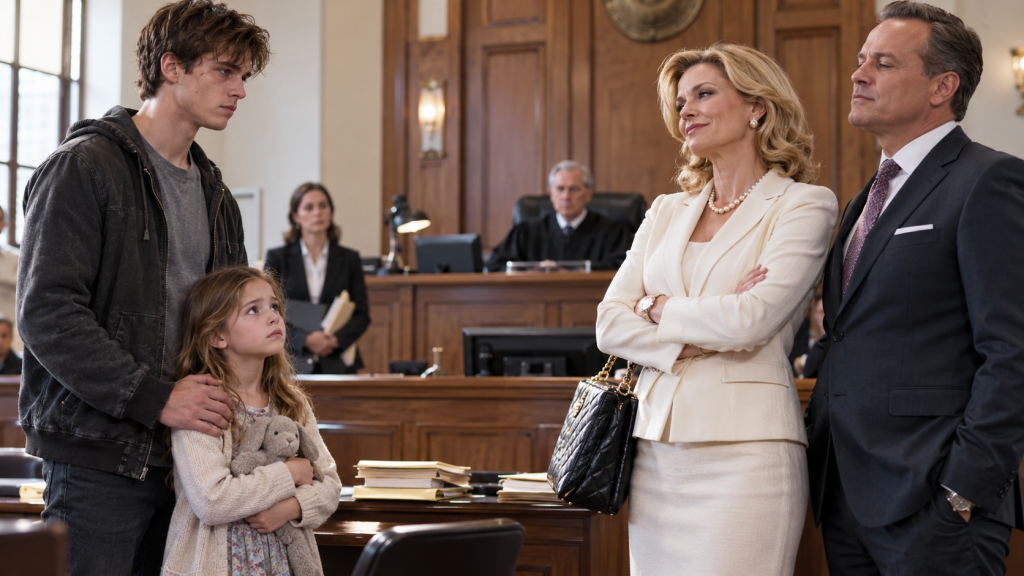
The judge looked toward my attorney.
“Mr. Marsh?”
Ellen’s son, David, represented me in court.
He stood.
“Your Honor, the original documents have already been authenticated through my mother’s office. We also have certified copies available for the court.”
The judge nodded.
“Proceed carefully.”
I removed the first document.
My hands were shaking.
Vicky’s tiny fingers slipped into mine beneath the table.
I looked at her.
She wore the blue dress Dad had bought her for Easter.
Her feet did not reach the floor.
She looked too small to be sitting in a courtroom while adults fought over who got to call themselves her family.
“You okay?”
I whispered.
She nodded.
She wasn’t.
Neither was I.
But sometimes courage is simply two frightened people lying gently to each other long enough to get through the next minute.
I unfolded Dad’s letter.
The first line nearly broke me.
Michael, if you are reading this, something has happened that your mother and I hoped never would.
I stopped.
The courtroom blurred.
David touched my shoulder.
“Take your time.”
Denise shifted impatiently.
The judge noticed.
So did I.
I breathed.
Then continued.
First: Vicky is not responsible for our estate.
Denise frowned.
I read on.
Your mother and I have deliberately structured everything so that no person gains control of our assets merely by obtaining guardianship of your sister.
Howard’s face changed.
Denise whispered:
“No.”
The judge looked at her.
“Mrs. Caldwell.”
She fell silent.
I continued.
If we die while Vicky is a minor, all substantial financial assets pass into the Mercer Family Trust.
Mercer was my father’s surname.
Mine.
Vicky’s.
The trust is administered by three independent trustees: Ellen Marsh, Samuel Price of Northwest Fiduciary Services, and Dr. Rebecca Mercer.
Rebecca was my father’s cousin.
A pediatrician in Seattle.
She had been at the funeral.
She had offered to help with Vicky but had never tried to take her away from me.
I read:
Neither Michael nor Vicky’s guardian may withdraw principal for personal use.
Denise looked toward Howard.
Funds may be used for Vicky’s education, health, housing, counseling, and reasonable living expenses, but payments must be approved by the trustees and, whenever practical, made directly to providers.
Howard’s shoulders sank.
The fortune Denise had imagined was not a bank account attached to Vicky’s name.
Guardianship would not give her a debit card.
It would not give her control.
It would not make her rich.
But Dad’s letter was not finished.
Michael receives a separate life-insurance benefit and educational trust so that caring for Vicky does not require him to sacrifice his entire future.
My eyes filled.
That part still hurt.
Because I had already sacrificed it.
Or thought I had.
I had withdrawn from college.
Taken two jobs.
Stopped imagining anything beyond the next grocery bill.
Dad had known.
Even before he died, he had thought about what would happen to me if I became responsible for Vicky.
He had tried to protect both of us.
I continued.
The family home, if habitable, passes to Michael. If destroyed, insurance proceeds are to be held separately for replacement housing.
I swallowed.
The home was gone.
Nothing remained except foundation, chimney, and blackened pieces of a life.
Neither child is to be made financially dependent upon whoever becomes Vicky’s guardian.
The judge leaned forward.
Denise’s attorney was writing rapidly.
Then came the sentence that mattered.
Under no circumstances do we nominate Denise Caldwell or Howard Caldwell as guardians, trustees, custodians, conservators, or financial decision-makers for either of our children.
A sound escaped Denise.
Not quite a gasp.
Not quite a word.
I looked up.
Her face had gone white.
Howard turned toward her.
“You knew?”
She shook her head.
“Denise.”
“I didn’t.”
“You knew they didn’t trust you.”
“Shut up.”
The judge’s voice cut across the room.
“Mr. and Mrs. Caldwell.”
They stopped.
I looked back at the letter.
My father had written:
The reason is documented separately.
I removed the second page.
That was the card Denise had not known I had.
Not the money.
Not even the recording.
History.
Dad had kept records.
Of course he had.
He was Dad.
The first attachment was dated four years earlier.
A loan agreement.
Twenty-eight thousand dollars.
Borrower:
Denise Caldwell.
Lender:
Thomas and Sarah Mercer.
My parents.
The second was another loan.
Twelve thousand.
The third was a signed acknowledgment.
Then bank statements.
Then emails.
I stared at Denise.
She stared back.
Vicky squeezed my hand harder.
David took over.
“Your Honor, the documents show that Mr. and Mrs. Mercer loaned Mrs. Caldwell and her husband approximately sixty-four thousand dollars over a three-year period.”
Howard turned sharply.
“Sixty-four?”
Denise hissed:
“Not now.”
He looked stunned.
“You told me it was thirty.”
The courtroom went silent.
David did not miss it.
“Mrs. Caldwell, your attorney may want to advise you not to volunteer information.”
Her lawyer leaned close and whispered urgently.
Denise ignored him.
“It was family money.”
David continued.
“The loans were never repaid.”
Denise crossed her arms.
“My sister said we didn’t have to.”
David lifted an email.
“Sarah Mercer wrote, ‘Denise, we cannot keep covering your debts. The previous loans still stand, and we need a repayment plan.’”
Denise said nothing.
Another email.
“Thomas Mercer wrote, ‘Do not ask Michael or the children for money if anything happens to us. Our estate will not be available to cover your debts.’”
Howard looked at her again.
This time, not with surprise.
With anger.
“You saw that?”
“Howard.”
“You told me Sarah promised to help us.”
“She did.”
“Mrs. Caldwell.”
The judge said.
“Enough.”
Denise sat back.
David placed another document before the court.
“Three years ago, the Mercers changed their estate plan.”
He looked toward me.
“Michael’s father specifically instructed our firm that Denise and Howard were not to have financial authority over either child.”
“Why?”
the judge asked.
David hesitated.
“Because money had disappeared.”
My stomach tightened.
That part had not been in Dad’s letter.
I looked at David.
He had warned me there were things the hearing might reveal that I did not know.
The judge said:
“Explain.”
David lifted a bank record.
“Mrs. Caldwell was briefly authorized to assist Sarah Mercer while Sarah recovered from surgery.”
I remembered.
Mom had needed a hysterectomy when I was fifteen.
Denise came for one week.
I had been shocked.
She almost never visited.
She cooked dinner twice.
Complained about our house.
Then left.
David continued.
“During that period, several unauthorized transfers totaling nineteen thousand eight hundred dollars were made from the Mercers’ emergency savings account.”
My mother.
My father.
Nineteen thousand eight hundred dollars.
Denise shot upright.
“That was resolved!”
My heart stopped.
Not denied.
Resolved.
Howard stared.
“What?”
Her lawyer grabbed her arm.
“Sit down.”
She did.
Slowly.
David continued.
“Mr. and Mrs. Mercer declined to pursue criminal charges because Mrs. Caldwell was Sarah’s sister.”
The judge looked directly at Denise.
“Did you make those transfers?”
Her attorney stood.
“My client will not answer questions that may expose her to criminal liability without appropriate advice.”
That sentence told me enough.
I looked at my aunt.
The woman who had called child services and said I could not be trusted.
The woman who told social workers I was irresponsible.
The woman who had sat in our burned-out family’s grief and presented herself as the stable adult.
Dad had known exactly who she was.
He had known before the fire.
My hands shook.
Not with triumph.
With rage.
I wanted to stand.
Shout.
Ask how she could do this to Mom.
How she could stand at Mom’s funeral.
How she could hug Vicky.
How she could call herself family.
Then I remembered Dad’s envelope.
Dad’s voice.
His obsession with records.
Understand before reacting.
So I stayed seated.
David continued.
“The Mercers did not publicize the incident. They demanded repayment and terminated Denise’s access to all accounts. Most importantly for today’s hearing, they amended their guardianship nominations immediately afterward.”
The judge asked:
“Who did they nominate?”
David looked at me.
“Michael.”
My breath caught.
I had known from the envelope.
Still, hearing it aloud was different.
At fifteen years old, my parents had already named me as the person they wanted to care for Vicky if I was legally able when the time came.
If I was not, Rebecca Mercer was named temporary guardian until I reached adulthood or the court determined another arrangement.
My parents had trusted me before I knew I needed to be trusted.
Denise laughed bitterly.
“He was a child.”
“So were you once.”
the judge said.
Denise stopped.
David continued.
“The nomination was updated after Michael turned eighteen.”
He placed the signed document on the table.
“Eleven months before the fire, Thomas and Sarah Mercer formally reaffirmed Michael as first-choice guardian.”
My throat closed.
Eleven months.
Dad and Mom had sat somewhere with Ellen.
Signed their names.
Imagined dying.
Imagined leaving Vicky.
Imagined me.
And chosen me.
I looked down because I could no longer see through tears.
Vicky whispered:
“Michael?”
“I’m okay.”
“You’re crying.”
“I know.”
She reached into the little pocket of her dress and pulled out a tissue.
Crumpled.
Probably used.
I accepted it anyway.
“Thanks.”
“You’re welcome.”
The judge watched us.
Not dramatically.
Just carefully.
Then she turned toward Denise.
“Mrs. Caldwell, your petition alleges that Michael lacks maturity and stability.”
“Yes.”
Denise said.
“He does.”
I looked up.
Even now.
Even after everything.
“He dropped out of college.”
“I withdrew for the semester.”
I said.
She ignored me.
“He works at a warehouse at night.”
“And a coffee shop mornings.”
I said.
“He lives in a tiny rental.”
“Because our house burned down.”
“He has no real career.”
“I am nineteen.”
“Exactly.”
Denise turned toward the judge.
“He’s a child raising a child.”
The words hurt because some part of me had whispered them every night.
When Vicky had nightmares.
When bills arrived.
When I burned dinner.
When I overslept and almost missed her school bus.
When I sat on the bathroom floor at two in the morning wondering if I had destroyed my future.
Maybe Denise saw my face.
Because she leaned into it.
“He can’t give her what we can.”
Howard looked at her.
I almost felt sorry for him.
Almost.
The judge asked:
“What exactly can you give her?”
Denise straightened.
“A proper home.”
“Stability.”
“Two parents.”
“Financial security.”
David spoke.
“Financial security derived from a trust you would not control?”
Denise glared at him.
“That’s not what I meant.”
The judge looked at me.
“Michael, what can you give your sister?”
Every eye turned toward me.
I had prepared an answer.
David and I had practiced.
Stable housing.
Income.
School continuity.
Childcare arrangements.
Counseling.
Support network.
All correct.
All important.
But Vicky’s hand was inside mine.
So I told the truth.
“I don’t know if I can give her everything.”
Denise smiled.
David’s eyes widened slightly.
I continued.
“I am nineteen.”
“I don’t know what I’m doing half the time.”
“I burned macaroni last Tuesday.”
Vicky whispered:
“It was really bad.”
A few people laughed.
Even the judge.
I looked at her.
“Thanks.”
She shrugged.
I continued.
“I had to watch a video to learn how to do her hair for picture day.”
“Three videos.”
Vicky corrected.
“Three.”
Another tiny laugh.
Then my voice broke.
“I can’t be Mom.”
“I can’t be Dad.”
“I don’t want to pretend I can.”
The courtroom became quiet.
“But I can be Michael.”
I squeezed Vicky’s hand.
“I can get up when she has nightmares.”
“I can make breakfast.”
“Usually.”
“I can take her to school.”
“I can sit outside the counselor’s office when she doesn’t want to go in.”
“I can make sure she knows the fire was not her fault.”
My throat tightened.
“And I can make sure she never has to wonder whether the person taking care of her actually wants her.”
Denise looked away.
I continued.
“I don’t want her money.”
“I didn’t know how much money there was until Dad’s attorney told me.”
“I left college because I thought we had nothing.”
“I took two jobs because I thought that’s what keeping her meant.”
I wiped my face.
“If the trust means I can go back to school, I’ll go.”
“If it means I can work one job instead of two, I’ll do that.”
“If the court wants parenting classes, I’ll take them.”
“If social workers want to inspect our refrigerator every Friday for the next ten years, I’ll buy extra milk.”
The judge smiled faintly.
“But please don’t send her to people who already decided she’s a paycheck.”
Vicky started crying.
I pulled her against me.
Denise whispered:
“This is manipulation.”
The judge looked at her.
“No.”
One word.
Denise stopped.
The judge called a recess.
Forty minutes.
Longest forty minutes of my life.
We sat in a hallway.
Vicky leaned against me.
“Am I going home with you?”
“I don’t know.”
She began crying again.
I hated that answer.
But I had promised myself after the fire I would not lie to her just because the truth was scary.
“I want to.”
she whispered.
“I know.”
“I don’t want Aunt Denise.”
“I know.”
“She says Mommy would want me with her.”
My chest tightened.
“What do you think Mom would want?”
Vicky stared at her shoes.
“You.”
I swallowed.
“Why?”
“Because she told me.”
Everything stopped.
“What?”
Vicky looked at me.
“She told me if something happened, I listen to you.”
“When?”
“Before.”
“Before what?”
“The fire.”
My skin went cold.
“When before the fire?”
She thought.
“That day.”
David, sitting across from us, slowly put down his coffee.
“What exactly did your mother say?”
Vicky looked frightened.
I touched her shoulder.
“You’re not in trouble.”
She whispered:
“Mommy was packing.”
I stared.
“Packing what?”
“A bag.”
“What bag?”
“The green one.”
Mom’s overnight bag.
“She said we might go to Aunt Rebecca’s.”
David and I looked at each other.
“Why?”
I asked.
Vicky shrugged.
“Mommy and Daddy were fighting.”
My heart began pounding.
“About what?”
“She said somebody kept calling.”
David leaned forward.
“Vicky, do you remember who?”
She shook her head.
“Mommy said, ‘She knows we said no.’”
My skin prickled.
Then:
“Did Mom say anything else?”
Vicky thought.
“She said you were coming home.”
“I was at work.”
“I know.”
“She said when you came home, we were going.”
I stared at David.
The fire had started at 9:17 p.m.
I had returned from work at 9:26.
I saw flames before I reached the driveway.
I had run inside before firefighters arrived.
Found Vicky in the upstairs hallway.
Carried her through smoke.
I had never found out why she wasn’t in bed.
“Vicky.”
My voice trembled.
“Why were you in the hallway that night?”
Her face changed.
Fear.
“I heard Mommy.”
My blood ran cold.
“What did you hear?”
“Her yelling.”
“At Dad?”
She shook her head.
“Then the alarm.”
“What yelling?”
“I don’t know.”
She began crying.
“I don’t remember.”
I stopped immediately.
“Okay.”
David did too.
No more.
This was not an interrogation.
She was seven.
Traumatized.
The fire investigation had ruled the blaze likely electrical.
An overloaded circuit near the back office.
No evidence of arson.
I reminded myself of that.
Do not turn grief into conspiracy because a frightened child remembers fragments.
Still, something had been happening that day.
Mom had been packing.
Someone had been calling.
And Mom had told Vicky we might leave.
David said quietly:
“We’ll tell the guardian ad litem.”
I nodded.
Not Denise.
Not yet.
The judge returned.
Everyone stood.
I felt like my heart had moved into my throat.
The judge reviewed the evidence.
The false reports.
The recording.
The trust.
My parents’ nomination.
The prior financial misconduct.
The home assessments.
School reports.
My employment.
Vicky’s therapist.
Then she said:
“The court’s primary concern is not which adult can provide the most expensive home.”
I stopped breathing.
“It is the best interest, safety, continuity, and emotional well-being of this child.”
Vicky held my hand with both of hers.
The judge looked at Denise.
“Mrs. Caldwell, the evidence presented today raises serious concerns regarding your motives, credibility, and conduct.”
Denise’s face collapsed.
“Your Honor—”
“Do not interrupt.”
Silence.
“Your recorded statements demonstrate that you contemplated removing Vicky from your home after obtaining guardianship.”
Howard stared at the floor.
“You discussed her as an obstacle to financial benefit.”
The judge turned toward me.
“Michael, youth alone does not make someone unfit.”
I cried before she finished.
“Your home evaluations have been satisfactory.”
“Vicky’s school reports show stable attendance.”
“Her therapist reports a strong attachment to you.”
“Your parents expressly nominated you.”
“And the financial structure removes many of the concerns regarding your ability to meet her material needs.”
She paused.
“The petition by Denise and Howard Caldwell is denied.”
I covered my mouth.
Vicky did not understand immediately.
She looked at me.
“What?”
I couldn’t speak.
David leaned toward her.
“You’re going home with Michael.”
Vicky screamed.
Not loudly.
A little broken sound.
Then threw herself around me.
I held her.
For the first time since the fire, my body stopped bracing for someone to take her.
The judge continued.
I barely heard.
My guardianship was confirmed subject to routine review.
Counseling would continue.
The trust would remain independently managed.
Child services would close the unsupported allegations after final review.
Denise and Howard’s visitation would be suspended pending separate assessment.
Then the judge said something that made me look up.
“The court is referring concerns regarding knowingly false reports and potential financial misconduct to the appropriate authorities for review.”
Denise stood.
“No.”
Her attorney grabbed her.
“This is because of him!”
She pointed at me.
“He turned everyone against me!”
I stood slowly.
Vicky clung to my jacket.
“No.”
I said.
“You did this.”
Denise laughed hysterically.
“You think you’re some hero because you ran into a burning house?”
I froze.
The courtroom froze.
Howard whispered:
“Denise.”
She kept going.
“You’ve always loved being the good son.”
“I barely knew you.”
I said.
“You think Sarah didn’t complain about you?”
My stomach tightened.
“Stop.”
Howard said.
“She complained about everything.”
Denise’s eyes were wild.
“She said you were throwing your future away.”
I knew what she was doing.
Searching for the deepest place to cut.
I almost let her.
Then I remembered Dad’s letter.
Mom’s nomination.
Eleven months before the fire.
Signatures.
Evidence.
Love is not proven by never being frustrated with someone.
Parents complain.
Siblings fight.
Family gets tired.
That does not erase who shows up.
So I said:
“Maybe she did.”
Denise stopped.
“Maybe Mom got angry with me.”
“Maybe Dad did too.”
“I wasn’t perfect.”
I looked at Vicky.
“Neither were they.”
Then back at Denise.
“But when they had to decide who they trusted with her, they signed my name.”
Silence.
Denise had no answer.
Security escorted her out.
Howard followed.
He looked back once.
Not at me.
At Vicky.
She hid behind my arm.
He left.
Outside the courthouse, I sat on the steps and cried so hard I embarrassed myself.
Vicky sat beside me.
David gave us privacy.
After a while, she asked:
“Are you sad?”
“Yes.”
“But we won.”
I looked at her.
There it was.
The language adults had accidentally taught her.
Won.
Lost.
Custody as competition.
Family as trophy.
I wiped my face.
“No.”
She frowned.
“We didn’t win you.”
“You were never a prize.”
“Then what happened?”
“The judge said you can stay home.”
“With you.”
“Yes.”
She smiled.
“Then we won.”
I laughed.
“Okay.”
Maybe seven-year-olds get some things right.
That evening, we ordered pizza.
I did not cook.
I had demonstrated enough incompetence with macaroni.
We sat on the floor of our tiny rental.
Vicky ate pepperoni.
I ate almost nothing.
Then she looked at me.
“Are we rich?”
I choked.
“What?”
“Aunt Denise said Mommy and Daddy had millions.”
I stared.
Of course.
Children hear everything.
“No.”
I said automatically.
Then stopped.
I had promised truth.
“There’s money.”
“How much?”
“More than we need right now.”
“Can I get a pony?”
I laughed for the first time all day.
“No.”
“Why?”
“We live in a rental.”
“When we get a house?”
“No.”
“Why?”
“Because I know you.”
She looked offended.
“I take care of animals.”
“You forgot your goldfish existed for two days.”
“Bubbles was fine.”
“Bubbles survived through intervention.”
She crossed her arms.
Then asked:
“Can I get a hamster?”
“We’ll discuss it.”
That became our first post-court financial negotiation.
She got the hamster.
His name was Judge.
Not my idea.
Rebecca’s.
The trust changed our lives.
But not in the way Denise had imagined.
No mansion.
No sports cars.
No boarding school.
I quit the warehouse job.
Kept the coffee-shop shifts for another few months because I needed routine.
Then I returned to Oregon State.
Not full-time at first.
Engineering.
My original dream.
The trust covered childcare and reasonable living expenses related to Vicky.
My educational trust covered tuition.
Dad had built a bridge back to the life I thought grief had burned.
The first morning I returned to campus, I sat in my car and cried.
I felt guilty.
Vicky was at school.
Safe.
Rebecca was authorized as emergency support.
Still, part of me believed good guardians never wanted anything for themselves.
My counselor, Dr. Priya Shah, challenged that.
“Why?”
she asked.
“Why what?”
“Why does loving Vicky require your life to become smaller?”
“Because she needs me.”
“Yes.”
“And?”
“And I’m responsible.”
“Yes.”
“And?”
I became irritated.
“I don’t know what you want me to say.”
“I want you to notice that responsibility and self-erasure are not synonyms.”
I hated that sentence.
Mostly because she was right.
My parents had not asked me to stop living.
Dad’s trust proved the opposite.
He had deliberately funded my education so guardianship would not consume my future.
I had mistaken sacrifice for evidence of love.
Maybe because after the fire, suffering felt appropriate.
How could I attend classes when Mom and Dad were dead?
How could I enjoy anything?
How could I laugh?
Grief makes joy feel disloyal.
It isn’t.
Vicky taught me that before anyone.
Six months after the hearing, we were making pancakes.
She got flour in her hair.
I laughed.
Really laughed.
Then immediately felt guilty.
She noticed.
“Why’d you stop?”
“Nothing.”
“You were laughing.”
“I know.”
“Then you did your sad face.”
Children are ruthless observers.
“I miss Mom.”
She looked at me.
“I miss her too.”
Then she poured too much syrup on her pancake.
That was it.
No philosophy.
No permission.
She missed Mom and wanted syrup.
Both fit inside the same morning.
I began learning how to do that too.
Miss them.
Live anyway.
The investigation into Denise took time.
I tried not to follow every detail.
David advised me to focus on Vicky.
The false child-services reports were documented.
The old unauthorized transfers resurfaced.
Additional financial irregularities emerged.
Howard eventually cooperated.
That ended their marriage.
I did not celebrate.
By then, revenge had lost its shine.
Denise had already lost the thing she wanted most.
Control.
She pleaded guilty to charges related to financial fraud and making false statements in connection with some of the complaints.
The outcome included restitution, probation, and restrictions.
I did not attend sentencing.
I was taking Vicky to a school science fair.
Her project was a baking-soda volcano.
It failed to erupt.
She cried.
I bought more vinegar.
Priorities.
Howard wrote me once.
A real letter.
He apologized.
Not perfectly.
He claimed Denise had hidden some things from him.
True.
He also admitted he had heard enough to know guardianship was partly about money.
Also true.
He asked whether he could eventually see Vicky.
I asked her therapist.
Then, when Vicky was older, I asked Vicky.
She said no.
So the answer was no.
Family titles do not override consent.
Years later, she changed her mind.
That belonged to her.
Not me.
The fire remained harder.
Vicky’s memory of Mom packing concerned investigators enough that they revisited the case.
Nothing proved Denise had anything to do with it.
That mattered.
I refused to let suspicion become fact merely because I hated her.
The fire remained what investigators believed it had been:
A catastrophic electrical fire.
Old wiring.
A failed breaker.
Terrible timing.
Mom’s phone records showed repeated calls that afternoon from Denise.
That was true.
Mom had apparently planned to take Vicky to Rebecca’s for several days because Denise had been pressuring her about money and threatening to “tell the family everything” about their disputes.
That explained the bag.
It explained the argument Vicky remembered.
It did not turn Denise into an arsonist.
Truth was painful enough without invention.
Mom and Dad died because of fire.
Not because every villain in life commits every possible crime.
I learned to live with uncertainty.
Vicky’s nightmares continued for years.
Smoke.
Sirens.
Mom calling.
Me carrying her.
Sometimes she woke screaming that I had left her.
I would sit beside her bed.
“I’m here.”
“Promise?”
“I’m here.”
“Promise you won’t die?”
That question destroyed me every time.
I could not promise.
So I said:
“I promise I will do everything I reasonably can to come home.”
She hated that answer.
“That’s not the same.”
“No.”
“Promise forever.”
“I can’t.”
She cried.
I held her.
Then I gave her a promise I could keep.
“If something happens to me, there will be people who know exactly what to do.”
That became important.
I updated documents.
Emergency plans.
Guardianship nominations.
Insurance.
Rebecca first.
Then David and his wife as backups.
The trust remained independent.
I refused to let Vicky’s future depend on one person being immortal.
That was one of grief’s hardest lessons.
Love needs paperwork sometimes.
Not because paperwork is romantic.
Because love should survive emergencies better than good intentions.
I graduated at twenty-four.
Vicky was twelve.
She sat in the front row with Rebecca.
When my name was announced, Vicky stood and screamed:
“THAT’S MY BROTHER!”
The entire section laughed.
I nearly tripped.
Afterward, she ran into my arms.
“You did it!”
“We did.”
She pulled back.
“No.”
I looked at her.
“You did.”
I swallowed.
“Vick—”
“Dad left money.”
“Rebecca helped.”
“I went to school.”
She grinned.
“But you did your homework.”
I laughed.
Fair.
She had learned something I was still learning.
Shared support does not erase personal effort.
I took a job with an engineering firm in Portland.
Not the highest-paying offer.
The one with reasonable hours.
People questioned that.
At twenty-four, I had already learned money is not the only thing jobs cost.
I wanted to be home.
Vicky was entering adolescence.
A terrifying developmental stage that should require federal licensing.
At thirteen, she hated me.
Not permanently.
Tuesday through Thursday mostly.
“You’re not my dad!”
she shouted once because I would not let her go to a party.
I froze.
She froze too.
The sentence hung between us.
Then she ran upstairs.
I stood in the kitchen.
For a moment, I was nineteen again.
Fire.
Courtroom.
Promises.
Two jobs.
Everything I had given.
Old resentment whispered:
After everything I’ve done for you.
I almost followed her upstairs with that sentence.
Then I stopped.
She had never asked me to give those things.
She had been seven.
My sacrifices were not a loan she had to repay through obedience.
So I waited.
An hour later, she came downstairs.
Eyes swollen.
“I’m sorry.”
I nodded.
“Me too.”
She frowned.
“For what?”
“I yelled.”
“You didn’t.”
“I was going to.”
“That doesn’t count.”
“Excellent. I’m innocent.”
She almost smiled.
Then:
“You’re really not my dad.”
“I know.”
“Did that hurt?”
“Yes.”
She cried.
“I didn’t mean it.”
“I know.”
I sat beside her.
“You don’t have to pretend I’m Dad.”
“But you raised me.”
“Yes.”
“What are you then?”
I thought.
“Michael.”
She rolled her eyes.
“Helpful.”
I smiled.
“I’m your brother.”
“I’m your guardian.”
“I’m the person who signs permission slips and ruins parties.”
She leaned against me.
“You’re kind of my parent.”
“Kind of.”
“Like discount Dad.”
I gasped.
“Unacceptable.”
She laughed.
We never needed a perfect title.
Love did not become more legitimate because we renamed it.
At fifteen, Vicky asked about Denise.
Really asked.
I had never lied.
But I had kept adult details age-appropriate.
Now she wanted the whole story.
We sat at the dining table in the house I had bought two years earlier.
Not enormous.
Three bedrooms.
Backyard.
Garage.
Safe wiring.
Very safe wiring.
I had become obsessive.
I showed her Dad’s letter.
The trust documents.
The recording transcript.
The old loan records.
Not every painful detail.
Enough.
She read quietly.
Then:
“She didn’t want me.”
My chest tightened.
“She wanted what she thought came with you.”
“That’s the same.”
“No.”
Vicky looked angry.
“How is it different?”
“Because her failure to love you properly says something about her.”
I touched the document.
“Not about whether you were lovable.”
She cried.
“I thought maybe she loved me a little.”
“Maybe she did.”
Vicky stared.
“You’re defending her?”
“No.”
“Then why say that?”
“Because people can want money and still have feelings.”
“They can love badly.”
“They can mix affection with selfishness.”
“Real life is inconvenient that way.”
Vicky looked down.
“Do I have to forgive her?”
“No.”
“Do you?”
“No.”
“Do you hate her?”
I thought.
“Not anymore.”
“How?”
“Practice.”
She laughed weakly.
Then:
“Will I ever see her?”
“Your choice when you’re old enough.”
“What do you want?”
“That doesn’t matter.”
“It matters to me.”
I considered.
“I want you safe.”
“I want you free.”
“And I don’t want my anger making decisions you have to live with.”
She leaned against me.
“I don’t want to see her.”
“Okay.”
At eighteen, she did.
One meeting.
Public place.
Therapist nearby.
I waited outside.
Not listening.
Not controlling.
Forty-seven minutes later, Vicky came out.
She got into my car.
Closed the door.
Stared forward.
“Well?”
I asked.
“She cried.”
“Okay.”
“She said she was sorry.”
“Okay.”
“She said she loved Mom.”
“I believe that.”
“She said she loved me.”
I waited.
Vicky looked at me.
“I believe that too.”
I was surprised.
“And?”
“It isn’t enough.”
There it was.
Eighteen years old.
Understanding something that takes some people a lifetime.
Love can be real and still insufficient to make a relationship safe.
“Okay.”
I said.
“That’s all?”
“What else?”
“I don’t know.”
“Do you want me to tell you what to feel?”
“No.”
“Good.”
She smiled.
“Can we get tacos?”
“Yes.”
Healing often ends with food.
Vicky went to college.
Psychology.
Of course.
She wanted to work with children after trauma.
I worried.
Not because she couldn’t.
Because I wondered whether she was turning her wound into an obligation.
So I asked.
“Do you actually like psychology?”
She stared.
“Yes.”
“Not because of the fire?”
“The fire is part of why.”
“Not because of me?”
“Michael.”
“What?”
“You are doing the thing.”
“What thing?”
“Trying to protect me from having a meaningful life because the meaning might be connected to something painful.”
I stared.
“When did you become smarter than me?”
“Approximately age eleven.”
Rude.
She became a child psychologist.
Excellent one.
She specialized in grief and family disruption.
But she also had hobbies.
Painted badly.
Ran half-marathons slowly.
Loved terrible reality television.
That mattered to me.
She was not required to spend every waking hour converting childhood pain into service.
At twenty-seven, she married Aaron.
I walked her down the aisle.
Not because I was her father.
Because she asked.
Before the doors opened, she looked at me.
“You’re crying.”
“No.”
“You are.”
“Allergies.”
“Inside?”
“Very aggressive flowers.”
She laughed.
Then became serious.
“I wish Dad were here.”
“So do I.”
“Mom too.”
“Yeah.”
She squeezed my arm.
“I’m glad you are.”
I could not speak.
She waited.
Then:
“Michael?”
“Yes?”
“You didn’t have to save me twice.”
I frowned.
“What?”
“The fire.”
She looked at me.
“Then everything after.”
My throat closed.
“I wasn’t going to let them take you.”
“I know.”
She smiled through tears.
“But you didn’t just keep me.”
“You let me grow up.”
That sentence meant more than any thank-you.
Because keeping a child safe is not the same as keeping a child small.
I kissed her forehead.
“Ready?”
“Yes.”
We walked.
Years later, Vicky asked me something I had avoided.
“Do you regret leaving college?”
We were sitting on my porch.
Her son, Thomas, was chasing bubbles in the yard.
I looked at her.
“I went back.”
“That’s not what I asked.”
Family is exhausting.
“Sometimes.”
She nodded.
“Thank you.”
I frowned.
“For regretting it?”
“For telling the truth.”
I thought.
“Yes.”
“I regret that I had to.”
“I regret losing those years with friends.”
“I regret being nineteen and feeling forty.”
“I regret working until I nearly collapsed.”
Her eyes filled.
“But I don’t regret staying with you.”
She cried.
I continued.
“Those are different things.”
That mattered.
Love does not require rewriting sacrifice as joy.
Some sacrifices hurt.
Some are unfair.
Some leave scars.
You can choose them and still grieve what they cost.
Vicky reached for my hand.
“I wish you hadn’t had to.”
“Me too.”
“You never made me feel like I ruined your life.”
I looked at her.
“You didn’t.”
“Still.”
She smiled.
“Thank you.”
I squeezed her hand.
“Buy me dinner.”
She laughed.
“That’s all?”
“Inflation.”
We remained close.
Not inseparable.
That was important.
She moved to Seattle.
I stayed in Oregon.
We called.
Visited.
Argued.
Forgot birthdays once or twice.
Lived.
I eventually married too.
Her name was Caroline.
We met when I was thirty-two.
She was an architect.
We fought during our first conversation about whether an engineer had ruined her design.
I told her physics had ruined it.
She told me engineers used physics as an excuse for having no imagination.
I married her three years later.
Vicky loved her.
Mostly.
Caroline and I had two children.
I was terrified before our first was born.
Not of diapers.
Of fire.
Of death.
Of becoming responsible for another small person whose safety I could never guarantee.
Caroline found me checking the smoke alarms at one in the morning.
“They work.”
“I know.”
“You tested them yesterday.”
“I know.”
“And Tuesday.”
“I know.”
She took the battery tester from me.
“Michael.”
“What?”
“You’re scared.”
I hated how easily she said it.
“Yes.”
She hugged me.
I let her.
Therapy helped.
So did time.
So did accepting that vigilance cannot negotiate with mortality.
We installed good alarms.
Maintained wiring.
Had evacuation plans.
Then lived.
That was the harder part.
Live after preparing.
Do not make safety your entire religion.
When my son was seven—the age Vicky had been during the fire—I struggled badly.
Every time he slept, I saw smoke.
Caroline noticed.
Vicky noticed too.
She called.
“You know I’m okay, right?”
“That isn’t the point.”
“I know.”
She paused.
“Do you know you’re okay?”
I looked around my kitchen.
My house.
My wife.
Children upstairs.
“Yes.”
“Then act like it sometimes.”
Therapists are unbearable siblings.
I listened.
Eventually.
Denise lived another thirty years.
I knew because Vicky knew.
They exchanged letters occasionally after that first meeting.
Not close.
Not mother-daughter.
Not even aunt-niece in the traditional sense.
Something smaller.
More cautious.
Denise apologized more clearly as she aged.
She admitted the guardianship petition had begun with money.
She admitted she had convinced herself Vicky would “adjust.”
That phrase infuriated me.
Children are always expected to adjust to adult selfishness.
But Denise also admitted something else.
She had resented my mother for years.
Mom had been the stable sister.
The one with the house.
Marriage.
Savings.
Children.
Denise had always felt judged.
Instead of confronting that resentment, she borrowed.
Then stole.
Then lied.
After Mom died, inheritance became one final imaginary score to settle.
None of that excused her.
It did explain the shape of the damage.
Vicky eventually forgave her.
Not in the way Denise wanted.
No holidays.
No keys to the house.
No grandmother role with Vicky’s children.
Forgiveness without restored access.
Denise struggled with that.
Vicky held the boundary.
I was proud.
When Denise died, Vicky attended the funeral.
I did not.
Neither choice was more moral.
They were simply ours.
Howard died earlier.
He and Vicky had met twice.
He apologized.
She accepted the apology.
That was all.
The money remained.
The mysterious millions everyone had fought over.
By the time Vicky turned thirty, the trust had grown considerably.
She received increasing decision-making authority gradually.
Dad had designed it that way.
At thirty-five, she became a co-trustee.
At forty, she had full control over her share.
She did not buy a mansion.
She paid off her house.
Funded retirement.
Set aside education money for her children.
Then came to me.
“I want to do something.”
“Dangerous sentence.”
“With the trust.”
“More dangerous.”
She rolled her eyes.
“I want to start a foundation.”
“For what?”
“Kinship caregivers.”
I went quiet.
Grandparents raising grandchildren.
Older siblings raising younger siblings.
Aunts.
Uncles.
Family members who suddenly become parents because tragedy, addiction, incarceration, illness, or abandonment changes everything overnight.
People like nineteen-year-old me.
“What would it do?”
“Emergency grants.”
“Legal help.”
“Childcare.”
“Counseling.”
“Education support for guardians who have to pause school.”
I could not speak.
Vicky smiled.
“Dad thought of you.”
“What?”
“The educational trust.”
“He made sure raising me didn’t permanently end your future.”
She looked at me.
“I want other people to have that.”
Tears filled my eyes.
“What are you calling it?”
She smiled.
“Second Home.”
I hated the name.
I told her.
She ignored me.
The Second Home Foundation helped thousands of families over the following decades.
One of its first grants went to a twenty-year-old woman named Jasmine raising her two younger brothers after their mother died.
She had dropped out of nursing school.
When Vicky told her the foundation could cover childcare and help her return, Jasmine cried.
“I can’t leave them.”
Vicky said:
“You aren’t.”
“I’d be at school.”
“Yes.”
“Then who takes care of them?”
“Someone safe while you’re in class.”
Jasmine stared.
“I should do it.”
“You should be their sister too.”
That sentence traveled back through decades and found me.
I had forgotten, sometimes, that I was Vicky’s brother.
Not only guardian.
Provider.
Protector.
Emergency contact.
Brother.
We deserved parts of that relationship too.
So did every kinship family.
The foundation became Vicky’s greatest work.
I served on the board for ten years.
Then stepped away.
It was hers.
I had spent enough of my life believing love meant being indispensable.
Age taught me to become replaceable.
Good systems should survive the person who starts them.
Good parenting should produce children who need you differently.
Good love makes room.
At sixty-four, I retired from engineering.
Caroline and I traveled.
Nothing glamorous at first.
Road trips.
National parks.
I finally took the trip I had planned with college friends at nineteen.
Thirty-five years late.
They were mostly bald.
One had a knee replacement.
We hiked badly.
At a campground in Utah, my friend Ben said:
“Remember when you disappeared?”
I looked at him.
“After the fire?”
“Yeah.”
“I didn’t disappear.”
“To us, you did.”
That hurt.
“I didn’t know how to call.”
“We didn’t know how to help.”
We sat beside the fire.
A controlled one.
I still hated the smell sometimes.
Ben said:
“We should’ve shown up.”
“You were nineteen.”
“So were you.”
There it was.
I had forgiven everyone for being young except myself.
We talked until midnight.
Friendship resumed.
Not as if no time had passed.
With the time included.
Vicky turned seventy before I was ready.
Impossible.
My little sister was supposed to remain seven somewhere in my mind.
Instead, she had silver hair.
Grandchildren.
Reading glasses she constantly lost.
One Christmas, she handed me a wrapped box.
Inside was the blue dress from the guardianship hearing.
Tiny.
Preserved.
I stared.
“Where did you find this?”
“Rebecca kept it.”
I touched the fabric.
“You fit inside this?”
“Apparently.”
“I remember you being bigger.”
“I was seven.”
“You felt like my entire world.”
She became quiet.
Then handed me a second item.
Dad’s letter.
Original.
The one I had read in court.
She had framed a copy.
The original remained protected.
“Why are you giving this to me?”
“Read the back.”
I turned it over.
There was writing.
Not Dad’s.
Vicky’s.
Michael,
Dad signed the paper.
The judge signed the order.
But you were the one who signed up for every ordinary day afterward.
I stopped breathing.
Thank you for not making me pay for being saved.
Tears fell onto the glass.
She continued:
Thank you for letting me miss Mom without making it a rejection of you.
Thank you for letting me be angry.
Thank you for going back to school.
Thank you for building a life big enough that I never had to believe mine destroyed yours.
I covered my face.
Caroline quietly left the room.
Smart woman.
Vicky sat beside me.
“You okay?”
“No.”
“Good.”
“Terrible therapist.”
“Retired.”
I laughed through tears.
Then I read the final line.
You were nineteen. You should never have had to become my safe place. But you did, and you never once made me feel like a burden for needing one.
I could not speak.
So I hugged her.
For a long time.
At seventy-eight, Vicky became ill.
Pancreatic cancer.
The diagnosis arrived like a second fire.
Fast.
Merciless.
Impossible.
I was ninety.
Older brother.
Still somehow expecting to protect her.
I sat in the oncologist’s office listening to words I could not fix.
Stage.
Treatment.
Months.
Options.
Vicky reached for my hand.
My hand was the one shaking.
“Michael.”
“No.”
She smiled sadly.
“You don’t even know what I’m saying.”
“No.”
“You can’t rescue me from this.”
“Watch me.”
She laughed.
Then cried.
So did I.
We had eight months.
Eight brutal, beautiful months.
She spent much of them at home.
Aaron cared for her.
Children.
Grandchildren.
Nurses.
Me when I could.
One afternoon, we sat by her bedroom window.
Rain against the glass.
She said:
“Do you remember the fire?”
“Yes.”
“I don’t.”
I looked at her.
“Not much.”
“That may be good.”
“I remember smoke.”
“You carrying me.”
“The ambulance.”
“Then pieces.”
She stared outside.
“My strongest childhood memories aren’t the fire.”
I swallowed.
“What are they?”
“Pancakes.”
I laughed.
“The burned ones?”
“Mostly.”
“Judge the hamster.”
“Awful animal.”
“You loved him.”
“He bit me.”
“You deserved it.”
“Probably.”
She continued.
“You doing my hair.”
“Badly.”
“Very.”
“Science fair.”
“The volcano disaster.”
“Graduation.”
“The party you wouldn’t let me attend.”
“You’re welcome.”
She smiled.
“That’s what I remember.”
I cried.
For decades, I had feared the fire defined her childhood.
It didn’t.
Trauma was part of the story.
Not the whole story.
Ordinary days had quietly outnumbered catastrophe.
That may be the most hopeful mathematics I ever learned.
Vicky said:
“Michael?”
“Yes?”
“I need you to promise me something.”
“No.”
She laughed.
“Still impossible.”
“What?”
“Don’t make my death the second fire.”
I went still.
“What does that mean?”
“You spent years after Mom and Dad trying to make your life small enough to match your grief.”
Tears filled my eyes.
“Don’t do that again.”
“I am ninety.”
“Exactly.”
“There’s not much future left to waste.”
“Rude.”
“Genetics.”
I held her hand.
“I don’t know how to lose you.”
“You already know.”
“No.”
“Yes.”
She looked at me.
“You don’t stop loving someone.”
“You just stop having access to new days with them.”
My chest broke.
“That is a horrible sentence.”
“I’m a psychologist.”
“Refund your degree.”
She laughed until coughing took over.
I helped her breathe.
Then she whispered:
“Promise.”
I knew what she meant.
Live.
However much remained.
“I promise.”
Vicky died on a Tuesday morning.
Aaron beside her.
Her daughters.
Me.
She was seventy-eight.
And somehow, when she stopped breathing, I saw the seven-year-old in the blue dress.
The child clutching my hand beneath a courtroom table.
The child asking:
Am I going home with you?
Yes.
You did.
You came home.
You grew up.
You lived.
That had to be enough.
At her funeral, I spoke.
I had not planned to.
Then I stood.
Looked at the room.
Hundreds of people.
Former patients.
Families helped by Second Home.
Colleagues.
Friends.
Children.
Grandchildren.
I said:
“When Vicky was seven, adults fought over where she would live.”
My voice shook.
“Some fought for the wrong reasons.”
“I fought because I was terrified of losing the only family I had left.”
I looked toward her photograph.
“For years, I thought saving Vicky was the most important thing I ever did.”
I paused.
“I was wrong.”
“The fire lasted minutes.”
“The guardianship hearing lasted hours.”
“Raising her lasted years.”
“Loving someone is usually less dramatic than rescuing them.”
“It is breakfast.”
“Permission slips.”
“Arguments.”
“Driving.”
“Listening.”
“Letting them leave.”
“Answering when they call.”
“Showing up when nothing is on fire.”
People cried.
So did I.
“That was the real privilege.”
“Not saving her once.”
“Knowing her afterward.”
I sat.
Caroline held my hand.
Three years later, Caroline died.
Ninety-one.
We had been married fifty-six years.
I was very old.
Very tired.
Very loved.
My children wanted me to move in.
I refused.
Then fell in the bathroom.
They won.
Humiliating.
I moved into my daughter’s house.
One evening, my grandson found the old recording file while helping organize digital archives for the foundation.
“Grandpa?”
“Yes?”
“What is this?”
I knew immediately.
Denise.
Howard.
Open window.
Money.
Boarding school.
The recording that had helped change the hearing.
“Old evidence.”
“Can I listen?”
I thought.
“No.”
“Why?”
“Because you don’t need every ugly thing a dead person ever said.”
He looked surprised.
“Was it Aunt Denise?”
“Yes.”
“Mom told me.”
“Then you know enough.”
I deleted the duplicate.
Kept the legal archive copy where it belonged.
Some evidence should remain evidence.
It does not need to become family entertainment.
At ninety-six, the Second Home Foundation invited me to its anniversary gala.
I hated galas.
Always had.
Vicky loved them.
Mostly because she enjoyed watching me suffer in a tie.
I attended.
A young man spoke.
His name was Caleb.
Twenty-three.
He had become guardian to his nine-year-old brother after their father died.
Second Home paid for legal assistance, after-school care, and helped Caleb remain in trade school.
He stood at the podium.
“I thought loving my brother meant giving up everything.”
My eyes filled.
“Then someone at the foundation told me something.”
He looked toward Vicky’s photograph.
“Your life does not have to become evidence that you love him.”
I stopped breathing.
That sounded like her.
Caleb continued.
“You can stay.”
“You can care.”
“You can sacrifice.”
“But you are still allowed to become someone.”
I cried openly.
No dignity left at ninety-six.
Afterward, Caleb came to meet me.
“You’re Michael?”
“Unfortunately.”
He smiled.
“Dr. Mercer wrote about you.”
“That sounds dangerous.”
“She said you were the reason she started this.”
I looked at Vicky’s portrait.
“No.”
“What?”
“She started it because she knew what she wanted to build.”
“She had her own reasons.”
Caleb nodded.
Then:
“Still.”
He held out his hand.
“Thank you.”
I shook it.
“You’re welcome.”
Then I corrected myself.
“No.”
He frowned.
“Thank her.”
I pointed toward Vicky.
“She took one family’s pain and built a door other people could walk through.”
I had saved one child.
Vicky helped thousands.
That was hers.
Near the end of my life, I thought often about Denise.
Not with anger.
Age makes some old enemies strangely small.
She had once seemed enormous.
Powerful.
Dangerous.
Then life moved.
Her schemes became court records.
Her threats became memories.
The money she wanted funded education, therapy, kinship families, and generations she would never know.
That was not poetic justice.
I no longer needed justice to be poetic.
Real justice was enough.
Vicky remained with someone who loved her.
Denise faced consequences.
The trust was protected.
Then we lived.
That last part mattered most.
Because revenge stories often end at the courtroom.
Life doesn’t.
After the judge rules, someone still has to make dinner.
A child still needs shoes.
School starts Monday.
Grief wakes at three.
Bills arrive.
People grow.
Love becomes repetitive.
And repetition is where character lives.
Denise had imagined guardianship as a transaction.
Get the child.
Get the money.
Send the child away.
Keep the money.
Dad had designed the trust to make that impossible.
But even Dad’s brilliant paperwork could only protect assets.
It could not raise Vicky.
No legal document could sit beside her after nightmares.
No trust could attend parent-teacher conferences.
No insurance policy could teach her to drive.
No court order could listen when she cried because Mom’s perfume had faded from an old scarf.
Money protected options.
People made a life.
That was the lesson.
My parents had money.
Enough that Denise became dangerous around it.
But their greatest preparation was not financial.
It was choosing people.
Me.
Rebecca.
Ellen.
Trustees.
A network.
They had understood something I learned later:
A child’s safety should never depend on a fortune attracting the right person.
The right people should be there even if the fortune is zero.
On my final birthday, I turned ninety-eight.
My family brought cake.
Too many candles were considered a fire hazard.
I appreciated the irony.
My great-granddaughter asked:
“Grandpa Michael, were you really nineteen when you became Aunt Vicky’s parent?”
“Guardian.”
“What is the difference?”
I thought.
“Paperwork.”
She laughed.
Then:
“Were you scared?”
“Terrified.”
“Did you know what to do?”
“No.”
“Then how did you do it?”
I looked around the room.
Photographs.
Children.
Grandchildren.
Vicky’s framed letter.
Dad’s envelope.
A life that had grown around one terrible night.
“One day at a time.”
She rolled her eyes.
“That sounds fake.”
“Correct.”
“What really happened?”
I smiled.
“I made mistakes.”
“Asked for help.”
“Learned.”
“Apologized.”
“Kept going.”
She nodded.
“That sounds more real.”
“It is.”
Then she asked:
“Was Aunt Denise evil?”
Children love simple categories.
I could have said yes.
At nineteen, I would have.
At ninety-eight, I knew better.
“She did cruel and selfish things.”
“Isn’t that evil?”
“Sometimes labels stop us from learning anything.”
She frowned.
“What should I learn?”
“That people can convince themselves greed is fairness.”
“That family can use the word love while trying to control you.”
“That being older doesn’t automatically make someone wiser.”
“That being young doesn’t automatically make someone incapable.”
I touched her hand.
“And that when someone tells you they deserve control because they’re family, ask what they’ve actually done with the trust they’ve already been given.”
She looked confused.
Good.
She was twelve.
Some lessons should wait.
Later that evening, everyone left.
My daughter helped me to bed.
On the nightstand sat Dad’s letter.
I had read it hundreds of times.
I opened it once more.
Michael, if you are reading this, something has happened that your mother and I hoped never would.
Then the lines about Vicky.
About the trust.
About my education.
About Denise.
At the bottom, after everything legal, Dad had handwritten one sentence I had never read aloud in court.
Son, if this falls on you, remember that protecting Vicky does not require disappearing yourself.
At nineteen, I had not understood.
I thought protection meant sacrifice without limit.
At ninety-eight, I understood.
The best thing I gave Vicky was not my abandoned college.
Not two jobs.
Not the courtroom recording.
Not rescuing her from the fire.
It was a brother who eventually learned how to remain a whole person while loving her.
Because children notice the shape of the love that raises them.
If your love requires you to become miserable, they may learn that being loved makes them a burden.
I never wanted Vicky to learn that.
So I went back to school.
I married.
Had children.
Traveled.
Worked.
Laughed.
Argued.
Aged.
I built a life beside my responsibility instead of beneath it.
And Vicky grew without carrying a debt she could never repay.
That was Dad’s last gift to both of us.
Permission.
My final winter came quietly.
No dramatic illness.
My body was simply finished.
I slept more.
Ate less.
My children rotated visits.
I complained about the rotation.
They ignored me.
One afternoon, snow began falling.
Rare enough where we were that everyone came to the windows.
I stayed in my chair.
My grandson brought me the old photograph of Vicky at seven.
Blue dress.
Front tooth missing.
Hair uneven because I had attempted a trim once.
Never again.
I touched the picture.
“You miss her?”
he asked.
“Yes.”
“Still?”
I laughed.
“Grief doesn’t expire.”
He sat beside me.
“Does it get easier?”
“Different.”
“How?”
“At first, grief is the whole house.”
“Later, it becomes a room.”
“You still go in.”
“You just don’t live there all day.”
He nodded.
“Was she worth it?”
The question startled him as soon as he said it.
“I mean—”
“I know.”
I looked at Vicky.
Worth leaving college temporarily?
Worth the jobs?
Court?
Fear?
Everything?
I smiled.
“She was never an investment.”
He became quiet.
“That was Denise’s mistake.”
I said.
“She kept asking what Vicky was worth.”
“What came with her.”
“What she could get.”
I touched the photograph.
“Love asks a different question.”
“What?”
“What does this person need from me that I can freely and honestly give?”
“And if you can’t give it?”
“You find help.”
“You don’t pretend.”
“You don’t make promises you cannot keep.”
He nodded.
Then:
“What did she need from you?”
I smiled.
“At seven?”
“Yes.”
“Home.”
“And later?”
“Freedom.”
That was the entire arc.
Keep them safe.
Then let them go.
A few nights before I died, I dreamed about the fire.
For decades, fire dreams ended the same way.
Smoke.
Heat.
Vicky screaming.
Me running.
But this dream was different.
I entered the hallway.
No smoke.
No flames.
Mom stood there.
Dad beside her.
Young.
Healthy.
Vicky was seven.
She ran toward them.
I panicked.
“No!”
Mom looked at me.
“Michael.”
“You can’t take her.”
Dad smiled.
“We’re not.”
I looked at Vicky.
She took Mom’s hand.
Then Dad’s.
Then turned toward me.
“You can go.”
I woke crying.
Not because I believed dreams were messages.
Because my mind had finally done something I had struggled to do for eighty years.
It released me from the night.
I had carried Vicky out.
I had kept carrying her in memory long after she learned to walk alone.
Maybe I could put her down now.
My daughter found me awake.
“Dad?”
“I’m okay.”
“You’re crying.”
“I know.”
“Want me to stay?”
I looked at the chair beside my bed.
“Yes.”
She sat.
No grand speech.
No inheritance fight.
No one asking about money.
Just my child staying because I asked.
That felt like the ending.
The next morning, I asked for Dad’s envelope.
My daughter brought it.
I held it against my chest.
Not because of the trust.
The millions had long ago become numbers on reports, grants, investments, houses, tuition, therapy, lives.
Money moves.
That is what it does.
The letter remained.
A father speaking to a son he hoped would never need those words.
Dad’s final card had not been a weapon against Denise.
At nineteen, that was how I saw it.
One more card to play.
Evidence.
A winning move.
But Dad had not written it to help me win.
He had written it to make sure that after losing him and Mom, Vicky and I did not lose ourselves too.
That was the real inheritance.
Not money.
Structure.
Protection.
Choice.
A way forward.
Denise thought the money was attached to Vicky.
It wasn’t.
Not in the way she imagined.
Vicky was not a key to a vault.
She was a grieving seven-year-old girl.
I was not a heroic guardian.
I was a terrified nineteen-year-old boy.
And my parents, knowing tragedy could make both of us vulnerable, had built a system that separated care from profit.
It may have been the wisest thing they ever did.
Never make someone’s dependency profitable to the person who controls them.
Never confuse guardianship with ownership.
Never assume blood guarantees good motives.
And never make a child believe they owe affection in exchange for being housed, fed, educated, or protected.
Those things are not loans.
They are care.
I closed my eyes.
In memory, I could hear Denise again.
My daughter, Vicky, and I have a very busy day planned.
She had called Vicky her daughter before earning even the right to be trusted as an aunt.
Then Dad’s words.
Then the judge.
Then Vicky:
Am I going home with you?
Yes.
That was what mattered.
Not that Denise lost.
That Vicky went home.
There is a difference between justice and revenge.
Revenge wants the other person to hurt.
Justice wants the vulnerable person protected.
At nineteen, I wanted both.
By the end of my life, only the second one still mattered.
Vicky had been protected.
Then she had become someone who protected others without controlling them.
That was enough.
More than enough.
My final clear memory was my daughter opening the curtains.
Morning light entered.
Snow on the yard.
She asked:
“Need anything?”
I thought of all the answers life had given me.
Money.
Lawyers.
Trusts.
Evidence.
Courage.
Family.
Then I looked at the chair beside my bed.
“Sit for a while.”
She did.
No hesitation.
And as she sat beside me, I understood something simple.
The most valuable thing my parents left behind had never been hidden in the trust.
It was the lesson that money should protect love from desperation, not turn love into a transaction.
Denise had looked at Vicky and seen access to a fortune.
I looked at Vicky and saw my little sister.
That was the only card I ever really needed.
Not the recording.
Not Dad’s documents.
Not the trust.
Love.
Not sentimental love.
Not the kind that makes speeches and then disappears when things become inconvenient.
The kind that gets up.
Makes breakfast.
Calls the lawyer.
Takes the parenting class.
Returns to school.
Says no.
Asks for help.
Apologizes.
Lets go.
Shows up.
Again.
Again.
Again.
Until a frightened child stops asking whether she is going home.
Because she knows she already is.
THE END STORIES! THANK YOU FOR READING GOOD LUCK !❤️
Related Posts