➡️ PART 3 ENDING PART ➡️
“Mr. Vance… I know your daughter.”
For a moment, the only sound in Marisol’s kitchen was the tired clanking of the heater.
I stared at her.
“What did you say?”
Marisol’s eyes remained fixed on the photograph sticking out of my wallet.
Julia at seventeen.
Sunburned shoulders.
Windblown hair.
Laughing at something outside the frame.
A photograph taken before every conversation between us became a negotiation.
Before she stopped calling me Dad and started calling me Arthur when she was angry.
Before she stopped calling altogether.
Marisol slowly set down her coffee.
“I know Julia.”
“How?”
Her gaze shifted toward the hallway where Renata had disappeared.
Then back to me.
“She helped us.”
I almost laughed.
Not because it was funny.
Because the sentence made no sense.
“Julia hasn’t spoken to me in almost three years.”
“I know.”
That answer landed harder.
“You know?”
Marisol looked uncomfortable.
“Yes.”
“How much do you know about my daughter?”
“Enough to know this conversation isn’t mine to have.”
I leaned forward.
“You just told me you know her.”
“I do.”
“You tell me she helped you.”
“She did.”
“And now you’re telling me you can’t explain?”
“I’m telling you that Julia trusted me with parts of her life that belong to her.”
I stared at her.
I was not accustomed to people refusing me information.
That sounds uglier written plainly than it felt at the time.
But it was true.
For most of my adult life, if I wanted an answer, someone found it.
If I wanted a report, it appeared.
If I wanted a name, a number, a projection, a background check, a market analysis, or a signed contract, people produced it.
Money had not bought me omniscience.
But it had created the illusion that information was something I was entitled to if I asked firmly enough.
Marisol did not care.
She had an eviction notice on her refrigerator and almost nothing in her pantry, yet she was looking at me as if my fortune had absolutely no authority in her kitchen.
“I’m her father.”
I said.
“Yes.”
“Then I have a right—”
“No.”
The word was quiet.
Not disrespectful.
Just complete.
Something hot moved through my chest.
Marisol continued.
“You have a relationship with her.”
“Or you don’t.”
“You have history.”
“You have love.”
“You may have regrets.”
“But you do not have ownership.”
I looked away.
The heater clanked again.
From the hallway, Renata called:
“Mom, where are my purple socks?”
“Second drawer.”
“I looked.”
“Look underneath your pajamas.”
Silence.
Then:
“Oh.”
Marisol almost smiled.
I stared at my coffee.
“How did Julia help you?”
Marisol considered the question.
Then answered carefully.
“Two years ago, Renata got sick.”
“What happened?”
“Pneumonia.”
Her voice changed immediately.
Mothers have a particular voice when describing the moment they realized a child was in danger.
It does not matter whether the danger passed.
Some part of them remains standing inside that first frightening room.
“She was hospitalized for six days.”
“I had no insurance at the time.”
“I was working temporary jobs.”
“I fell behind on rent.”
“Someone at the hospital connected me with a community assistance program.”
“Julia volunteered there.”
I looked up.
“She volunteered?”
“Yes.”
“What program?”
“Family Bridge.”
I knew the name.
One of my foundations had rejected a funding request from Family Bridge four years earlier.
Too small.
Insufficient scalability.
Limited measurable return.
I remembered those phrases because I had approved them.
I had never visited the program.
Never met anyone it served.
Never asked what “limited scalability” looked like to a mother with a sick child.
“What did Julia do?”
“She helped me fill out forms.”
Marisol smiled faintly.
“She was terrible at the first one.”
I blinked.
“What?”
“She filled out the wrong housing application.”
“Julia?”
“Yes.”
“She swore for about thirty seconds.”
Despite myself, I laughed.
That sounded like my daughter.
Marisol continued.
“She helped me find a short-term rental assistance fund.”
“She brought Renata coloring books.”
“She sat with her while I met with the hospital billing office.”
“She found a legal clinic when my landlord threatened to lock us out without going through the proper process.”
My throat tightened.
I had not known any of this.
I did not know where Julia lived.
I did not know what she did on Tuesday mornings.
I did not know whether she still hated olives.
I did not know if she had cut her hair.
But Marisol knew the way my daughter behaved beside a hospital bed.
“How often do you see her?”
I asked.
“Not often anymore.”
“When was the last time?”
“About five months ago.”
“Do you have her number?”
Marisol looked at me.
I already knew the answer.
“Yes.”
“Give it to me.”
“No.”
I felt anger flare again.
“Marisol.”
“Mr. Vance.”
“That is my daughter.”
“Yes.”
“And she gave me her number.”
The sentence was devastating precisely because she did not emphasize it.
Julia had given her number to a woman she met through a community program.
Julia had not given it to me.
I sat back.
“Does she talk about me?”
Marisol looked down.
“That’s not my story to tell.”
“Does she hate me?”
“I don’t know.”
“You know her.”
“I know enough to understand that hate is usually a simpler word than what people actually feel.”
I looked toward the photograph.
“What does that mean?”
“It means you should ask her.”
“She won’t answer.”
“Then maybe you need to ask differently.”
I laughed bitterly.
“You think I haven’t tried?”
“I don’t know.”
“What have you tried?”
I reached for my phone.
Opened the call log.
Julia.
Julia.
Julia.
Dozens of unanswered calls over three years.
“I call.”
Marisol looked at the screen.
Then at me.
“What do you say when you leave a message?”
“I tell her to call me.”
“Anything else?”
“I ask how she is.”
“Anything else?”
I became irritated.
“What exactly are you trying to prove?”
“Nothing.”
She folded her hands.
“I’m asking whether your messages are about what she needs to hear or what you need her to do.”
I stared.
She continued.
“Do you apologize?”
I said nothing.
That was answer enough.
“For what?”
I finally asked.
Marisol’s expression softened.
“That’s probably why she doesn’t call.”
The sentence cut deeper than cruelty would have.
Because she was not attacking me.
She was simply observing.
Renata returned wearing purple socks and carrying a blanket.
“Mom, can I have the hot chocolate now?”
“You still have it?”
Renata nodded.
She had apparently brought the paper cup home.
It was probably cold.
Marisol touched it.
“It’s freezing.”
Renata shrugged.
“I like chocolate.”
I looked at the little girl.
She had stood in rain for almost two hours to return my wallet.
She had rejected hundreds of dollars.
Now she was willing to drink cold hot chocolate because wasting it bothered her.
Something about that hurt.
“Renata.”
She looked at me.
“What?”
“Why did you wait so long?”
“For your wallet?”
“Yes.”
She frowned as if the answer were obvious.
“It had your family picture in it.”
I looked down.
The photograph of Julia.
“You could have left it with security.”
“I told you.”
“I know.”
“But why wait almost two hours?”
Renata pulled the blanket around herself.
“Because maybe the picture was important.”
“It is.”
“What if somebody lost my picture?”
She looked at Marisol.
“My mom would want it back.”
Marisol’s eyes filled.
Renata did not notice.
Children sometimes say enormous things while thinking they are saying nothing.
I looked at Julia’s photograph again.
For years, I had carried that picture as evidence that I loved my daughter.
Maybe it was.
But carrying a photograph was easy.
Carrying responsibility for why the person in it no longer spoke to me was harder.
I stood.
Marisol immediately stood too.
“I should leave.”
“Mr. Vance.”
“Yes?”
“If you really want to help me—”
I waited.
“Don’t hire me because Renata returned your wallet.”
“I wasn’t planning to.”
She raised an eyebrow.
I smiled.
“All right.”
“I was considering it.”
“That’s what I thought.”
“But you said you supervised forty-three employees.”
“Yes.”
“Tomorrow morning, bring me your résumé.”
“I have one.”
“Good.”
“I’ll have HR interview you.”
“Not me.”
“Not my assistant.”
“HR.”
“And if you’re qualified, we’ll talk.”
Marisol nodded.
“That’s fair.”
Then she added:
“And don’t punish anyone if I’m not.”
I stared.
“You think I would?”
“I don’t know you.”
There it was again.
No flattery.
No assumptions.
“I won’t.”
I walked toward the door.
Renata followed.
“Mr. Vance?”
“Yes?”
“You forgot something.”
She held out my wallet.
I laughed.
For the first time in a very long time, the sound surprised me.
“Apparently I’m terrible at keeping track of that.”
She handed it over.
Then she said:
“You should call your daughter.”
I looked at Marisol.
She shrugged.
“I didn’t tell her anything.”
Renata pointed at the photograph.
“You keep looking at her.”
I swallowed.
“She doesn’t answer.”
Renata thought for a second.
“Maybe write her.”
“Why?”
“Because then she can listen without you talking.”
Marisol closed her eyes.
“Renata.”
“What?”
I almost laughed again.
“That might be the best advice I’ve gotten all year.”
Renata smiled.
“That’ll be a hundred dollars.”
I stared.
She burst out laughing.
So did Marisol.
I drove home carrying a wallet worth less to me than the photograph inside it.
That night, I sat in my study.
My house was eleven thousand square feet.
I knew because I had approved every drawing.
Italian stone in the foyer.
Custom walnut cabinetry.
A wine cellar I rarely entered.
Five bedrooms.
Only one occupied.
Mine.
There had been a time when Julia ran through those halls in socks.
There had been a time when her friends slept over.
There had been a time when I complained about the noise.
Now I would have paid anything to hear it again.
That thought almost made me laugh.
Of course I would have paid.
Paying was what I understood.
I opened my laptop.
Started an email.
Julia,
Deleted it.
Started again.
I met someone who knows you today.
Deleted.
Too manipulative.
I tried:
Please call me.
Deleted.
That was exactly what I always said.
I sat there for nearly an hour.
Then I remembered Renata.
Maybe write her.
Because then she can listen without you talking.
I took out paper.
Actual paper.
And began.
Julia,
I have spent three years asking you to call me without once asking myself what I would say if you did.
I stopped.
That sentence frightened me.
So I knew it was probably honest.
I continued.
I think I have been treating the silence between us as a problem you created rather than a consequence I participated in.
My hand shook.
I do not know whether you want a relationship with me.
I am not writing to demand one.
I am writing because I owe you something even if you never speak to me again.
Then I stopped.
Because I did not know what came next.
What exactly had I done?
I knew the final fight.
Everyone remembers explosions.
It is harder to remember the years of gas leaking into the room beforehand.
Julia had been thirty when she stopped speaking to me.
She worked for a nonprofit.
I thought she was wasting her education.
She had a master’s degree.
I had offered her a position at Vance Development.
She refused.
I called her work “charity administration.”
She called my company “a machine for turning neighborhoods into spreadsheets.”
We both knew how to wound.
Then she became engaged.
His name was Daniel.
A public-school history teacher.
I disliked him immediately.
Not because he was a bad man.
Because I thought he lacked ambition.
There is a shameful clarity that comes when you finally stop dressing prejudice in sophisticated language.
I thought my daughter could do better.
By better, I meant richer.
More connected.
More like me.
Daniel did not care.
That irritated me more.
At dinner one night, I asked him how he planned to support a family on a teacher’s salary.
Julia put down her fork.
“Dad.”
Daniel answered calmly.
“We’ll support each other.”
I laughed.
Not loudly.
But enough.
Julia never forgot.
Neither should I.
Months later, I offered to pay for their wedding.
There were conditions.
A different venue.
More guests.
A prenuptial agreement.
A financial planner.
A “proper” photographer.
Daniel’s family had to reduce their guest list because, as I phrased it, “the event needed balance.”
Julia said:
“You’re buying control.”
I said:
“I’m protecting you.”
She said:
“From what?”
I answered:
“From waking up at forty and realizing love doesn’t pay bills.”
She went pale.
Daniel left the room.
Julia stayed.
“You think I’m stupid.”
“I think you’re emotional.”
That was worse.
She returned the wedding check.
They married at a botanical garden.
I did not attend.
That was the real wound.
I told everyone I had a business conflict.
I did not.
I stayed home because I thought my absence would prove a point.
It did.
Just not mine.
Julia sent me one photograph afterward.
Her in a simple dress.
Daniel beside her.
Underneath she wrote:
I wish you had wanted to be here more than you wanted to be right.
I never answered.
Six months later, Daniel was killed by a drunk driver.
I attended the funeral.
Julia stood beside his coffin.
Thirty years old.
Widowed.
I tried to hold her.
She stepped away.
I said the worst possible thing.
I had forgotten it for years.
Or perhaps I had trained myself not to remember.
“You’re still young.”
Four words.
As if Daniel were an unfortunate investment she had time to replace.
Julia looked at me.
I will never forget her face.
“You didn’t come to my wedding.”
I said:
“I know.”
“You didn’t respect my husband.”
“I was wrong.”
It was the first time I said it.
Too small.
Too late.
Then I ruined even that.
“But I’m here now.”
Julia stared at me.
“You always think showing up with money or a car or a solution means you showed up.”
“That’s not fair.”
There it was.
My favorite defense.
Not fair.
As though grief were required to be fair.
She whispered:
“Go home, Dad.”
I did.
Two weeks later, she stopped answering.
Three years.
And I had spent those three years calling.
Never writing.
Never naming the wedding.
Never naming Daniel.
Never naming my absence.
Never naming the sentence beside his coffin.
I picked up my pen.
I am sorry I did not attend your wedding.
My vision blurred.
I told myself I was refusing to endorse a choice I believed would hurt you.
The truth is that I chose my pride over witnessing one of the most important days of your life.
I continued.
I am sorry for the way I treated Daniel.
I measured him by income and status because those were measurements I understood.
You measured him by how he loved you.
You were right.
I cried.
There was no audience.
No board.
No employee pretending not to notice.
Just an old man in an expensive empty house finally telling the truth to paper.
I am sorry for what I said after he died.
You were not young enough to replace him.
Grief is not a vacancy.
My hand stopped.
That one hurt.
I should have sat beside you and said his name.
I should have asked what you needed.
Instead, I tried to rush you toward a future because I was uncomfortable with pain I could not solve.
I am sorry.
You do not owe me a call.
You do not owe me forgiveness.
You do not owe me access to your life because I am your father.
I thought of Marisol.
History.
Love.
Not ownership.
If you ever want to speak to me, I will listen.
If you never do, I still needed to tell you this.
I love you.
Dad
I read it three times.
Then I did something almost impossible for me.
I did not add anything.
No explanation.
No request.
No deadline.
No “please.”
I mailed it.
The next morning, Marisol arrived at Vance headquarters at 8:40.
Twenty minutes early.
I knew because security notified me.
I told them:
“Treat her like any other applicant.”
Then immediately realized I was interfering by saying even that.
So I called back.
“Actually, ignore me.”
The security manager laughed.
“Sir?”
“Nothing.”
HR interviewed her.
Then operations.
Then facilities.
I stayed out.
It nearly killed me.
At four that afternoon, our vice president of facilities came into my office.
“Where did you find Marisol Duarte?”
“Why?”
“She’s excellent.”
Something inside me relaxed.
He continued.
“She understands labor scheduling, supply procurement, turnover control, building-specific workflow.”
“She caught two flaws in our overnight staffing model during the interview.”
“Are you hiring her?”
“I want to.”
“What position?”
“Assistant regional facilities manager.”
I stared.
Not cleaner.
Not charity.
Management.
“Salary?”
He told me.
It was almost four times the wage from the job she had interviewed for across the street.
“Is that what you’d pay anyone else?”
He looked offended.
“Yes.”
“Good.”
He hesitated.
“Is there something I should know?”
“No.”
And there wasn’t.
Renata had returned my wallet.
That had opened a door.
Marisol walked through it on her own qualifications.
That distinction mattered.
She accepted the position.
Her first words when she called me were:
“I got it.”
Not thank you.
I smiled.
“I heard.”
“You stayed out of it?”
“Mostly.”
“Mr. Vance.”
“I stayed out of it.”
“Good.”
Then, after a pause:
“Thank you for the interview.”
“You earned the job.”
“Yes.”
she said.
“I did.”
I liked her enormously.
Three days later, Julia called.
I was in a meeting.
My phone vibrated.
I looked down.
Julia.
I stopped breathing.
Twelve executives watched me.
I stood.
“Meeting over.”
Someone began:
“Arthur, we haven’t—”
“Tomorrow.”
I walked out.
Answered.
“Hello?”
Silence.
Then:
“Dad.”
My knees almost gave way.
“Julia.”
“You wrote me.”
“Yes.”
Another silence.
“Did Marisol tell you to?”
I smiled through tears.
“Her eight-year-old did.”
“What?”
I laughed.
“I met Renata.”
Julia laughed too.
It was the first time I had heard my daughter laugh in years.
I gripped the hallway railing.
“She found my wallet.”
“Of course she did.”
“You know her?”
“I know her.”
“She waited in the rain for almost two hours.”
Julia groaned.
“Oh, Renata.”
“She refused a reward.”
“That also sounds like her.”
Then the laughter disappeared.
Silence returned.
But this silence felt different.
Not a wall.
A room neither of us knew how to enter.
Finally Julia said:
“I got your letter.”
“I know.”
“No.”
she said softly.
“I mean I got it.”
I closed my eyes.
“Okay.”
“You said Daniel’s name.”
“Yes.”
“You never say his name.”
“I know.”
Her breath broke.
I heard her crying.
Every instinct in me wanted to fix it.
Say something.
Stop the pain.
I did not.
I stood in the hallway and listened to my daughter cry.
After a while, she said:
“I loved him so much.”
“I know.”
“No, you didn’t.”
I swallowed.
“You’re right.”
She cried harder.
“I loved him.”
“Tell me.”
Silence.
“What?”
“Tell me about him.”
“You knew him.”
“Not enough.”
That was the beginning.
Not reconciliation.
Beginning.
She told me about Daniel burning pancakes.
About the stupid song he sang while brushing his teeth.
About the way he taught seventh graders to argue from primary sources.
About his habit of buying used books and leaving them everywhere.
About the morning of the accident.
About the police officer at her door.
About identifying his body.
I leaned against a wall in a forty-story building bearing my name and cried while my daughter described the man I had once considered unworthy of her.
We spoke for forty-seven minutes.
At the end, I said:
“Can I see you?”
She became quiet.
Old Arthur would have pushed.
“When?”
“Where?”
“I’ll send a car.”
New Arthur waited.
Julia said:
“Not yet.”
It hurt.
“Okay.”
She sounded surprised.
“Okay?”
“Yes.”
“I said not yet.”
“I heard you.”
Another pause.
“Thank you.”
We hung up.
I went into my office.
Closed the door.
And cried again.
Money had taught me that persistence solved problems.
Family taught me that sometimes persistence becomes pressure.
For the next four months, Julia and I spoke by phone.
At first, once every two weeks.
Then weekly.
I did not ask where she lived.
That nearly killed me too.
Eventually, she told me.
Houston.
She worked full-time at Family Bridge now.
Program director.
I looked up their financial statements.
Then stopped myself.
Almost.
I looked once.
Old habits die with paperwork in their hands.
I did not donate.
That may sound strange.
But I knew myself.
If I wrote a million-dollar check, part of me might begin feeling entitled to involvement.
So I waited.
I asked Julia about her work.
She explained emergency rental assistance.
Hospital navigation.
Food support.
Domestic violence referrals.
Transportation.
Childcare.
Legal aid partnerships.
All the messy little needs that did not fit neatly into the categories wealthy donors preferred.
“What’s your biggest challenge?”
I asked.
“Unrestricted funding.”
I smiled.
Of course.
“Can I donate?”
Silence.
I immediately added:
“You can say no.”
“I know.”
She thought.
“Anonymous.”
“Done.”
“No naming.”
“Done.”
“No board seat.”
“Ouch.”
“Dad.”
“Done.”
“No calling the executive director to tell him how to use it.”
I sighed dramatically.
“You remove all the joy from philanthropy.”
She laughed.
“Do we have a deal?”
“Yes.”
I donated.
Not millions.
Enough to matter.
Not enough to become the organization’s center of gravity.
Julia never thanked me personally.
Good.
The organization sent a receipt.
Six months after the wallet, Julia agreed to dinner.
She chose the restaurant.
A little Mexican place halfway between Austin and Houston.
I arrived forty minutes early.
Of course.
I sat in my car because arriving at the table forty minutes early would look deranged.
At exactly seven, she walked through the door.
I almost did not recognize her.
Her hair was shorter.
There were lines around her eyes.
She was thirty-three.
My daughter had aged three years without me witnessing any of it.
That realization hurt more than I expected.
She stopped.
Looked at me.
I stood.
Neither of us moved.
Then she said:
“Hi.”
“Hi.”
I wanted to hug her.
Did not.
She stepped forward.
Hugged me.
I nearly collapsed.
It lasted perhaps three seconds.
I carried it for years.
Dinner was awkward.
Beautifully awkward.
We talked about traffic.
Food.
Work.
Renata.
Anything safe.
Then Julia said:
“I’m still angry.”
I put down my fork.
“Okay.”
“Don’t say okay like you’re my therapist.”
I smiled.
“Fair.”
“I’m really angry.”
“You should be.”
“That’s also annoying.”
“I’m not sure what answer is available to me.”
She almost smiled.
Then tears filled her eyes.
“You missed my wedding.”
“I know.”
“You could have come.”
“I know.”
“You could have hated every choice I made and still sat in a chair.”
“I know.”
“Daniel kept looking at the door.”
My chest cracked.
“What?”
“He thought you might show.”
I covered my mouth.
Julia cried.
“He kept saying, ‘Your dad loves you. He’ll come.’”
I could barely breathe.
“I’m sorry.”
“I know.”
“No.”
I looked at her.
“I need you to hear this without me making you take care of my guilt.”
I forced myself to continue.
“I was cruel.”
Her face changed.
“I thought I was teaching you something.”
“I was punishing you for not needing my approval.”
“I missed the only wedding you ever had with him because I wanted my absence to make my opinion louder.”
“I cannot repair that.”
“I cannot attend it later.”
“I cannot apologize to Daniel.”
“I can only tell you that I understand now that I failed you.”
Julia cried.
So did I.
A waiter approached.
Saw us.
Retreated.
Excellent judgment.
Julia whispered:
“I wanted you there.”
“I know.”
“I kept looking too.”
“I’m sorry.”
She wiped her face.
“I don’t forgive you yet.”
“Okay.”
She glared.
I corrected myself.
“I understand.”
“That’s better.”
We both laughed through tears.
Dinner lasted three hours.
When we left, she hugged me again.
Longer.
That was enough.
Marisol flourished at Vance.
Within three years, she became regional facilities director.
Some people whispered she had received special treatment because her daughter found my wallet.
I heard about it.
I wanted to fire them.
Marisol refused.
“Absolutely not.”
“They’re undermining you.”
“They’re gossiping.”
“There’s a difference.”
“They’re questioning your qualifications.”
“Then my work will answer.”
I hated that.
She was right.
Again.
She implemented a new staffing model.
Reduced turnover.
Improved safety reporting.
Negotiated better supplier contracts without cutting wages.
She saved the company more in two years than her salary would total in twenty.
The whispers stopped.
Not because I defended her.
Because she became impossible to dismiss.
Renata grew.
The first time I saw her after the rainy day, she marched into my office carrying an envelope.
“What’s this?”
I asked.
“Money.”
I opened it.
Twenty dollars.
“For what?”
“The hot chocolate.”
I stared.
“You’re nine.”
“It was expensive.”
“It was four dollars.”
She frowned.
“Then give me change.”
I laughed until my stomach hurt.
I gave her sixteen dollars.
She counted it.
Twice.
Then looked around my office.
“Why is it so big?”
“I don’t know.”
“Do you sleep here?”
“No.”
“Then why do you need a couch?”
“Meetings.”
“You have chairs.”
“Renata.”
“What?”
Marisol stood behind her trying not to laugh.
I pointed toward the door.
“Take your child.”
“She’s your problem now.”
“Mom!”
That became our joke.
Renata never became my surrogate daughter.
That distinction mattered.
She had a mother.
A good one.
I did not rescue her.
She did not exist to repair the hole Julia left.
But she became my friend.
A strange little friend who had no respect for corporate hierarchy.
When she was eleven, she asked why rich people put their names on buildings.
“Sometimes they built them.”
“Did you build this one?”
“I paid people to.”
“So why isn’t their name on it?”
I stared at her.
Marisol said:
“Renata.”
“What?”
I answered:
“That’s a good question.”
Years later, when we renovated the lobby, the new plaque listed the architects, engineers, project managers, construction crews, and maintenance team.
Renata noticed.
She said nothing.
Just smiled.
Julia and I rebuilt slowly.
There was no dramatic morning when everything became forgiven.
People love stories where one apology restores a family.
Real reconciliation is less cinematic.
It is repetition.
Call when you say you will.
Do not punish boundaries.
Remember important dates.
Ask before advising.
Listen when corrected.
Apologize without turning your shame into someone else’s burden.
Show up.
Then show up again.
Two years after our first dinner, Julia invited me to her home.
I stood outside for several seconds before knocking.
She opened the door.
“Are you going to stand there all day?”
“I’m appreciating the moment.”
“You’re being weird.”
“Probably.”
Her house was small.
Warm.
Books everywhere.
Daniel’s books.
His photograph stood on the mantel.
I approached it.
Julia watched.
“Can I?”
I asked.
She nodded.
I picked up the frame.
Daniel was laughing.
I had forgotten his laugh.
Or perhaps I had never paid enough attention.
“I’m sorry.”
I whispered.
Julia heard.
She said nothing.
That afternoon, she showed me their wedding album.
I thought it would destroy me.
In some ways, it did.
Daniel waiting beneath flowers.
Julia walking toward him.
His parents crying.
Their first dance.
An empty chair in the second row.
Mine.
I touched the photograph.
“I should have been there.”
“Yes.”
No comfort.
No cruelty.
Truth.
I nodded.
Then turned the page.
That was healing.
Not pretending the empty chair had never existed.
Turning the page without tearing it out.
Julia eventually forgave me.
She told me so when I was sixty-eight.
Five years after the wallet.
We were walking through a park.
She said:
“I forgive you.”
I stopped.
“For everything?”
She smiled sadly.
“No.”
I laughed.
“Fair.”
“I forgive you enough.”
“What does that mean?”
“It means I don’t need you to keep suffering for what you did.”
My eyes filled.
“But I still need you to remember.”
“I will.”
She nodded.
“That’s enough.”
I understood.
Forgiveness was not amnesia.
It was not restored innocence.
It was not a declaration that the harm had become acceptable.
Sometimes forgiveness simply meant the debt was no longer being actively collected.
The record remained.
The relationship could still move.
At seventy, I retired as chief executive.
Everyone assumed Julia would take over.
She laughed when reporters asked.
“No.”
One journalist wrote that my daughter had “rejected the family empire.”
Julia called me.
“Are you devastated?”
“Completely.”
“Should I reconsider?”
“No.”
“Good.”
She remained at Family Bridge.
Eventually became executive director.
I joined no board.
Kept my promise.
Vance Development hired a professional CEO.
Someone unrelated to me.
The company survived.
That taught me another humiliating lesson.
Things can continue without us.
Companies.
Children.
Families.
Sometimes our insistence on being indispensable is just ego dressed as responsibility.
Marisol retired at sixty-two.
I gave a speech.
She hated it.
I told the story of her interview.
Not the wallet.
Her work.
The forty-three employees she had once supervised.
The scheduling system.
The safety improvements.
The people she mentored.
At the end, I said:
“Marisol Duarte never needed me to give her value.”
“She needed one door not to be closed before anyone looked at what she could do.”
Marisol cried.
Then whispered:
“Too dramatic.”
I whispered:
“You worked for me twenty years. Let me have this.”
She laughed.
Renata was twenty-eight by then.
She had become an attorney.
Of course she had.
Legal aid.
Housing law.
The first time she represented a tenant facing an unlawful eviction, she called me afterward.
“I won.”
“I heard.”
“How?”
“Your mother.”
“She tells you everything.”
“Eventually.”
Renata laughed.
Then said:
“Do you remember the notice on our refrigerator?”
“Yes.”
“I remember Mom pretending she wasn’t scared.”
I closed my eyes.
“She was scared.”
“I know now.”
Renata became quiet.
“I used to think she wasn’t because she never cried in front of me.”
“That’s what children think strength looks like.”
“What do adults think?”
I looked out my window.
“Being scared and doing the next necessary thing anyway.”
She was quiet.
Then:
“That’s annoyingly good.”
“I’m old.”
“We collect sentences.”
She laughed.
I established a housing stability fund.
Not named after me.
Renata helped design it.
Emergency legal representation.
Short-term rent support.
Utility assistance.
Job transition services.
No moral tests.
No requirement that people demonstrate exceptional virtue before receiving help.
That last part mattered to me.
Because for years, people told Renata’s story as though she deserved opportunity because she returned a rich man’s wallet.
But what if she had not?
What if she had been an ordinary eight-year-old?
What if she had been frightened?
What if she had made a mistake?
What if Marisol had been less articulate?
Less qualified?
Less impressive?
Would they deserve heat?
Housing?
Food?
Dignity?
Human need should not require a heroic audition.
That became one of the most important things I learned.
Renata’s honesty introduced us.
It did not make her family worthy of survival.
They were already worthy.
Julia taught me that too.
When I was seventy-four, she fell in love again.
His name was Marcus Lee.
A pediatric nurse.
Widower.
Two children.
When Julia told me, my first instinct was to ask about his finances.
I physically bit my tongue.
She noticed.
“What?”
“Nothing.”
“Dad.”
“I’m evolving.”
She laughed.
“What were you going to ask?”
“Whether he treats you well.”
“That was not what you were going to ask.”
“No.”
“What were you going to ask?”
I sighed.
“Retirement plan.”
She laughed so hard she nearly fell off the chair.
“Dad!”
“I didn’t ask.”
“That is growth.”
“I thought so.”
Marcus was wonderful.
Not because he was perfect.
Because he was steady.
He spoke about his late wife without making Julia compete with a ghost.
Julia spoke about Daniel without making Marcus feel temporary.
Their griefs did not cancel their new love.
They made room.
When they decided to marry, Julia came to my house.
“Dad.”
“Yes?”
“I need to ask you something.”
My heart pounded.
“Anything.”
“Would you walk me down the aisle?”
I cried before she finished.
She laughed.
“Is that a yes?”
I could not speak.
So I nodded.
Then I remembered.
“Are you sure?”
Her expression softened.
“Yes.”
“I missed the first one.”
“I know.”
“This isn’t replacing it.”
“I know.”
“Daniel mattered.”
“I know.”
I cried harder.
Julia hugged me.
“Dad.”
“I’m sorry.”
“I know.”
“Stop saying you know.”
“I know.”
We laughed.
At the wedding, I walked my daughter down the aisle.
Slowly.
Not because I was old enough to need it.
Because I wanted the walk to last.
Halfway down, Julia squeezed my arm.
“You okay?”
“No.”
She smiled.
“Good.”
At the front, Marcus held out his hand.
I did not “give her away.”
I hated that phrase by then.
I kissed Julia’s cheek.
Then sat down.
That was my role.
Witness.
Not owner.
At the reception, Julia made a toast.
She told everyone about Daniel.
Then Marcus’s late wife, Hannah.
Then she spoke about second chances.
Not replacing people.
Not erasing grief.
Building new rooms beside old ones.
Then she looked at me.
“My father taught me something about second chances too.”
I stopped breathing.
“He taught me that people can hurt you deeply and still become capable of loving you better.”
My eyes filled.
“But change does not create a debt.”
she continued.
“No one owes reconciliation because someone finally improves.”
“She taught me that.”
People laughed softly.
Julia smiled.
“We chose each other again.”
That was all.
Enough.
I became a grandfather through Marcus’s children before Julia ever had children biologically.
A boy, Theo.
A girl, Grace.
The first time Grace called me Grandpa Arthur, I went into the bathroom and cried.
I did that often in old age.
Money had not prepared me for being emotionally ambushed by children.
Julia and Marcus later had a daughter.
They named her Elena.
Not after me.
I was delighted.
Legacy had become less important.
Presence mattered more.
I went to school plays.
Terrible ones.
I attended soccer games in weather that should have been illegal.
I learned to sit in folding chairs without complaining.
Mostly.
When Elena was eight, she found twenty dollars on a playground.
She immediately brought it to the teacher.
Julia called me laughing.
“Apparently eight-year-old girls are your moral weakness.”
I smiled.
“Did she stand in the rain for two hours?”
“No.”
“Then I’m unimpressed.”
Renata remained part of our lives.
At thirty-five, she married a woman named Camille, an elementary-school principal.
Marisol walked her down the aisle.
I sat beside Julia.
During the ceremony, Renata caught my eye.
Then pointed subtly at her pocket.
Afterward, she handed me a battered brown wallet.
Mine.
I stared.
“You stole my wallet?”
“Borrowed.”
“For what?”
She opened it.
Inside was a new photograph.
The old picture of seventeen-year-old Julia remained.
Beside it, Renata had inserted another.
Julia and me at her second wedding.
Both laughing.
On the back, Renata had written:
Some things are worth returning.
I cried.
Of course.
Renata grinned.
“You’re getting predictable.”
“Give me my wallet.”
She did.
Then I handed her an envelope.
She narrowed her eyes.
“What is this?”
“Open it.”
“If it’s money—”
“It isn’t.”
She opened it.
Inside was a copy of the original security log from that rainy Tuesday.
Minor female waiting outside. Refuses to surrender found property. States she will return it directly to owner.
One hour and fifty-two minutes.
Renata stared.
“You kept this?”
“Yes.”
“Why?”
“Because that was the day my life started changing.”
Her eyes filled.
“I just found your wallet.”
“No.”
“You reminded me there were things I had lost before I noticed they were missing.”
She hugged me.
That time, I hugged back without hesitation.
Marisol died at eighty-one.
Renata held one hand.
I held the other.
Julia was there.
So was Camille.
Marisol had lived long enough to see her daughter become everything she had hoped and several things she had never imagined.
Near the end, Marisol looked at me.
“Arthur.”
“Yes?”
“You still owe me.”
“For what?”
“Coffee.”
I laughed.
“You drank my coffee.”
“It was terrible.”
“It was all you had.”
“Exactly.”
Her eyes closed.
Then opened.
“Thank you.”
I shook my head.
“No.”
She frowned.
“No?”
“You told me not to turn your life into gratitude.”
She smiled.
“Good.”
“You earned your job.”
“Yes.”
“Renata earned her own life.”
“Yes.”
“And you gave me something I couldn’t buy.”
Marisol whispered:
“What?”
“A truthful answer when I didn’t want one.”
She smiled.
“That was free.”
“I know.”
She died the following morning.
At her funeral, Renata told the wallet story.
But she told it differently than newspapers eventually would.
Because, yes, the story became public.
Years earlier, someone at Vance had mentioned it during an interview.
The headline practically wrote itself:
POOR GIRL RETURNS MILLIONAIRE’S WALLET—HER LIFE CHANGES FOREVER.
I hated it.
Renata hated it more.
“It makes it sound like we won a morality lottery.”
she said.
She was right.
At Marisol’s funeral, Renata stood before everyone.
“I returned Arthur’s wallet because my mother taught me not to keep things that weren’t mine.”
She paused.
“But my mother’s life did not become valuable because I found a rich man’s property.”
“She was valuable before that.”
“She was skilled before that.”
“She was hardworking before that.”
“She deserved heat before that.”
“She deserved housing before that.”
“She deserved dignity before that.”
My eyes filled.
“The wallet did not make my mother worthy.”
“It only made one powerful person finally look long enough to see her.”
I bowed my head.
That sentence became the philosophy of the housing fund.
Look long enough to see.
When I turned eighty-five, Vance Development wanted to rename the original headquarters after me.
Arthur Vance Tower.
I declined.
The board was shocked.
“It already has the company name.”
I said.
“That’s enough.”
They insisted on doing something.
So I suggested a public atrium.
Free seating.
Indoor space accessible during severe weather.
A staffed resource desk connecting people to shelters, transit, legal aid, employment services, and emergency assistance.
Someone asked what to call it.
I thought of the little girl outside in the rain.
“Renata Hall.”
Renata threatened to sue me.
“You named a building after me!”
“It’s an atrium.”
“That is part of a building.”
“You’re a lawyer.”
“You know I have a case.”
“Against a retired old man?”
“Especially against a retired old man.”
We compromised.
The Open Door Atrium.
No person’s name.
Better.
The first winter after it opened, I visited during a storm.
A teenage boy sat inside charging his phone.
A woman with two children waited for a bus.
An elderly man drank coffee.
No one needed to return a wallet to enter.
That was the point.
Julia stood beside me.
“You’re smiling.”
“I like this.”
“I know.”
“Your organization rejected Family Bridge once.”
“I remember.”
“You remember everything now.”
“No.”
I looked at her.
“I remember the things I spent years trying not to.”
She took my arm.
“Dad.”
“Yes?”
“I’m glad you came back.”
I looked at her.
“You came back too.”
She shook her head.
“Not exactly.”
I understood.
She had not returned to the old relationship.
Neither had I.
We had built a new one.
That distinction was important.
At ninety, my health began failing.
Nothing dramatic.
Heart.
Lungs.
Age.
The machinery slowing.
I sold the enormous house.
People were shocked.
I moved into a two-bedroom apartment near Julia.
My entire old study could have swallowed the living room.
I loved it.
Less space for echoes.
I kept the wallet.
Same brown leather.
Cracked now.
Worth perhaps twenty dollars.
Inside remained the old photograph of Julia at seventeen.
The newer photograph from her wedding to Marcus.
A picture of Marisol holding Renata’s law-school diploma.
One of my grandchildren.
And a tiny note Renata had slipped inside years earlier:
Do good things even when nobody pays you.
I smiled every time I saw it.
At ninety-two, Renata visited with her own daughter.
Her name was Sofia.
Eight years old.
Of course.
Sofia found my wallet on the kitchen counter.
“Is this the famous wallet?”
I groaned.
Renata laughed.
“Yes.”
Sofia opened it.
“Mom!”
“What?”
“There’s money in here.”
“Arthur still believes in cash.”
“I’m ninety-two.”
I said.
“I’m allowed.”
Sofia counted.
“Three hundred dollars.”
“Put it back.”
Renata said.
“I know.”
Sofia replied indignantly.
I smiled.
“Your mother once refused a reward.”
“I know the story.”
“Everyone knows the story.”
Renata groaned.
Sofia looked at me.
“Why did you offer her money?”
“Because I thought money was the best way to say thank you.”
“What do you think now?”
I looked at Renata.
Then Julia’s photographs.
Then the little note.
“I think money is one way.”
“What’s better?”
“Depends.”
“On what?”
“What the person actually needs.”
Sofia considered that.
Then asked:
“What did Mom need?”
Renata became quiet.
I answered carefully.
“Your mother needed dry socks.”
Sofia laughed.
Renata did too.
“But more than that?”
Sofia asked.
I thought.
“She needed adults to notice that her mother was working very hard and still needed a fair opportunity.”
“What did Grandma need?”
“A job that respected what she knew how to do.”
“What did you need?”
That question silenced me.
Even after all those years.
I looked toward Julia.
She was sitting by the window.
Older now.
Gray in her hair.
Daniel’s memory still part of her.
Marcus beside her.
A life larger than my mistakes.
“I needed someone to return something I didn’t know I had lost.”
Sofia frowned.
“Your wallet?”
“No.”
“What?”
I smiled.
“My attention.”
She looked confused.
Good.
Eight-year-olds should not understand every old man’s metaphor.
She ran off to bother Julia.
Renata sat beside me.
“You know that’s not what happened.”
“What?”
“I didn’t fix you.”
“I know.”
“Mom didn’t.”
“I know.”
“Julia did most of the work.”
“I know.”
“You did some.”
“Thank you for the generous assessment.”
She smiled.
“I just found the wallet.”
“Yes.”
“But sometimes a small thing can interrupt a person long enough for them to see a bigger thing.”
Renata looked at me.
“That I’ll accept.”
At ninety-four, I asked Julia to help me organize my papers.
Estate plan.
Charitable trusts.
Company shares.
Everything transparent.
No surprises after death.
I had spent too much of my life believing dramatic revelations were powerful.
Clarity was kinder.
Julia sat across from me.
“Why are you leaving me so little?”
I stared.
“Excuse me?”
She laughed.
“I’m kidding.”
I nearly threw a folder at her.
She had enough.
More than enough.
Most of my remaining fortune went to foundations with independent governance.
Housing.
Education.
Worker development.
Legal aid.
Not because charity made me a good man.
It did not.
Money given away does not retroactively cleanse harm.
I did it because I had resources.
Resources should be useful.
That was all.
Julia received family assets.
The grandchildren received carefully structured inheritances.
No morality clauses.
No approved careers.
No conditions about whom they married.
The lawyer asked:
“Any restrictions on distributions?”
I thought.
“Basic protections.”
“Age staging.”
“Financial education.”
“Substance-abuse safeguards if legally appropriate.”
“Nothing about lifestyle approval.”
He nodded.
Then I added:
“And no one loses inheritance because they stop speaking to the family.”
The lawyer looked at me.
“That specific?”
“Yes.”
Very specific.
Julia heard about it later.
She cried.
So did I.
At ninety-five, I attended the anniversary celebration of the housing fund.
Renata gave the keynote.
She did not tell the wallet story.
Thank God.
Instead she spoke about structural dignity.
How emergency help should preserve agency.
How employment should be evaluated by competence rather than desperation.
How children should not have to perform goodness to make adults care whether they are cold.
I sat in the front row.
Afterward, she joined me.
“Well?”
she asked.
“Too long.”
She stared.
I smiled.
“It was excellent.”
“Better.”
Then she asked:
“Do you ever wonder what would have happened if I had given the wallet to security?”
“All the time.”
“You would have gotten it back.”
“Yes.”
“Mom might have gotten another job.”
“Yes.”
“Maybe.”
“Yes.”
“You might have reconciled with Julia anyway.”
“Maybe.”
She nodded.
“That’s important.”
“Why?”
“Because people turn chance into destiny after the fact.”
I smiled.
“You sound like your mother.”
“Best compliment available.”
She sat beside me.
“We could tell the story like everything happened because I stood in the rain.”
“But that would make suffering sound necessary.”
I nodded.
“It wasn’t.”
“No.”
“You didn’t need to freeze for me to become a better father.”
“No.”
“Marisol didn’t need an eviction notice to become a successful manager.”
“No.”
“Julia didn’t need to lose Daniel for me to learn humility.”
Renata looked at me.
“No.”
I breathed.
“That took me a long time.”
“What?”
“Understanding that a good ending doesn’t justify the painful road to it.”
She took my hand.
“That’s because you’re slow.”
I laughed.
At ninety-six, Julia asked me the question I had feared for decades.
“Do you think Daniel would forgive you?”
We were sitting on her porch.
Marcus was inside making dinner.
I thought carefully.
“I don’t know.”
She nodded.
Good answer.
“I hope he would.”
I continued.
“But I don’t think I’m entitled to imagine forgiveness from someone who isn’t here to give it.”
Julia’s eyes filled.
“That’s a better answer.”
“I’ve had thirty-six years to work on it.”
She smiled.
Then:
“He would have liked who you became.”
I cried.
That was not forgiveness from Daniel.
I knew better than to turn it into that.
It was a gift from my daughter.
I accepted it as such.
“Thank you.”
Julia leaned her head against my shoulder.
I remembered carrying her when she was small.
Children become adults so slowly that parents barely notice.
Then suddenly they are carrying parts of you.
A month before my ninety-seventh birthday, I was hospitalized.
Heart failure.
Julia came.
Marcus.
Renata.
Camille.
Grandchildren.
Too many people.
I complained.
Julia said:
“You own buildings. You can handle visitors.”
“Owned.”
“Whatever.”
On the third night, the room became quiet.
Julia stayed.
Rain tapped against the hospital window.
Of course it rained.
I smiled.
“What?”
she asked.
“Nothing.”
“Dad.”
“The wallet.”
She laughed.
“Renata?”
“Yes.”
“You know she hates when you make that day sentimental.”
“I know.”
“She says she was mostly annoyed.”
“I know.”
“She thought you were taking forever.”
“I was in a meeting.”
“She was eight.”
“I know.”
Julia held my hand.
“Do you still have it?”
“The wallet?”
“Yes.”
“In the drawer.”
She opened the bedside drawer.
There it was.
Old leather.
She handed it to me.
I opened it.
The first photograph.
Julia at seventeen.
I pulled it out.
“You were happy.”
“I was seventeen.”
“You were furious half the time.”
“Also seventeen.”
I smiled.
“I’m sorry.”
She sighed.
“You don’t have to spend the end apologizing.”
“I know.”
“Do you?”
“Yes.”
I looked at her.
“I don’t apologize now because I think you need it.”
“I do it because I need to remain honest about who I was.”
She squeezed my hand.
“You were also a good dad sometimes.”
I laughed.
“Sometimes?”
“Do you want honesty or flattery?”
“Flattery.”
“Wrong daughter.”
I smiled.
She continued.
“You taught me to ride a bike.”
“I did.”
“You came to every swim meet until college.”
“Yes.”
“You stayed up all night when I had appendicitis.”
“Yes.”
“You made terrible grilled cheese.”
“Unfair.”
“You loved me.”
“I did.”
“You just didn’t always know how to love me without trying to direct me.”
My eyes filled.
“Yes.”
She leaned closer.
“You learned.”
“Too late for Daniel.”
“Yes.”
“Too late for your first wedding.”
“Yes.”
“Too late for those three years.”
“Yes.”
“Not too late for everything.”
I cried.
There it was.
The sentence I had spent decades earning.
Not too late for everything.
I looked at my daughter.
“Are you happy?”
“Yes.”
“Really?”
“Yes.”
“With Marcus?”
“Yes.”
“With your work?”
“Yes.”
“With me?”
She smiled.
“Usually.”
I laughed.
Then coughed.
She gave me water.
“Julia.”
“Yes?”
“I don’t want the wallet story at my funeral.”
She laughed.
“Renata will ignore you.”
“Put it in the will.”
“She’s an attorney.”
“She’ll find a loophole.”
“Definitely.”
I smiled.
Then became serious.
“Don’t tell people she saved me.”
Julia understood immediately.
“She didn’t.”
“I know.”
“But people like simple stories.”
“I know.”
“She returned a wallet.”
“Yes.”
“She showed me something.”
“Yes.”
“But I had to do the work.”
“Yes.”
“And you did too.”
Julia nodded.
“I did.”
I looked toward the rain.
“That’s the story.”
She squeezed my hand.
The next morning, Renata arrived carrying coffee.
“Terrible coffee?”
I asked.
“Hospital coffee.”
“Worse.”
She sat beside me.
For a while, nobody spoke.
Then she said:
“I have something for you.”
“If it’s my wallet, I already have it.”
She smiled.
“No.”
She handed me a folded sheet of paper.
“What is this?”
“Read.”
I opened it.
Her handwriting.
Dear Arthur,
When I was eight, I thought returning your wallet was simple.
It wasn’t mine.
You were.
End of problem.
I smiled.
Adults made the story complicated later.
They said I was unusually honest.
They said you rewarded us.
They said our lives changed because I did the right thing.
But Mom always corrected them.
My eyes filled.
She said our lives changed because several people finally made better choices.
I chose to return the wallet.
You chose to offer Mom an interview instead of charity she didn’t ask for.
Your company chose to hire her because she was qualified.
Mom chose to do the work.
Julia chose when she was ready to speak to you.
You chose to listen.
Then all of you had to keep choosing.
I looked at Renata.
She nodded toward the page.
I continued.
That is what I learned from you.
One good choice does not make a good person forever.
One bad choice does not always make change impossible.
Character is repetition.
I cried.
Thank you for never making me repay you for the opportunities that came after that rainy day.
Thank you for eventually understanding that my mother’s success belonged to her.
Thank you for letting me grow up without turning me into a symbol of your redemption.
That line broke me.
And thank you for keeping the ugly wallet.
It really should have been replaced thirty years ago.
I laughed.
Love,
Renata
I folded the letter.
“You made an old man cry.”
“You’ve been crying for thirty years.”
“Rude.”
She smiled.
“Arthur?”
“Yes?”
“Mom was proud of you.”
I closed my eyes.
“Thank you.”
“And I am too.”
That was enough.
I went home on hospice three days later.
My apartment filled with flowers.
Too many.
I asked Julia to give half away.
She did.
The final week was quiet.
I slept.
Woke.
Listened.
Rain came once.
Sun afterward.
One afternoon, Sofia—Renata’s daughter—visited.
She sat beside me.
“Mr. Vance?”
“Arthur.”
“My mom says I have to respect old people.”
“Your mother never did.”
Sofia laughed.
Then asked:
“Do you still remember what my mom said when you offered her money?”
I smiled.
Of course.
If you only do good things when someone gives you money, then you’re not really good. You’re just selling it.
“Yes.”
“Was she right?”
I thought.
“Yes.”
“But people get paid for good work.”
“Yes.”
“So what did she mean?”
I smiled.
“Ask her.”
“I did.”
“What did she say?”
“She told me to ask you.”
“Coward.”
Sofia giggled.
I thought for a while.
Then said:
“She meant some things lose their meaning if the only reason you do them is the reward.”
“Like what?”
“Honesty.”
“Kindness.”
“Showing up for someone who is grieving.”
“Apologizing.”
“Listening.”
“Returning wallets.”
She nodded.
“What about jobs?”
“Get paid.”
She laughed.
“Always get paid for jobs.”
“Mom says that too.”
“Good.”
I rested my head back.
“Money matters, Sofia.”
“Anyone who says it doesn’t has probably never been afraid of losing their home.”
“But money is not a moral score.”
“Having more does not make you better.”
“Having less does not make you purer.”
“What matters is what choices you make with whatever power you have.”
She thought about that.
“Were you a good person?”
Children.
No mercy.
I smiled.
“Sometimes.”
She frowned.
“That’s not an answer.”
“It’s the truest one I have.”
I looked at her.
“I did good things.”
“I did selfish things.”
“I hurt people.”
“I helped people.”
“I learned.”
“I failed.”
“I apologized.”
“I repeated some mistakes.”
“I stopped others.”
“I loved people badly sometimes.”
“Then I learned to love some of them better.”
She was quiet.
“So were you good?”
I smiled.
“I hope my life became useful.”
That seemed to satisfy her.
A few days later, Julia sat with me near the window.
My breathing had become difficult.
She knew.
I knew.
No one said it.
She opened my wallet.
Pulled out the photograph of herself at seventeen.
“Why did you keep this one all these years?”
“Because you looked free.”
She stared.
“Really?”
“Yes.”
“You hated when I was free.”
I laughed weakly.
“Apparently I enjoyed photographs of it.”
She smiled through tears.
I continued.
“I think part of me always knew.”
“Knew what?”
“That the girl in that photograph belonged to herself.”
Julia cried.
“So did the woman.”
“I know.”
“So does the old lady.”
“You’re not old.”
“I’m sixty-nine.”
“Child.”
She laughed.
I reached for her hand.
“Julia.”
“Yes?”
“Thank you for coming back.”
She shook her head.
“No.”
“What?”
“Thank you for becoming someone I could come back to.”
I closed my eyes.
There are sentences people spend entire lives waiting to hear.
That was mine.
I did not need anything else.
Not forgiveness.
Not praise.
Not a building with my name.
Not another year.
Just that.
I died two mornings later.
Julia was beside me.
So was Marcus.
Renata arrived twenty minutes too late and complained about Austin traffic at my funeral.
Apparently she told everyone I would have appreciated that more than tears.
She was right.
They did tell the wallet story.
Of course.
But Julia told it correctly.
She stood at the front and held the battered brown wallet in her hand.
“My father lost this when he was sixty-one.”
People smiled.
“An eight-year-old girl named Renata Duarte stood in the rain for almost two hours because she believed important things should be returned directly to the people who lost them.”
Julia paused.
“My father thought the important thing was the wallet.”
“He was wrong.”
My grandchildren smiled through tears.
“The wallet contained money.”
“Cards.”
“Access.”
“Proof of who he was in the world.”
“But it also contained a photograph.”
Julia held up the picture of herself at seventeen.
“And that photograph reminded him of something money could not return on its own.”
“A relationship.”
She looked toward Renata.
“Renata did not save my father.”
“My father would be the first person to object to that version.”
“Renata interrupted him.”
“She made him stop.”
“Marisol challenged him.”
“I confronted him.”
“He confronted himself.”
“And then, over many years, we made choices.”
Julia’s voice broke.
“He learned that help without respect can become control.”
“That apology without change becomes performance.”
“That money can open doors but should not decide who deserves dignity.”
“That parents can love their children and still hurt them.”
“That children may forgive without forgetting.”
“And that being allowed back into someone’s life is a privilege, not an inheritance.”
I would have liked that.
Julia continued.
“My father spent much of his life building towers.”
“Near the end, he told me the most important thing he ever built was not a building.”
“It was a relationship he had once damaged badly enough to lose.”
“He rebuilt it slowly.”
“Not by purchasing it.”
“Not by demanding it.”
“By listening.”
“By changing.”
“By showing up without insisting that showing up erased where he had failed to be.”
Then she smiled.
“And it all began because a little girl refused six hundred dollars.”
Renata called from the front row:
“It was more than that.”
Everyone laughed.
Julia laughed too.
Then she corrected herself.
“Apparently inflation has reached family mythology.”
That was how I would have wanted it.
Laughter.
Not sainthood.
After the funeral, Julia gave the wallet to Renata.
Renata refused.
Of course.
“It belongs to your family.”
Julia smiled.
“You are part of the story.”
“Not the same thing.”
They argued.
Eventually they compromised.
The wallet went into the Open Door Atrium.
Not behind glass as some sacred object.
In a small display about the housing fund.
Beside it was a plaque.
Renata wrote the words.
It did not mention my net worth.
It did not mention how much cash was in the wallet.
It did not call her heroic.
It said:
In this place, no one has to prove exceptional goodness before receiving ordinary human dignity.
A safe place to sit.
A warm room.
A fair hearing.
A chance to work.
Help when help is needed.
Respect always.
Beneath that, in smaller letters:
Important things should be returned to the people who lost them.
Years later, children would ask what that meant.
Some thought it meant the wallet.
That was fine.
Some understood something else.
That was fine too.
Because stories change depending on where you are standing.
For Renata, it was the story of a mother who taught honesty while struggling to keep the heat on.
For Marisol, it was the story of finally receiving a professional opportunity equal to her ability.
For Julia, it was the story of a father learning that love did not grant him ownership.
For me, it was the story of discovering that the things we lose are not always objects.
Sometimes we lose trust.
Time.
Humility.
People.
Sometimes we lose them so gradually that we do not notice the empty pocket until someone points it out.
And sometimes what is lost cannot be returned exactly as it was.
Julia and I never recovered her first wedding.
I never met Daniel again.
I never got those three silent years back.
Marisol never recovered the years she spent working below her ability.
Renata never became eight again and stood somewhere warm instead of shivering in the rain.
A good ending does not travel backward and erase the cost.
It does something more honest.
It refuses to waste what remains.
That rainy Tuesday, I had walked out of a boardroom believing I had completed the most important transaction of my week.
Millions of dollars.
Dozens of signatures.
A deal everyone congratulated me for closing.
None of it mattered by dinner.
The most important exchange happened outside.
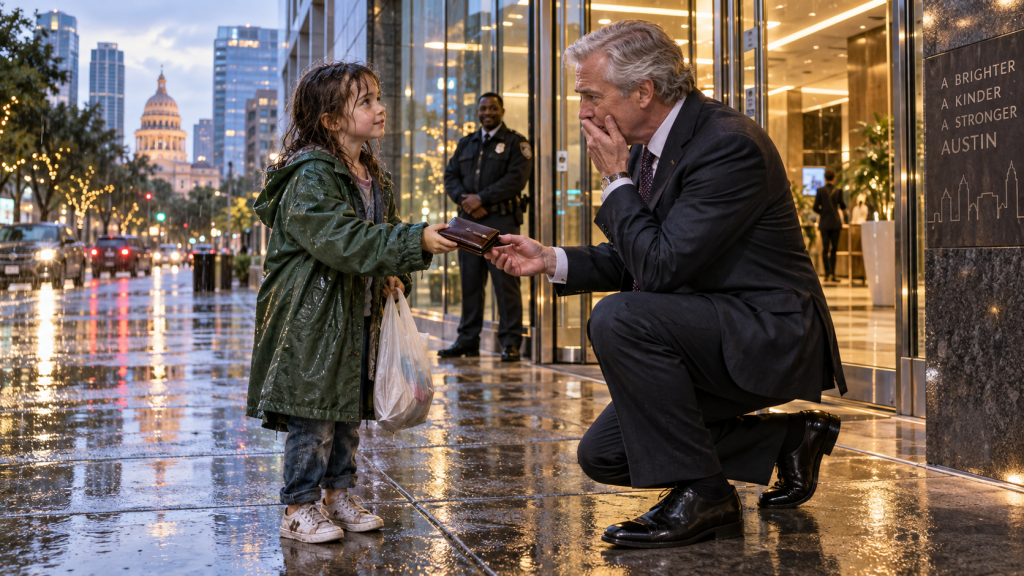
A soaked eight-year-old girl held out a battered wallet.
I offered money.
She refused.
And with the simple certainty only a child could possess, she told me:
“If you only do good things when someone gives you money, then you’re not really good. You’re just selling it.”
At sixty-one, I had thought wealth meant being able to put a price on almost anything.
At ninety-seven, I understood the things that mattered most had never been for sale.
Marisol’s dignity.
Renata’s integrity.
Daniel’s worth.
Julia’s forgiveness.
My place in my daughter’s life.
None could be purchased.
They could only be respected.
Earned where earning was possible.
Accepted when freely given.
And protected once received.
That was the fortune I had almost missed.
Not the towers.
Not the company.
Not the accounts.
Not the wallet.
A second chance to become someone my daughter could willingly call Dad again.
And all because one little girl stood in the rain holding something that belonged to me, waiting patiently for me to notice that I had lost far more than leather, cash, and credit cards.
She returned the wallet in an afternoon.
The rest took me the remainder of my life to find.
THE END STORIES! THANK YOU FOR READING GOOD LUCK !❤️
Related Posts