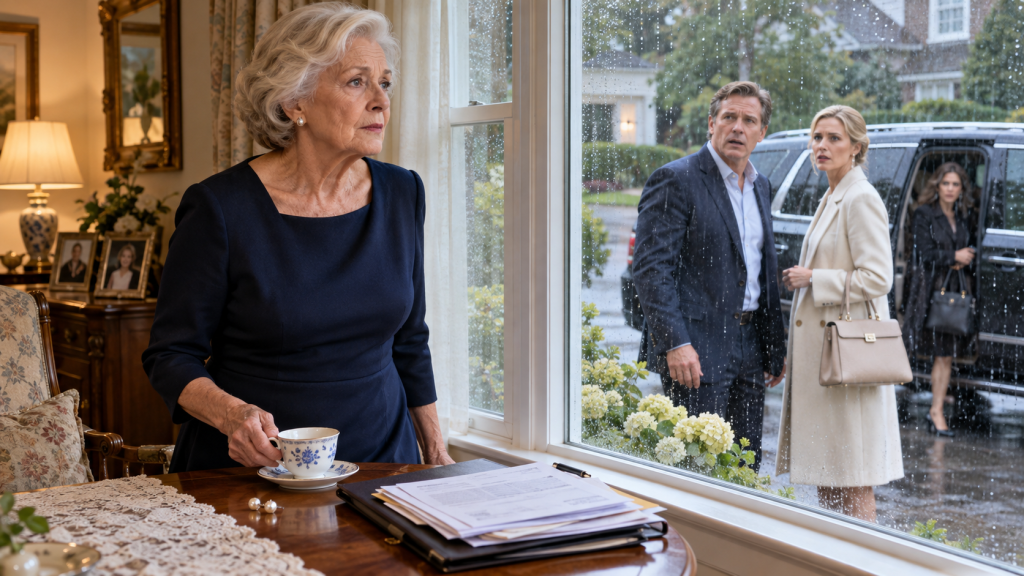
➡️ PART 3 ENDING PART ➡️
Benjamin opened his mouth.
Nothing came out.
And somehow, after seventy-seven years of living, I discovered that silence could be louder than shouting.
I looked down at the paper Lily had placed in my hand.
The rain had dampened one corner.
Her little fingers had wrinkled the bottom where she had been holding it too tightly.
But the words remained perfectly readable.
Once the townhouse is secure, we won’t need to keep pretending she belongs here.
I read them again.
Then I looked at my son.
“Tell me.”
My voice trembled despite everything I did to steady it.
“Tell me Genevieve wrote this without you knowing.”
Benjamin looked at his wife.
That was his answer.
Not at me.
Not at his daughter.
At Genevieve.
The same way he had been looking at her for years whenever he needed permission to decide which version of himself would appear.
“Mom,” he finally said, “it’s not what you think.”
At seventy-seven, I had learned that those six words almost always meant it was precisely what you thought, only accompanied by an explanation designed to make you ashamed for noticing.
“What do I think?”
I asked.
Benjamin swallowed.
Genevieve stepped forward.
“This is ridiculous.”
I looked at her.
She was still wearing that cream coat.
Beautiful coat.
I remembered the day she bought it.
She had called me from a department store.
Her card had been declined because Benjamin had forgotten to transfer money.
I paid for it.
Eight hundred and forty dollars.
At the time, she had hugged me and said:
“You’re a lifesaver.”
Now she stood on my porch wearing it while explaining why an email describing my removal from the family was ridiculous.
“Lily went through private correspondence.”
Genevieve said.
I looked at my granddaughter.
Her face changed immediately.
Shame.
That frightened little folding-in of the shoulders children learn when adults move blame quickly enough.
“No.”
I said.
Genevieve blinked.
“No what?”
“You will not do that.”
“Do what?”
“Make an eleven-year-old responsible for the words two adults wrote.”
Lily moved closer to me.
I put one arm around her.
Benjamin sighed.
“Mom, can we come inside?”
I looked at him.
“No.”
His eyebrows rose.
It was probably the first time in his forty-nine years that I had denied him entry into my home.
“This isn’t something we should discuss on the porch.”
“Then perhaps you should have considered that before driving here.”
“Mom.”
“No.”
I held up the paper.
“What is the trust?”
His face tightened.
Genevieve answered.
“It was an estate-planning idea.”
“Whose idea?”
“Ours.”
“At least you’re honest about something.”
She flinched.
Benjamin stepped in.
“Mom, you’re getting older.”
There it was.
Not old.
Older.
A gentle word.
A concerned word.
A word children use when they want to take something from their parents while pretending they are carrying it for them.
“I noticed.”
I said.
“This isn’t funny.”
“I wasn’t joking.”
“You live alone.”
“Yes.”
“You have substantial assets.”
“Yes.”
“You shouldn’t be managing everything yourself forever.”
I stared at him.
“Interesting.”
“What?”
“Yesterday I was competent enough to pay your mortgage.”
His face reddened.
“But today I’m too old to manage money.”
“That isn’t what I said.”
“It is remarkably close.”
Genevieve crossed her arms.
“You’re twisting everything because you’re hurt about dinner.”
I turned to her.
“No, Genevieve.”
My voice was very quiet.
“I canceled one hundred seventy-four payments because I finally understood that I had mistaken financing your life for participating in it.”
“That is not the same thing.”
“You canceled Lily’s tuition.”
“I canceled an automatic payment.”
I looked at my granddaughter.
“Your education will be addressed separately, sweetheart.”
Genevieve laughed.
“There. You see? This is manipulation.”
Something inside me went still.
Not angry.
Still.
Perhaps there comes an age when certain insults simply become too lazy to wound you.
“Go home.”
I said.
Benjamin stared at me.
“Mom.”
“Take your wife home.”
“What about the mortgage?”
I almost smiled.
“What about it?”
“The payment was rejected.”
“Yes.”
“We have penalties.”
“Then pay them.”
“With what?”
The question escaped him before pride could stop it.
And there it was.
The truth standing naked on my porch.
I looked at my son.
My only son.
The baby I had once carried against my chest through a fever.
The boy whose science projects Thomas and I stayed up finishing.
The teenager who crashed his first car and called me before the police.
The young man who cried into his father’s shoulder on his wedding day because he said he had never been happier.
The man who now stood at seventy-seven-year-old me’s front door asking how he was supposed to pay his own mortgage.
I felt something crack inside my heart.
Not love.
Love remained.
Illusion.
That was what broke.
“You earn money.”
I said.
Benjamin looked away.
“So does Genevieve.”
Genevieve stiffened.
“We have obligations.”
“So did Thomas and I.”
“You don’t understand our expenses.”
“I understand them better than you think.”
I lifted the folder from the small table beside the door.
“Country club.”
Genevieve’s expression changed.
“Private preschool.”
“Two vehicle leases.”
“Townhouse mortgage.”
“Utilities.”
“Landscaping.”
“Streaming subscriptions.”
“Insurance.”
“Your business account.”
Benjamin interrupted.
“You went through my accounts?”
“No.”
I looked at him.
“I went through mine.”
That silenced him.
“Those were payments leaving my money.”
I continued.
“I didn’t have to spy on you.”
“I only had to look at what I was paying for.”
Lily began crying.
Quietly.
I looked down.
“Oh, sweetheart.”
“I’m sorry.”
she whispered.
“For what?”
“I ruined everything.”
My heart nearly broke.
I crouched as far as my knees allowed and took her face gently between my hands.
“No.”
I said.
“Look at me.”
She did.
“You did not write that email.”
“You did not create this problem.”
“You did not ruin anything.”
“But I printed it.”
“And I’m glad you trusted me enough to bring it to me.”
Behind her, Genevieve said sharply:
“Lily, get in the car.”
Lily froze.
I stood.
“Do you want to go?”
I asked her.
Genevieve stared at me.
“She is my daughter.”
“Yes.”
“And she is standing right here.”
I looked at Lily.
“Do you want to go home with your parents?”
She looked frightened.
“I don’t know.”
That answer changed the atmosphere immediately.
Benjamin stepped forward.
“Lily.”
She flinched.
My son saw it.
So did I.
His face softened.
“Sweetheart, nobody’s angry with you.”
Genevieve said nothing.
Lily looked at me.
“Can I stay with Grandma for a little while?”
Benjamin closed his eyes.
Genevieve immediately said:
“No.”
Benjamin turned.
“Genevieve.”
“She stole private emails.”
“She is eleven.”
“She needs consequences.”
I felt Lily’s fingers tighten around mine.
Benjamin looked at his daughter.
Then at his wife.
For the first time that morning, I saw uncertainty in him.
Real uncertainty.
Not fear about money.
Fear about what his daughter had learned about her parents.
“Let her stay for an hour.”
he said.
Genevieve stared at him.
“Excuse me?”
“She can stay.”
“Benjamin.”
“One hour.”
The way he said it told me this was unusual.
Perhaps Genevieve had been making more decisions in that house than I understood.
Perhaps my son had learned the same habit I had.
Avoid conflict.
Laugh quietly.
Pay.
Yield.
Tell yourself silence is peace.
That did not excuse what he had done.
But it explained something.
Genevieve turned and walked toward the car.
Benjamin remained.
“Mom.”
I waited.
“We’ll talk later.”
“Yes.”
“Please don’t do anything else.”
That sentence almost made me laugh.
“Anything else?”
“Financially.”
“I won’t touch anything that belongs to you.”
He stared at me.
Then I added:
“And I won’t pay anything that belongs to you.”
His face tightened.
He walked away.
Lily and I watched the car disappear beyond the wet trees.
Then she started sobbing.
I held her.
At seventy-seven, my knees hurt.
My back hurt.
My hands had arthritis.
But there are some weights the body remembers how to carry.
A crying child is one of them.
I brought her inside.
Made cocoa.
Not tea.
Children should not have to drink tea while adults destroy their sense of safety.
She sat at my kitchen table.
The same table where I had read Benjamin’s text.
Her blue dress looked too formal for eleven in the morning.
“Why were you wearing that?”
I asked.
She looked down.
“Mom said we had to look nice when we came.”
Of course she did.
Even a financial emergency required presentation.
“Grandma?”
“Yes?”
“Did Mom mean it?”
I knew exactly what she was asking.
The email.
We won’t need to keep pretending she belongs here.
Children understand belonging before they understand mortgages.
I sat beside her.
“I think your mother wrote something cruel.”
“Does she hate you?”
“I don’t know.”
“Do you hate her?”
That question deserved care.
“No.”
“Are you mad?”
“Yes.”
“Really mad?”
“Very.”
She considered this.
“Can you be mad and not hate someone?”
“Yes.”
I smiled sadly.
“That’s something adults sometimes forget.”
She took a sip of cocoa.
“Dad knew.”
It wasn’t a question.
“Yes.”
“He replied.”
I looked at her.
“There was more?”
She nodded.
My stomach tightened.
“What did he say?”
Lily hesitated.
“I don’t remember exactly.”
“That’s okay.”
“He said something like, ‘Just give me time. Mom trusts me.’”
I closed my eyes.
Mom trusts me.
Three words.
Three ordinary words.
They hurt more than Genevieve’s cruelty.
Because she was right.
I had trusted Benjamin.
Not blindly.
Maternal trust is rarely blind.
We see faults.
We remember tantrums.
We know every weakness from the first time it appeared.
But somewhere inside me, I had believed there was a line my son would never cross.
He might be careless.
Entitled.
Weak.
Influenced.
But he would not deliberately use my trust as a tool against me.
Apparently, I had been wrong.
Lily touched my hand.
“Grandma?”
I opened my eyes.
“I’m all right.”
“You look sad.”
“I am.”
She leaned against me.
We stayed like that.
At noon, Benjamin returned alone.
He knocked.
That mattered.
I let him in.
Lily went upstairs to the room she had slept in since she was a toddler.
Benjamin sat at the kitchen table.
For a long time, neither of us spoke.
Finally, he looked at the folder.
“How much?”
I knew what he meant.
“How much what?”
“Were you paying?”
“This year?”
He nodded.
“Ninety-three thousand six hundred dollars.”
His face changed.
“That can’t be right.”
I opened the folder.
“It is.”
He stared.
“No.”
“Yes.”
“I didn’t ask for that much.”
I laughed once.
Not because anything was funny.
“No.”
I said.
“You stopped asking years ago.”
He looked at me.
“That was the trick, wasn’t it?”
I continued.
“At first you asked.”
“Mom, could you help with tuition?”
“Mom, could you cover the repair?”
“Mom, we’re short on the mortgage.”
“Then we made things automatic.”
“And once they became automatic, gratitude became unnecessary.”
His face reddened.
“I appreciated it.”
“When?”
“What?”
“When did you appreciate it?”
“Mom—”
“No.”
I leaned forward.
“When did you look at your life and understand that a seventy-seven-year-old widow was paying nearly a hundred thousand dollars a year to maintain it?”
He said nothing.
“You invited people to dinner last night.”
I continued.
“In a townhouse whose mortgage I paid.”
“You served food purchased on a card whose balance I regularly covered.”
“You drove a vehicle I insured.”
“You wore clothes cleaned with utilities I paid.”
“And then you sent me a message saying I wasn’t invited.”
His eyes filled.
“Genevieve didn’t want you there.”
“I know.”
“I was trying to avoid a fight.”
“And you chose me to lose it.”
That silenced him.
I had never said anything more accurate.
Benjamin rubbed his forehead.
“She said you make her feel judged.”
“Do I?”
“Sometimes.”
“How?”
“She thinks you notice things.”
I blinked.
“Notice things?”
“She says when you come over, you look around.”
“Benjamin, I have eyes.”
Despite himself, he almost smiled.
Then his face fell again.
“She feels like you’re evaluating her.”
“Perhaps because she knows I pay for what I’m looking at.”
“That isn’t fair.”
“No.”
I agreed.
“It wasn’t.”
He looked surprised.
“I should never have allowed my money to give me a silent vote inside your marriage.”
“I see that now.”
“I paid because I loved you.”
“But somewhere along the way, my help became tangled with access.”
“I assumed because I helped with the townhouse, I belonged there.”
My voice broke.
“I should have known better.”
Benjamin immediately shook his head.
“No.”
I looked at him.
“You should have belonged because you’re my mother.”
There it was.
The first true thing he had said.
My eyes filled.
“Yes.”
I whispered.
“Exactly.”
He cried.
Not dramatically.
Benjamin had always cried the way Thomas did.
Quietly.
As though embarrassed by water.
“I’m sorry.”
I waited.
“For last night?”
“For everything.”
“Everything is too large.”
He looked confused.
“Name something.”
I said.
His face changed.
I had learned this from age.
General apologies often ask the wounded person to do the accounting.
Specific apologies require the person who caused harm to look at the receipt.
Benjamin swallowed.
“I’m sorry I texted you instead of calling.”
I nodded.
“I’m sorry I let Genevieve decide you weren’t welcome.”
Another nod.
“I’m sorry I didn’t tell Lily.”
His voice broke.
“She kept asking when you were coming.”
That hurt.
“I’m sorry I let you pay for so much that I stopped seeing it as help.”
He wiped his eyes.
“And I’m sorry about the trust.”
I went still.
“Tell me.”
He looked toward the window.
“It started six months ago.”
“Why?”
“Genevieve was worried about estate taxes.”
I almost laughed.
“Of course she was.”
“She said your assets were complicated.”
“They aren’t.”
“I know.”
“Do you?”
“Yes.”
He looked ashamed.
“The house.”
“My investments.”
“Thomas’s retirement accounts.”
“Insurance.”
“Some municipal bonds.”
“Cash reserves.”
“Nothing particularly exotic.”
“I know.”
He nodded.
“Now.”
“What did she want?”
“A family trust.”
“Managed by?”
“Us.”
“You.”
He looked at me.
“Mostly me.”
“Beneficiary?”
“You during your lifetime.”
“And afterward?”
“Me.”
“And Lily?”
“Eventually.”
I sat back.
“Eventually.”
“Mom, it wasn’t designed to steal from you.”
“Then why didn’t you ask me?”
Silence.
“Why did you need me to trust you?”
Another silence.
“Why did Genevieve write that once the townhouse was secure, you wouldn’t need to pretend I belonged?”
His face collapsed.
“I don’t know.”
“Yes, you do.”
He cried harder.
“Because she wanted the townhouse paid off.”
There it was.
“How much remains?”
“Four hundred and twelve thousand.”
I stared at him.
I had known the mortgage was substantial.
Still.
“And the plan?”
He covered his face.
“Genevieve thought if you paid off the townhouse before transferring the rest into the trust, it would simplify things.”
“Simplify what?”
“Our future.”
Not mine.
Ours.
His.
Genevieve’s.
I looked toward Thomas’s photograph.
For fifteen years after his death, I had tried to make sure our son never struggled.
Perhaps I had succeeded too well.
Benjamin had forgotten struggle was not fatal.
Sometimes it was instructional.
“What did you say to her email?”
He looked at me.
“I said, ‘Just give me time. Mom trusts me.’”
Hearing it aloud was worse.
I nodded.
“Yes.”
“I did.”
“Mom—”
“Don’t.”
My voice cracked.
“I need you to understand something.”
“I can forgive foolishness.”
“I can forgive selfishness.”
“I can even forgive cowardice.”
“But you used my love as a weakness in a plan.”
His face twisted.
“I know.”
“No.”
I shook my head.
“You know now because Lily found the email.”
“That is different.”
He cried.
“You’re right.”
I looked at my son.
“Did you ever intend to tell me what Genevieve wrote?”
“No.”
“Did you intend to stop the plan?”
He hesitated.
That hesitation gave me my answer.
I stood.
My knees protested.
“Lily can stay until dinner.”
“Mom.”
“I need you to leave.”
“Please.”
“I love you.”
He stared at me.
“And I need you to leave.”
That distinction nearly destroyed both of us.
He stood.
At the door, he turned.
“What happens now?”
“I don’t know.”
“Are you cutting me out of the will?”
There are moments when grief becomes so absurd that laughter is the only place left to put it.
I laughed.
Benjamin looked horrified.
“You’re asking me about inheritance?”
“I didn’t mean—”
“Then don’t.”
He closed his eyes.
“You’re right.”
“Yes.”
I opened the door.
“Go home.”
He did.
That afternoon, I called Wesley.
Wesley Hart had been Thomas’s attorney and later mine.
He was eighty-one and officially retired, which meant he worked only three days a week and complained about young attorneys on the fourth.
He answered:
“Eleanor?”
“Yes.”
“What’s wrong?”
“How do you know something’s wrong?”
“You haven’t called me before four in the afternoon since Thomas died.”
Fair.
I told him everything.
The dinner.
The payments.
The email.
The trust.
Benjamin.
When I finished, Wesley was silent.
Then he said:
“Don’t sign anything.”
“I haven’t.”
“Good.”
“Do you have copies?”
“Yes.”
“Bring them tomorrow.”
“I thought you retired.”
“I did.”
“You sound employed.”
“I make exceptions for disasters.”
“Thank you.”
Then I called Serena.
Serena was my niece.
My younger sister’s daughter.
Fifty-two.
A certified public accountant.
Sharp as broken glass when necessary, warm as bread when it wasn’t.
I had deliberately avoided involving her because I didn’t want family taking sides.
That had been another habit.
Protect Benjamin.
Protect Genevieve.
Protect appearances.
At seventy-seven, I was tired of protecting adults from facts.
Serena arrived that evening with a laptop and two containers of soup.
She read the email.
Then read it again.
Her face became very still.
“Aunt Eleanor.”
“Yes.”
“Do you understand what this is?”
“A betrayal.”
“Yes.”
“But financially?”
I shook my head.
“This isn’t just a son casually discussing estate planning.”
She pointed at the email chain.
“They were strategizing around your assets.”
“Did you sign anything?”
“No.”
“Give anyone power of attorney?”
“No.”
“Add Benjamin as joint owner anywhere?”
“A few years ago I added him as authorized signer to one household account in case I was hospitalized.”
Her eyes sharpened.
“We’re reviewing that tomorrow.”
“I already canceled recurring payments.”
“Good.”
She closed the laptop.
“How much have you given them?”
“Over the years?”
“Yes.”
“I don’t know.”
“We’re finding out.”
I sighed.
“Serena.”
“No.”
She gave me a look inherited directly from my sister.
“You’ve spent fifteen years saying, ‘It’s only this once.’”
“I want the number.”
“Why?”
“Because generosity without records can become exploitation without anyone noticing when the line was crossed.”
That sentence stayed with me.
For the next three weeks, we counted.
Not because I wanted reimbursement.
I didn’t.
Most payments had been gifts.
Freely given.
Legally theirs once paid.
I counted because truth required a number.
The number made me physically ill.
Over fifteen years, I had transferred, paid, or covered more than $780,000 for Benjamin and his household.
College debt.
Wedding costs.
Down payment.
Mortgage.
Cars.
Insurance.
Private education.
Vacations disguised as “family expenses.”
Club dues.
Repairs.
Business expenses.
Credit cards.
Emergency transfers.
Regular transfers.
The occasional check Genevieve cashed without even sending a thank-you message.
I stared at Serena’s spreadsheet.
“How?”
She looked at me gently.
“Incrementally.”
Clara’s words returned.
It rarely happens overnight.
No.
It never does.
Neither exploitation nor surrender usually arrives carrying a sign.
It arrives as one favor.
Then another.
Then a system.
Then expectation.
Then entitlement.
By the time someone says you weren’t invited, they may have forgotten who paid for the table.
Wesley reviewed my estate plan.
It was not as disastrous as I feared.
Benjamin was the primary beneficiary.
Lily had provisions.
There were charitable gifts.
Nothing gave Benjamin present control.
Wesley tapped his pen.
“What do you want?”
“I don’t know.”
“That is not a legal instruction.”
“I know.”
“Do you want to disinherit Benjamin?”
I looked at him.
“No.”
“Do you want to leave everything unchanged?”
“No.”
“Good.”
He sat back.
“Now we’re somewhere.”
I spent months thinking.
I did not rewrite my will in anger.
That mattered to me.
Anger is useful.
It tells you something is wrong.
But I did not want anger drafting documents that would speak after I was dead.
So I waited.
Meanwhile, the payments stayed canceled.
That changed Benjamin’s life quickly.
The country club membership disappeared first.
Genevieve blamed me.
Then the luxury SUV lease was traded for something cheaper.
They withdrew Lily from one extracurricular program but kept the one she loved.
Benjamin took over the mortgage.
Genevieve increased her hours at her consulting business.
They canceled two vacations.
Sold a boat I had not known I was indirectly helping finance.
And something astonishing happened.
They survived.
Of course they did.
That realization hurt and healed me simultaneously.
For years, I believed I was preventing disaster.
Mostly, I had been preventing adjustment.
There is a difference.
Benjamin called me two months later.
“Mom?”
“Yes?”
“Can we have coffee?”
“Just you?”
“Yes.”
We met at a little café Thomas used to love.
Benjamin looked tired.
More tired than I remembered.
“Mortgage is current.”
he said.
I smiled faintly.
“Congratulations.”
He laughed despite himself.
“I deserved that.”
“Yes.”
“We’re selling the townhouse.”
That surprised me.
“Why?”
“We can’t comfortably afford it.”
I waited.
“Turns out we never could.”
he added.
There was no accusation in his voice.
That mattered.
“What will you do?”
“Buy something smaller.”
“Good.”
He stirred his coffee.
“Genevieve and I are in counseling.”
I said nothing.
“Lily insisted.”
That almost made me smile.
“She said she doesn’t want to live in a house where everybody lies politely.”
That sounded exactly like my granddaughter.
“How is she?”
“Angry.”
“At me?”
“At both of us.”
He looked down.
“Mostly me.”
“Why mostly you?”
“She says she expected better.”
His eyes filled.
Children have a brutal way of locating the exact center of our shame.
“I expected better too.”
I said.
“I know.”
He swallowed.
“Mom, I need to tell you something.”
I waited.
“I blamed Genevieve.”
“For the email?”
“For all of it.”
“Was that inaccurate?”
“Partly.”
He looked at me.
“She pushed.”
“She wanted the trust.”
“She wrote that horrible sentence.”
“But I liked what she was offering me.”
“What?”
“An excuse.”
He took a breath.
“I didn’t have to admit I wanted your money if I could call it estate planning.”
That was the first time I saw my son return to himself.
Not because he was suddenly good.
Because he stopped outsourcing his guilt.
“I had gotten used to your money.”
he continued.
“I told myself you could afford it.”
“You can.”
“It doesn’t hurt you.”
“You like helping.”
“Dad would have wanted me comfortable.”
His voice cracked.
“I turned your generosity into a reason I didn’t have to feel ashamed.”
I listened.
“And when Genevieve said we should put everything in a trust, part of me knew it was wrong.”
“But another part thought…”
He looked at me.
“Eventually it will all be mine anyway.”
The sentence hurt.
He did not look away.
“Thank you for telling me.”
I said.
“You’re not angry?”
“I’m devastated.”
His face fell.
“But I’d rather be devastated by the truth than comforted by another lie.”
He nodded.
We drank coffee.
Before leaving, he placed an envelope on the table.
“What is this?”
“The first repayment.”
I stared.
“Benjamin.”
“I know the money was gifted.”
“You don’t legally owe me.”
“I know.”
“Then why?”
“Because I need to.”
Inside was a check for $1,000.
I almost returned it.
Then stopped.
Perhaps refusing it would have been another way of controlling how he repaired himself.
So I accepted it.
Not because I needed $1,000.
Because Benjamin needed to become someone who paid his own way.
Every month after that, he sent another.
Sometimes $1,000.
Sometimes $500.
Once only $200.
I deposited every check into a separate account.
He did not know.
Three years later, when Lily turned fourteen, I transferred that account into an education trust established solely for her, with an independent trustee.
Not Benjamin.
Not Genevieve.
Not me.
Independent.
Wesley smiled when we signed it.
“Learning.”
he said.
“Yes.”
I smiled.
“Slowly.”
My new estate plan took nearly a year.
Benjamin remained a beneficiary.
But not sole beneficiary.
Lily received a protected share.
Several charities Thomas and I had supported received gifts.
A scholarship fund was created in Thomas’s name for students caring for elderly family members.
And I created something else.
A modest fund for older adults experiencing financial exploitation by relatives.
Wesley read that clause twice.
“Thomas would like this.”
My throat tightened.
“Yes.”
“I think he would.”
The townhouse sold.
Benjamin and Genevieve moved into a smaller home.
The first time I visited, Genevieve opened the door.
For nearly eight months, she and I had barely spoken.
She looked different.
No cream coat.
No polished performance.
Jeans.
Bare feet.
Tired face.
“Eleanor.”
“Genevieve.”
She stepped aside.
“You can come in.”
The words were ordinary.
Still, we both heard the echo.
I entered.
Lily ran downstairs and hugged me.
Their new house was lovely.
Smaller.
Warm.
Lived-in.
There were dishes in the sink.
A blanket folded badly over the sofa.
Shoes by the door.
For the first time in years, Genevieve’s home looked like people actually lived there.
Dinner was simple.
Pasta.
Salad.
Bread.
Benjamin cooked.
I noticed.
Genevieve noticed me noticing.
After Lily went upstairs, Genevieve said:
“I owe you an apology.”
I put down my glass.
“Yes.”
She blinked.
Perhaps she expected me to rescue her from the discomfort.
Old Eleanor would have.
New Eleanor had retired from making other people’s apologies easier.
She continued.
“What I wrote was cruel.”
“Yes.”
“I was angry.”
“At me?”
“At everything.”
She looked around the kitchen.
“At Benjamin.”
“At money.”
“At myself.”
“That doesn’t explain me.”
“No.”
She nodded.
“It doesn’t.”
Then she said something unexpected.
“I resented you because every time you paid something, I felt like a failure.”
I stared at her.
“I never called you one.”
“I know.”
“That almost made it worse.”
She gave a humorless laugh.
“You were always gracious.”
“You’d pay the mortgage and say, ‘Don’t worry, darling.’”
“You’d cover tuition and tell us Lily was worth it.”
“You’d pay for dinner and pretend not to notice the price.”
“I started feeling like our entire life existed because you permitted it.”
I thought about that.
“Then why keep taking the money?”
“Because I liked the life.”
At least she was honest.
“I wanted the townhouse.”
“The club.”
“The schools.”
“The vacations.”
“And once I had them, losing them felt like humiliation.”
She looked at me.
“So I turned the humiliation toward you.”
That was painfully human.
Not admirable.
Human.
“And the trust?”
She cried.
“I wanted security.”
“Mine.”
“Yes.”
“Without me.”
Her face crumpled.
“Yes.”
I let the silence stay.
Then Genevieve whispered:
“I’m sorry.”
This time, I believed her.
Not because tears prove anything.
Because she had named the ugly parts without polishing them.
“I accept your apology.”
Her eyes lifted.
“That does not mean I trust you financially.”
“I understand.”
“It does not mean things return to the way they were.”
“I understand.”
“It means I accept your apology.”
She nodded.
“That is more than I deserve.”
“Don’t say that.”
She looked confused.
“Why?”
“Because then I have to either reassure you or agree with you.”
For the first time, she laughed.
A real laugh.
“So what should I say?”
“Thank you.”
She smiled through tears.
“Thank you.”
We did not become close overnight.
Some relationships do not heal by returning.
They heal by becoming something new.
Genevieve and I became careful.
Then cordial.
Then, slowly, honest.
I stopped paying.
That helped more than anything.
Money had contaminated too many emotional exchanges between us.
Without it, we had to decide whether we actually liked one another.
Sometimes we did.
Sometimes we didn’t.
That was healthier.
Lily grew.
At sixteen, she asked me about the night I was uninvited.
We were sitting on my porch.
“Did you really cancel everything the next morning?”
“Yes.”
“One hundred seventy-four payments?”
“Yes.”
She whistled.
“Savage.”
I laughed.
“I was not savage.”
“Grandma.”
“I was seventy-seven.”
“Exactly.”
She grinned.
Then became serious.
“Did you do it to punish them?”
I thought.
“Partly.”
She looked surprised.
“You admit that?”
“At my age, darling, lying to make myself look noble would be exhausting.”
She laughed.
“I was hurt.”
“I wanted them to feel consequences.”
“But mostly I needed to stop participating in something that was hurting me.”
“There’s a difference between punishment and a boundary.”
“What difference?”
“A punishment says, ‘I want you to suffer because you hurt me.’”
“A boundary says, ‘I will no longer keep doing something that harms me.’”
“Sometimes the other person experiences both the same way.”
Lily nodded slowly.
“Mom definitely thought it was punishment.”
“I know.”
“Dad says you saved them.”
I frowned.
“From what?”
“Themselves.”
“No.”
I shook my head.
“They saved themselves.”
“I stopped rescuing them.”
“That isn’t the same thing.”
That distinction became important in our family.
Benjamin’s business improved.
Not dramatically.
Honestly.
He became better at budgeting.
He and Genevieve stayed in counseling.
They nearly separated once.
Then decided not to.
I stayed out of it.
That was difficult.
Mothers develop muscles for intervention.
Mine were overtrained.
When Benjamin complained, I listened.
I did not write checks.
When Genevieve cried, I listened.
I did not solve.
When Lily needed something genuinely important, I found ways to support her without routing the support through her parents.
Clean boundaries.
Clear documents.
No secret strings.
When I turned eighty, Benjamin hosted a dinner.
At his house.
Seven p.m.
The invitation arrived three weeks early.
Printed.
Ridiculous.
At the bottom, he had handwritten:
Mom, you are invited. I checked with everyone.
I laughed until I cried.
At dinner, he stood.
“Oh, no.”
I said.
“Sit down.”
“No.”
He raised his glass.
“I need to say something.”
Genevieve looked at me and smiled.
Lily whispered:
“Let him.”
Benjamin looked around the table.
“My mother spent most of my adult life making sure I never fell.”
My throat tightened.
“I thought that was what love looked like.”
“And maybe sometimes it is.”
“But I became so accustomed to her catching me that I stopped learning how to stand.”
He looked at me.
“Three years ago, I told my mother she wasn’t invited to dinner.”
“The house where that dinner happened existed partly because she had been paying the mortgage.”
Everyone went quiet.
“I thought losing the money was the worst thing that happened afterward.”
“It wasn’t.”
“The worst thing was realizing my daughter had seen me treat my mother like an account instead of a person.”
Lily started crying.
“So this dinner is not an apology.”
Benjamin continued.
“I’ve apologized.”
“This is gratitude.”
He raised his glass toward me.
“Mom, thank you for helping me when help was help.”
“And thank you for stopping when help became something uglier.”
I cried.
Then I raised my glass.
“To paying your own mortgage.”
Everyone laughed.
Even Genevieve.
Especially Genevieve.
Thomas would have loved it.
That thought arrived suddenly.
I looked toward the empty chair beside me.
For years after he died, grief had felt like a hole.
Then it became a shadow.
Then a companion.
At eighty, I finally understood that missing Thomas did not mean I was required to preserve the family exactly as it had been when he was alive.
He had left me money because he loved me.
Not because he wanted me to become a distribution center for our son.
I had confused motherhood with continuation.
Keep giving.
Keep smoothing.
Keep preventing discomfort.
Thomas had been better at boundaries.
I remembered something he once told Benjamin when our son was twenty-three and wanted us to pay off a credit card.
“We can help you once.”
Thomas had said.
“But I won’t finance the habit that created the problem.”
I had thought him harsh.
After he died, I secretly paid another balance.
Then another.
I wondered how different things might have been if I had listened.
But regret can become vanity too.
It imagines we should have possessed wisdom before life taught it to us.
I forgave myself.
That took longer than forgiving Benjamin.
At eighty-two, I sold the large house.
Everyone was shocked.
Benjamin most of all.
“But this was Dad’s house.”
“No.”
I corrected.
“It was ours.”
He nodded.
“Right.”
“And now it’s too much house.”
I moved into a smaller cottage near the botanical gardens.
Two bedrooms.
A tiny study.
A porch just large enough for three chairs.
Benjamin offered to help financially.
I stared at him until he laughed.
“Worth trying.”
“No.”
“I know.”
I bought the cottage myself.
The first night there, I unpacked Thomas’s photograph.
Then the pearl earrings.
Then my finest teacup.
I put the teacup in the front of the cupboard.
Not the back.
I used it every morning.
That became one of my private rituals.
Nice things are not only for company.
Neither is kindness.
Neither is money.
Neither is life.
At eighty-four, Lily went to college.
She received the letter about her education trust a month before tuition was due.
She called me screaming.
“Grandma!”
“Please don’t rupture anything.”
“You did this?”
“Partly.”
“Dad did too?”
“In a way.”
I finally told her about the repayment account.
Every check Benjamin had sent me had gone toward her education.
She became quiet.
“So Dad paid you back and you saved it for me?”
“Yes.”
“Does he know?”
“Not yet.”
“Can I tell him?”
“Please.”
Benjamin called twenty minutes later.
He was crying.
“Mom.”
“Yes?”
“You saved all of it?”
“Yes.”
“Why?”
“Because I didn’t need repayment.”
“Then why take it?”
“Because you needed to repay.”
Silence.
Then he laughed through tears.
“You’re terrifying.”
“I’m eighty-four.”
“Same thing.”
Lily graduated four years later without student debt.
Not because Grandma paid everything blindly.
Because a carefully structured trust supported education while Lily worked, earned scholarships, and understood exactly what the money was for.
On graduation day, she hugged me.
“I know what I want to do.”
“What?”
“Elder law.”
I stared at her.
“Why?”
She smiled.
“You really have to ask?”
I cried harder at that graduation than I had at Benjamin’s.
Lily became an attorney.
A good one.
Annoyingly good.
She specialized in estate planning, guardianship disputes, elder financial exploitation, and family mediation.
Her first office had Thomas’s photograph on the bookshelf.
Beside it was a framed copy of one page from my old bank records.
Not amounts.
Just the line showing:
174 RECURRING AUTHORIZATIONS CANCELED.
Underneath, she placed a small plaque:
GENEROSITY REQUIRES CONSENT EVERY TIME, NOT JUST THE FIRST TIME.
I told her it was dramatic.
She told me she inherited that from my side.
At eighty-seven, I became ill.
Nothing immediately fatal.
Heart trouble.
Age.
The body gradually sending invoices for decades of use.
Benjamin began coming every Tuesday.
At first, he brought groceries.
Then I noticed he was paying for them.
I protested.
He looked offended.
“Mom.”
“I have money.”
“So do I.”
“I don’t need you to—”
He held up a hand.
“You taught me this.”
“What?”
“Not every act of care is a debt.”
That shut me up.
He cooked badly.
Thomas had been the cook.
Benjamin inherited my abilities, unfortunately.
One evening, he burned chicken so thoroughly that the smoke alarm became involved.
I sat at the table laughing.
“This is elder abuse.”
he said.
“Then stop making chicken.”
We ordered soup.
While we ate, he looked around my little cottage.
“Do you ever wish you’d kept paying?”
I stared.
“Why on earth would I?”
“I don’t know.”
“Maybe things would have been easier.”
“For whom?”
He smiled.
“Fair.”
Then his face became serious.
“I think about that email all the time.”
“Don’t.”
“How can I not?”
“Because guilt is only useful while it teaches.”
I put down my spoon.
“After that, it becomes another form of self-absorption.”
He looked startled.
“That’s harsh.”
“I’m eighty-seven.”
“Apparently age is your excuse for everything.”
“One of the benefits.”
I reached across the table.
“You hurt me.”
“Yes.”
“You changed.”
“I’m trying.”
“No.”
I squeezed his hand.
“You did.”
His eyes filled.
“Do you trust me?”
That was a difficult question.
“Now?”
“Yes.”
“With my money?”
He almost smiled.
“With me.”
I looked at my son.
“Yes.”
He cried.
So did I.
Trust had returned differently.
Not innocent.
Not automatic.
Earned trust has seams.
You can see where it was repaired.
That does not make it weaker.
Sometimes it makes it more honest.
Genevieve changed too.
Not into a saint.
I would have distrusted that.
She remained particular.
She still liked expensive coffee.
Still folded napkins beautifully.
Still had the ability to insult a person with one raised eyebrow.
But she worked.
Paid her own bills.
Built her consulting business.
She and Benjamin never returned to the country club.
One Christmas, she gave me a cream scarf.
I looked at it.
She looked at me.
We both remembered the coat.
Then she said:
“This one I paid for.”
I laughed so hard I had to sit down.
That became our strange peace.
At ninety, I changed my estate plan one final time.
Wesley was gone by then.
Lily handled it with another attorney because she refused to draft documents from which she benefited.
I was proud of her for that.
Benjamin received enough.
Not everything.
Lily received enough.
Not everything.
The rest went outward.
Scholarships.
A widow-support program.
Legal assistance for older adults.
A small library fund in Thomas’s name.
And a grant program helping grandparents raising grandchildren.
Benjamin reviewed nothing.
He did not ask.
That was perhaps the greatest evidence of his change.
At my ninetieth birthday, he handed me a card.
Inside he had written:
Mom, whatever you leave someday is yours until the last second you choose otherwise. I finally understand that inheritance is a gift, not a reservation.
I kept that card beside Thomas’s photograph.
At ninety-two, Genevieve died unexpectedly.
A stroke.
Fast.
Benjamin was seventy-four.
He called me from the hospital.
“Mom.”
One word.
I knew.
I sat beside him at the funeral.
Lily spoke beautifully about her mother.
Not falsely.
Beautifully.
She talked about Genevieve’s elegance.
Her ambition.
Her sharp humor.
Her love of flowers.
Her terrible habit of correcting restaurant menus.
Then Lily said:
“My mother made serious mistakes.”
The room went still.
“She also did something I think families do not discuss enough.”
“She changed after being confronted.”
I looked at Benjamin.
He was crying.
“Change did not erase what happened.”
Lily continued.
“It gave us new things that happened afterward.”
That sentence stayed with me.
New things afterward.
That was what healing actually was.
Not erasure.
Addition.
Enough new truth that the old truth no longer occupied every room.
After Genevieve died, Benjamin became lonely.
I worried.
Then deliberately did not manage him.
He joined a walking group.
Learned to cook.
Poorly.
Made friends.
Volunteered.
At seventy-six, he started helping a nonprofit teach basic budgeting to young families.
When he told me, I laughed.
“What?”
he asked.
“You?”
“I know.”
“You once needed your mother to pay your streaming subscriptions.”
“I have a redemption arc.”
“Don’t get theatrical.”
He laughed.
Then he became serious.
“I tell them about you.”
“Oh, Lord.”
“Not your name.”
“What do you say?”
“That someone can love you and still stop rescuing you.”
I smiled.
“Good.”
“And that the stopping might be the most loving part.”
I thought about that.
“Sometimes.”
I said.
“Sometimes.”
At ninety-four, I stopped driving.
I hated it.
Benjamin took my keys after I backed into a decorative stone wall.
I accused him of tyranny.
He reminded me that the wall was stationary.
We compromised.
He drove me to appointments.
I complained about his routes.
Some things between mothers and sons are sacred.
At ninety-five, Lily had her first child.
A girl.
Her name was Clara Thomas.
Clara for the banker who had helped me see the payments.
Thomas for my husband.
When Lily told Clara—the original Clara from First National, now in her nineties—she cried for ten minutes.
I held my great-granddaughter and thought about all the money I had once spent trying to hold a family together.
None of it had accomplished what that tiny child did by simply existing.
Families cannot be purchased into closeness.
You can pay tuition.
Mortgages.
Insurance.
Vacations.
Dinners.
But belonging has no automatic withdrawal.
Love cannot be scheduled as a recurring payment.
It has to be chosen again and again.
By everyone.
I lived long enough to see little Clara turn six.
One afternoon, she was coloring at my kitchen table.
I used the finest teacup.
Always.
She looked at it.
“Great-Grandma, why do you use the fancy cup every day?”
“Because I’m company.”
She frowned.
“You live here.”
“Exactly.”
She thought about this.
Then nodded as though I had said something profound.
Children are generous that way.
At ninety-seven, my heart began failing seriously.
The doctors were kind.
I was tired.
Not sad.
Tired.
There is a difference.
Benjamin spent more time with me.
One rainy evening, he sat beside my bed.
The rain sounded almost exactly like the night of the townhouse dinner.
I remembered the navy dress.
The cold tea.
Thomas’s photograph.
The text.
You weren’t invited.
I smiled.
Benjamin noticed.
“What?”
“Nothing.”
“That’s suspicious.”
“I was remembering.”
He knew.
His face changed.
“That night?”
“Yes.”
“I wish I could erase it.”
“I don’t.”
He stared.
“Why?”
“Because it happened.”
“That isn’t a reason to keep it.”
“No.”
I looked at him.
“But I don’t need to erase pain to prove I’ve healed.”
He took my hand.
“I still hate that I did it.”
“I know.”
“Do you know what I remember most?”
“What?”
“Your message.”
He smiled sadly.
“Then you and your wife can start paying your own way.”
I laughed weakly.
“Good line.”
“Terrifying.”
“I was furious.”
“I know.”
“No.”
I smiled.
“You were too busy panicking about the mortgage.”
He laughed.
Then cried.
“Mom.”
“Yes?”
“Were you ever afraid I’d only come back because of the money?”
The question had waited twenty years.
“Yes.”
He closed his eyes.
“For a while, I was.”
I appreciated the honesty.
“I know.”
“Then I started coming because I missed you.”
“I know that too.”
“How?”
“Because eventually you stopped asking what I was going to do with the will.”
He laughed through tears.
“God.”
“You were awful.”
“I was.”
“So was Genevieve.”
“Yes.”
“She got better.”
“Yes.”
“So did you.”
He squeezed my hand.
“I love you.”
“I love you too.”
“Even then?”
I looked at my seventy-nine-year-old son and saw every age he had ever been.
Newborn.
Seven.
Sixteen.
Twenty-five.
Forty-nine on my porch.
Seventy-nine beside my bed.
“Yes.”
I whispered.
“Even then.”
His face crumpled.
“That was the problem.”
I continued.
“I thought because I loved you, I had to keep protecting you from consequences.”
“I was wrong.”
“Love survived the word no.”
“Maybe it became healthier because of it.”
He kissed my hand.
We sat listening to the rain.
I died eleven days later.
Benjamin was there.
Lily was there.
Little Clara had visited that morning and left a drawing beside my bed.
Thomas’s photograph stood on the table.
I wore the pearl earrings.
The same earrings I had removed at 7:03 p.m. on the night everything changed.
Lily had asked:
“Are you sure?”
“Yes.”
“Why those?”
“Because they were never about that dinner.”
They were Thomas.
Fifty years.
Love.
Memory.
I refused to let one ugly evening steal their meaning.
My final estate was distributed exactly as I intended.
No surprises.
No punishment from beyond the grave.
I did not believe in turning wills into weapons.
Benjamin received a meaningful inheritance.
Lily received one.
The charitable funds received theirs.
The elder financial assistance program received enough to continue for years.
And Benjamin received something separate.
An envelope.
Inside was the old folder marked BENJAMIN.
College tuition.
Mortgage assistance.
Insurance.
Country club dues.
Preschool.
Repairs.
The history of everything I had once mistaken for the only way to love him.
On top, I left a letter.
He read it alone.
My darling Benjamin,
If you are reading this, then I am finally having dinner with your father, and I assure you he would never dare uninvite me.
Benjamin laughed and cried at the same time.
Do not read this folder as a debt.
You owe me nothing in it.
I gave those things because I chose to give them.
Some choices were wise.
Some were foolish.
Some helped you.
Some helped you avoid growing.
That distinction took me too long to understand.
For years, I believed a good mother made sure her child never struggled.
I was wrong.
A good mother prepares her child to survive struggle without losing himself.
I wish I had learned that earlier.
You hurt me deeply.
I know you know that.
I also know you spent the years afterward becoming someone who no longer needed to be reminded.
That mattered.
I did not forgive you because you were my son.
I forgave you because you took responsibility.
And I loved you throughout because love and approval were never the same thing.
Then:
There is one receipt missing from this folder.
The dinner.
I never paid for that one.
You did.
And in the end, I think it bought you something worth having.
Perspective.
Use it well.
Love,
Mom.
Benjamin kept the letter.
He burned the folder.
Not angrily.
Ceremonially.
Lily stood beside him in the garden.
“You sure?”
she asked.
“Yes.”
“Grandma kept records.”
“She also said they weren’t debts.”
He lit one corner.
Paper curled.
Numbers darkened.
Fifteen years of rescues became ash.
The lesson remained.
At my memorial, Lily gave the final speech.
She did not tell the story as revenge.
I would have hated that.
She stood beside my photograph wearing my pearl earrings.
“My grandmother was seventy-seven when she learned something most people assume age should have taught us much earlier.”
She looked around the room.
“That love without boundaries can become a place where entitlement grows.”
Benjamin lowered his head.
Then lifted it again.
He did not hide.
“Her son—my father—hurt her.”
Lily continued.
“My mother hurt her.”
“And my grandmother responded by canceling one hundred seventy-four recurring payments.”
A few people laughed softly.
“Yes.”
Lily smiled.
“She was formidable.”
More laughter.
“But that isn’t why I’m telling this story.”
“The important part isn’t that she stopped paying.”
“The important part is what happened after.”
“My father had to become responsible for his own life.”
“My mother had to confront what insecurity and entitlement had turned her into.”
“My grandmother had to confront something too.”
“She had to admit that giving endlessly had allowed her to feel necessary.”
That was true.
Painfully true.
“She learned that being needed is not the same as being loved.”
“She learned that helping someone is not always the same as helping them grow.”
“And she learned that saying no does not automatically make love disappear.”
Lily looked toward Benjamin.
“My father and grandmother had almost twenty more years after that dinner.”
“They were better years.”
“Not because they forgot.”
“Because they remembered accurately.”
Then she held up my finest teacup.
Everyone laughed.
“She also left me this.”
On the bottom, years earlier, I had written with a ceramic marker:
USE THE GOOD CUP.
Lily smiled.
“Grandma spent most of her life saving nice things for other people.”
“The good dishes.”
“Money.”
“Energy.”
“Patience.”
“Second chances.”
“Eventually she realized she was also one of the people worth saving nice things for.”
She placed the cup beside my photograph.
“That’s the inheritance I want.”
Not the accounts.
Not the bonds.
Not the house.
That.
Years later, Lily kept the story alive through her work.
Not my name.
The lesson.
When elderly clients came into her office afraid to stop paying an adult child’s bills, she did not tell them what to do.
She asked questions.
“Is this still a gift?”
“Or has it become an expectation?”
“Are you giving freely?”
“Or are you afraid of what happens if you stop?”
“Does this support independence?”
“Or replace it?”
“Would this relationship survive if the money disappeared?”
That last question was difficult.
But useful.
Benjamin sometimes spoke at community financial workshops too.
He told his side.
That mattered.
He would stand in front of a room and say:
“My mother didn’t turn me into an entitled man.”
“I participated.”
“She gave too much.”
“I took too easily.”
“Those are different responsibilities.”
Then he would tell them about the townhouse.
The text.
The 174 payments.
The email.
His shame.
His repayment checks.
Counseling.
The smaller house.
The years of rebuilding trust.
And eventually he would say:
“The day my mother stopped financing my life felt like abandonment.”
“It wasn’t.”
“It was the first time in years she treated me like an adult.”
When Benjamin died at eighty-eight, Lily found my letter in his bedside drawer.
Folded.
Soft from being opened many times.
Beside it was a photograph.
Me at eighty.
Benjamin beside me.
Genevieve on the other side.
Lily behind us.
The birthday dinner.
On the back, Benjamin had written:
THE FIRST DINNER WE ACTUALLY PAID FOR OURSELVES. BEST ONE WE EVER HAD.
Lily cried.
Then laughed.
She framed it.
Little Clara grew up hearing the story.
By then, it had become family history.
Not family shame.
There is a difference.
Shame says:
Hide this.
History says:
Learn from this.
When Clara became a mother herself, she opened a savings account for her son.
Then another for herself.
She and her husband kept shared accounts and individual accounts.
They talked openly about money.
Who earned what.
Who paid what.
What belonged to whom.
What gifts meant.
What help meant.
When their son became an adult and asked for help with his first apartment, Clara helped with the deposit.
Then she handed him a budget.
He groaned.
She smiled.
“Family tradition.”
He had no idea how true that was.
And somewhere, in a cabinet in Lily’s home, my finest teacup survived.
Chipped eventually.
Of course.
Good things used long enough acquire evidence.
Lily never repaired the chip.
She said it belonged there.
Beside the cup sat the pearl earrings.
Thomas’s photograph.
And a copy of the text that changed our family:
You weren’t invited. My wife doesn’t want you there.
Below it was my reply:
Then you and your wife can start paying your own way.
People who heard the story sometimes focused on that exchange.
They loved the drama.
The rejected mother.
The canceled payments.
The panicked son.
The cruel daughter-in-law.
The secret plan.
But life is rarely improved by reducing people to the worst sentence they ever wrote.
Genevieve was more than that email.
Benjamin was more than his cowardice.
I was more than the woman who paid.
The real ending was not that I punished them.
It was that we all stopped pretending.
Genevieve stopped pretending luxury was security.
Benjamin stopped pretending dependence was temporary.
I stopped pretending unlimited giving was the same thing as unconditional love.
Lily stopped pretending children did not notice what adults were doing.
And once the pretending ended, something more honest had room to grow.
The townhouse disappeared.
The country club disappeared.
The automatic payments disappeared.
The expensive cars disappeared.
Genevieve eventually disappeared too, as all of us do.
Then I did.
Then Benjamin.
But the family remained.
Not because I paid for it.
Because, eventually, we learned how to belong to one another without invoices.
That was what I had wanted all along.
Not gratitude.
Not control.
Not repayment.
A place at the table.
And the irony was that I did not truly get one until I became willing to walk away from the table that excluded me.
At seventy-seven, I thought my son’s message was telling me I did not belong.
Years later, I understood it differently.
It was telling me I had been trying to purchase belonging from people who should have been giving it freely.
That was why the money had to stop.
Not because Benjamin needed punishment.
Because love needed somewhere else to stand.
I used to believe generosity meant keeping your hand open.
Age taught me something more difficult.
Sometimes generosity means closing it.
Not into a fist.
Simply closing it long enough to ask:
Am I still choosing this?
Does this still help?
Is this still love?
Or am I paying because I am frightened that without the payment, nobody will need me?
Those questions saved more than my bank account.
They saved my relationship with my son.
Because once money stopped answering every problem, Benjamin and I had to decide whether we actually wanted each other.
We did.
That was worth more than $93,600.
More than 174 payments.
More than the townhouse.
More than everything Thomas left behind.
The last great gift I gave my son was not a check.
It was the chance to discover that when the checks stopped, I was still his mother.
And the last great gift Benjamin gave me was proving that when the money stopped, he could still become my son again.
So yes.
At seventy-seven, dressed in navy with pearl earrings beside me and cold tea on the table, I received a message telling me I wasn’t invited to dinner.
By sunrise, 174 payments had vanished.
But that was never the real story.
The real story was everything that returned afterward.
My dignity.
My judgment.
My boundaries.
My son.
My granddaughter’s trust.
Genevieve’s honesty.
Benjamin’s adulthood.
And the quiet understanding that love is not measured by how much one person is willing to pay to keep everyone comfortable.
Sometimes love looks like a warm meal.
Sometimes a tuition check.
Sometimes a second chance.
And sometimes love is an elderly woman sitting at a kitchen table, holding a pen over an authorization form, finally understanding that she can say:
Enough.
Not because she has stopped loving her family.
But because she has finally remembered to include herself in it.
And somewhere beyond all those years, I like to imagine Thomas waiting at a dinner table.
Two cups.
Two plates.
No mortgage.
No country club.
No automatic withdrawals.
He looks at his watch.
Seven o’clock.
I walk in wearing my pearl earrings.
He smiles.
“Took you long enough.”
I sit across from him.
“Am I invited?”
Thomas laughs.
“Eleanor.”
He reaches across the table for my hand.
“You always were.”
And this time—
I believe him.
THE END STORIES! THANK YOU FOR READING GOOD LUCK !❤️
Related Posts