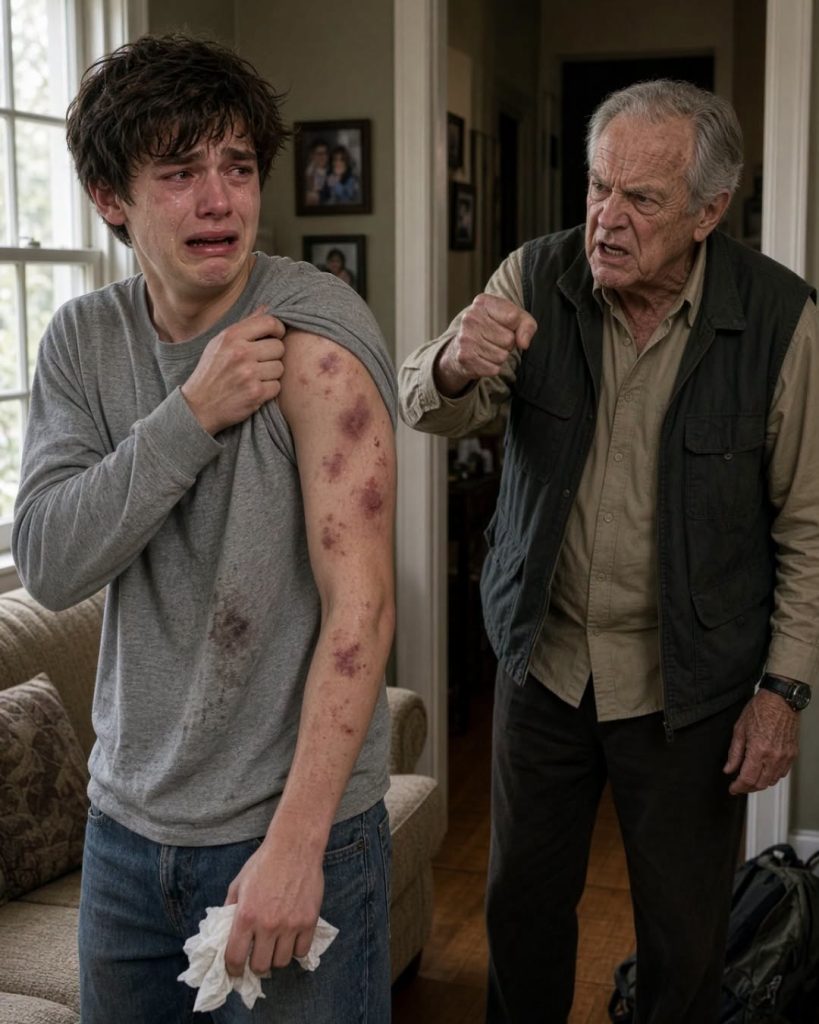
➡️ PART 3 ENDING PART ➡️
Dad stared at the sealed hospital document in Grandpa Elias’s hand.
“What did the doctor find?”
Grandpa did not answer immediately.
He looked at me.
That mattered.
Everyone else was looking at the bruises.
Grandpa was looking at me.
“Do you want me to tell him?”
he asked.
I swallowed.
“Yes.”
Only then did Grandpa turn toward my father.
“The doctor says some of these injuries are older than the ones you can see.”
Dad’s face changed.
“What does that mean?”
Grandpa opened the report.
“Different stages of healing.”
The police officer nearest the door became very still.
Grandpa continued.
“Bruising along her ribs.”
“Her shoulder.”
“Her upper arms.”
“A healing fracture in one rib.”
Dad whispered:
“A fracture?”
I looked at the floor.
Miranda immediately said:
“She fell off her bike.”
The officer turned toward her.
“Ma’am, I asked you not to interrupt.”
“But this is insane.”
Grandpa’s voice remained quiet.
“The doctor specifically wrote that the pattern is inconsistent with the bicycle fall she described.”
Miranda laughed.
Too loudly.
“Of course he did.”
Dad looked at me.
“When did you break a rib?”
I could not answer.
Not because I did not remember.
Because I remembered exactly.
The laundry room.
Three weeks earlier.
Miranda had been angry because I forgot to move her uniforms from the washing machine to the dryer.
She grabbed my arm.
I pulled away.
That made her angrier.
She shoved me.
My side struck the corner of the utility sink.
I couldn’t breathe for several seconds.
Miranda stood over me.
Then she crouched.
I remembered her face.
Not furious anymore.
Calm.
That was always worse.
“You slipped.”
she said.
I looked at Dad.
“The laundry room.”
His eyes filled.
“What happened?”
Miranda said:
“Daniel—”
Dad turned.
“Stop.”
One word.
Miranda froze.
I had never heard him speak to her that way.
Dad looked back at me.
“What happened in the laundry room?”
“She pushed me.”
His face crumpled.
“Why?”
I hated that question.
Not because Dad meant anything bad by it.
Because abused children spend too much time trying to find an answer.
Why?
Because I forgot laundry.
Because I talked back.
Because I spilled juice.
Because I closed my bedroom door.
Because I received a B.
Because I was too loud.
Because I was too quiet.
Because she had a headache.
Because Dad worked late.
Because Tuesday existed.
Eventually, you stop understanding that none of those things answer the question.
So I whispered:
“I forgot the dryer.”
Dad covered his mouth.
Grandpa said gently:
“No.”
I looked at him.
“You forgot the dryer.”
“That explains the laundry.”
“It does not explain why an adult put her hands on you.”
Something inside me loosened.
I had not known how badly I needed someone to separate those two things.
My mistake.
Her choice.
They were not the same event.
Miranda folded her arms.
“This is ridiculous.”
The officer looked at her.
“What’s ridiculous?”
“A teenager twisting discipline into abuse.”
I was thirteen.
She said teenager as if it made me six feet tall.
As if turning thirteen had somehow made my ribs less breakable.
Dad stared at her.
“Did you push her?”
“No.”
“You just heard her say you did.”
“She lies.”
Dad looked at me.
Then back at his wife.
“When has she lied?”
Miranda blinked.
“What?”
“You said she lies.”
“Give me an example.”
“Daniel, don’t do this.”
“An example.”
“She lies about school.”
I stared.
Dad frowned.
“When?”
“Grades.”
Dad looked at me.
I had never hidden a grade.
Miranda realized it.
“She lies about chores.”
“What did she lie about?”
“She said she cleaned the bathroom when she hadn’t.”
Dad shook his head slowly.
“That was six months ago.”
“Exactly.”
“She forgot the mirror.”
“Daniel—”
“That isn’t lying.”
Dad’s voice cracked.
“That is a thirteen-year-old cleaning a bathroom badly.”
Grandpa almost smiled.
I almost did too.
Miranda’s face hardened.
“You’re going to believe her over your wife?”
Dad looked at my arms.
I watched him see the bruises again.
Really see them.
“Yes.”
Miranda recoiled as though he had struck her.
The officer stepped forward.
“Mrs. Mercer, we’re going to need you to answer some questions.”
“I already told you what happened.”
“You told dispatch your father-in-law kidnapped a child from your home.”
“He did.”
Grandpa said:
“She packed her own backpack.”
“You removed a minor without parental authorization.”
“My son is her legal parent.”
“And he wasn’t there.”
“No.”
Grandpa nodded toward me.
“But she disclosed physical abuse.”
“I took her for medical treatment.”
“I contacted Daniel repeatedly.”
Dad pulled out his phone.
Fourteen missed calls.
He worked in a warehouse where personal phones remained in lockers during overnight shifts.
He had not seen them until break.
Miranda had known that.
She had gone to the police before he could call back.
Dad looked at her.
“You knew I couldn’t answer.”
“I panicked.”
“Why?”
“Because your father took our daughter.”
Our daughter.
I hated hearing her say that.
Grandpa noticed.
He stepped closer to me.
Not touching.
Just there.
The officer asked Miranda:
“Would you be willing to accompany us voluntarily while we clarify the situation?”
Her composure finally cracked.
“No.”
The officer nodded.
“Okay.”
Miranda looked toward Dad.
“Daniel.”
He said nothing.
“Tell them.”
“What?”
“That I’m her mother.”
“You’re her stepmother.”
Miranda stared.
“I raised her.”
My stomach twisted.
My mother died when I was seven.
Dad married Miranda when I was nine.
Four years.
Four years was long enough to know where I kept my socks.
Long enough to attend school conferences.
Long enough to learn exactly where to grab me so long sleeves would hide the marks.
But she was not my mother.
She had demanded that title without doing what the word required.
Dad whispered:
“Go with them.”
Miranda’s face went pale.
“You’re choosing her.”
I watched Dad.
His eyes filled.
“She is my child.”
There was something broken in his voice.
Something ashamed.
“I should’ve chosen her before I knew there was a choice.”
Nobody spoke.
The officer escorted Miranda toward the patrol car.
She did not go quietly.
Not anymore.
At the porch, she turned.
She pointed at me.
“This is your fault.”
I flinched.
Grandpa moved in front of me.
The officer immediately told Miranda:
“Keep walking.”
But the words had already landed.
This is your fault.
Those four words followed me for years.
Not because I believed them forever.
Because part of me had believed them long before she said them aloud.
Dad came toward me.
I stepped backward.
He stopped.
Pain crossed his face.
Good.
I don’t mean I wanted to hurt him.
I mean he needed to understand that being my father did not automatically make his touch safe after months of not noticing what was happening inside his own house.
“Can I hug you?”
he asked.
That question saved something.
Not everything.
Something.
I nodded.
Dad hugged me carefully.
The moment his arms closed around me, I broke.
“I’m sorry.”
he whispered.
I cried against his work jacket.
“I’m sorry.”
Again.
“I’m sorry.”
Again.
No excuses.
Not yet.
Just sorry.
Grandpa stood beside us.
The second officer waited.
Eventually Dad pulled away.
“Why didn’t you tell me?”
Grandpa said sharply:
“Daniel.”
Dad closed his eyes.
“Wrong question.”
“Yes.”
Dad nodded.
Then he looked at me.
“I’m sorry.”
He tried again.
“What made you feel like you couldn’t tell me?”
That was different.
I stared at him.
“You were never home.”
The truth hurt him.
He let it.
“I know.”
“She said you’d think I hated her.”
Dad cried.
“I wouldn’t.”
“She said you’d send me away.”
“I never would.”
“She said you were finally happy.”
That one destroyed him.
I watched my father physically fold.
His hands went to his knees.
He stared at the gravel.
“She said if I told you, I’d ruin your marriage.”
Dad whispered:
“Oh, sweetheart.”
I started crying again.
“I didn’t want you to be alone.”
He looked at me.
And for the first time, I saw my father understand the terrible bargain I had been trying to make.
My body for his happiness.
My silence for his marriage.
My fear for his peace.
He shook his head.
“No.”
His voice broke.
“You were never supposed to pay for my happiness.”
I cried.
Grandpa looked away.
Even the officer did.
Dad came closer but did not touch me.
“You hear me?”
I nodded.
“No.”
he said.
“Say it.”
“I wasn’t supposed to pay for your happiness.”
“Again.”
“I wasn’t supposed to pay for your happiness.”
He cried.
“Never.”
That became one of the sentences I carried for the rest of my life.
The police took statements.
Then more statements.
Child protective services became involved.
The words frightened me at first.
Miranda had spent months telling me that if anyone found out, “the state” would put me in foster care.
That was not what happened.
A caseworker named Angela Ruiz came to Grandpa’s house.
She wore flat shoes and carried a purple folder.
She did not talk to me like a baby.
She did not talk to me like a criminal.
She asked whether I felt safe with Grandpa.
“Yes.”
Whether I wanted Dad there.
I hesitated.
Dad saw it.
“I can leave the room.”
he said.
I nodded.
He left.
That mattered too.
Angela asked questions.
Not all at once.
Not all that day.
The investigation did not become a dramatic television montage where everyone immediately understood everything.
It was slow.
Painfully slow.
Doctors.
Photographs.
Interviews.
School records.
Neighbors.
Phone records.
Miranda’s employment records.
My father’s schedule.
The security recordings.
And then something none of us expected.
The school nurse had records.
Seven visits in four months.
Headache.
Stomach pain.
Shoulder pain.
“Fell down stairs.”
“Bike accident.”
“Ran into door.”
I had become creative.
Or so I thought.
The nurse had written a note after the fifth visit:
Student appears unusually anxious when discussing home. Recommend counselor follow-up.
The follow-up never happened.
Not because nobody cared.
Because paperwork got lost between departments.
That became hard for me later.
There had been clues.
So many clues.
But clues are not always conclusions.
My teachers saw a quiet girl.
My father saw a teenager becoming private.
The nurse saw accidents.
The neighbor heard occasional shouting.
Grandpa saw me mostly on weekends, usually in sweaters.
Miranda depended on everyone seeing only one piece.
Abuse survives in fragments.
Grandpa was the first person who accidentally saw enough pieces at once.
The bruises.
My face.
My fear when Miranda came upstairs.
Then he believed me.
Immediately.
That was the difference.
Dad moved into Grandpa’s house too.
I did not like that at first.
Grandpa asked me before allowing it.
“Do you want your father here?”
I didn’t know.
So Grandpa said:
“Then he can stay at a motel tonight.”
Dad stayed at a motel.
That sounds small.
It was enormous.
My father owned the house where I had been hurt.
He was Grandpa’s son.
And still, my uncertainty mattered.
Three nights later, I asked:
“Can Dad come here?”
Grandpa looked at me.
“You sure?”
“Yes.”
“Okay.”
Dad moved into the spare bedroom.
He did not ask when we were going home.
He knew.
I was not going back there.
Not then.
Maybe never.
He returned once with police supervision to collect clothes, documents, photographs, my mother’s jewelry, and my cat, Pepper.
When he brought Pepper into Grandpa’s house, I screamed.
Not from fear.
Joy.
I had thought Miranda would keep her.
Pepper ran straight toward me, furious about the entire experience.
I held her against my chest.
Dad cried.
Grandpa said:
“That cat has always hated me.”
Pepper hissed at him.
“See?”
For the first time in weeks, I laughed until my ribs hurt.
Then I stopped because my ribs actually hurt.
Healing is inconvenient that way.
Miranda was placed on administrative leave from the hospital where she worked.
Not because an accusation automatically proved guilt.
Because the nature of the allegations required review.
She hired an attorney.
Her attorney attacked the recordings.
Questioned the timing.
Suggested Grandpa had influenced me because he never liked her.
That part was true.
Grandpa had never liked Miranda.
But disliking someone does not manufacture bruises.
Her lawyer suggested I resented household discipline.
That I wanted to live with Grandpa because he was less strict.
That I had injured myself.
That one made me sick.
I stopped eating for two days after hearing it.
Grandpa found me sitting on the back steps.
“You hungry?”
“No.”
He sat beside me.
He had learned not to force conversation.
After several minutes, I said:
“What if they believe her?”
“Then we keep telling the truth.”
“What if truth isn’t enough?”
He looked at the yard.
“Sometimes it isn’t.”
That scared me.
Grandpa continued:
“But truth doesn’t become less true because somebody argues with it.”
I looked at him.
“Is she going to get away with it?”
“I don’t know.”
That was Grandpa.
He did not promise what he could not control.
He promised what he could.
“You won’t go back there.”
That he could control.
“You won’t face this alone.”
That too.
“And nobody gets to make you responsible for what happens to Miranda.”
I stared.
“What if she loses her job?”
“Her actions.”
“What if she goes to jail?”
“Her actions.”
“What if Dad divorces her?”
“His decision based on her actions.”
“What if everybody hates her?”
“Their feelings.”
Then Grandpa tapped my knee gently.
“None of those belong in your backpack.”
I cried.
For months, I imagined guilt as physical objects.
Miranda’s job.
Dad’s marriage.
Police.
Court.
Family gossip.
I pictured myself carrying them in the same backpack I had packed that first night.
Grandpa kept reminding me:
“Take that out.”
It became our phrase.
When I blamed myself:
“Out of the backpack.”
When I worried about Dad’s marriage:
“Out.”
When I wondered whether Miranda was crying:
“Not yours.”
When relatives called Dad asking whether the allegations were “really that serious”:
Grandpa became less philosophical.
He hung up.
Dad filed for divorce eleven days after the disclosure.
I found out accidentally.
He did not tell me beforehand because he did not want me believing the decision was mine.
When I asked why, he said:
“Because I cannot remain married to someone I believe hurt my child.”
“What if she didn’t?”
The question came from fear.
Dad looked at me.
“I believe you.”
“But what if court—”
“I didn’t say I believe a verdict.”
“I said I believe you.”
I cried.
Then asked:
“Do you hate me?”
Dad looked horrified.
“No.”
“For ruining—”
“Stop.”
He knelt in front of me.
“You did not ruin my marriage.”
“Miranda did.”
“And I failed to see what was happening.”
I shook my head.
“You worked.”
“Yes.”
“For us.”
“Yes.”
“You didn’t know.”
“No.”
Then Dad said something I did not expect.
“But not knowing does not mean I did everything right.”
I looked at him.
“I worked too much.”
“I dismissed things.”
“I remember you asking me last month if I could stay home one night.”
My throat tightened.
He remembered.
“I said we needed overtime because everything was expensive.”
“You said okay.”
“You always said okay.”
He cried.
“I treated your ability to cope as evidence that you were fine.”
That sentence stayed with me too.
Children who are quiet are not necessarily okay.
Children who get good grades are not necessarily okay.
Children who say “it’s fine” are sometimes trying desperately to make it fine by saying it.
Dad went to therapy.
That surprised Grandpa.
“Good.”
was all he said.
Dad learned not to make his guilt my responsibility.
At first, he apologized constantly.
Eventually my therapist, Dr. Maya Patel, helped me tell him:
“When you apologize every day, I feel like I have to tell you it’s okay every day.”
Dad went pale.
“I’m doing that?”
“Yes.”
“I’m sorry.”
We both stared at each other.
Then laughed.
He corrected himself.
“Right.”
He stopped.
Instead of apologizing repeatedly, he changed things.
That mattered more.
He moved to day shift.
Less money.
More time.
He attended school meetings.
Learned my friends’ names.
Cooked badly.
Very badly.
Grandpa once stared at Dad’s meatloaf and said:
“I survived Vietnam-era rail yards for this?”
Dad said:
“You weren’t in Vietnam.”
“I said rail yards.”
“That doesn’t make sense.”
“Neither does this meatloaf.”
I laughed.
Our house—Grandpa’s house—became noisy again.
Safe noise.
Pans.
Television.
Pepper knocking things over.
Grandpa yelling at baseball.
Dad arguing with him about thermostats.
I learned that not every raised voice meant danger.
That took longer than people think.
For months, if Dad dropped something in the kitchen, my body froze.
If Grandpa walked heavily down the hallway, my heart raced.
If someone knocked unexpectedly, I stopped breathing.
My body had learned rules my mind no longer needed.
Therapy helped.
Time helped.
Safety repeated helped most.
One safe night does not teach a frightened nervous system that danger is over.
A hundred safe nights begin to.
Then two hundred.
Then one day you realize someone closed a cabinet too hard and you did not flinch.
That day feels enormous.
Miranda’s case moved forward.
Investigators found more than my statements.
A former boyfriend came forward after seeing her name in a local report.
He described violent behavior.
Not proof of what she did to me.
But relevant context.
Then one of Miranda’s former coworkers contacted investigators.
She remembered Miranda asking unusually specific questions about how bruises of different ages appear clinically.
That chilled me.
Miranda was a nurse.
She knew bodies.
She knew healing.
She knew what could be hidden.
But the strongest evidence came from her own phone.
Messages.
Not confessions.
Nothing so simple.
Messages to a friend complaining about me.
Ungrateful little brat.
Daniel babies her.
Sometimes I wish she’d go live with the old man permanently.
Then one message:
Had to teach her a lesson tonight. Maybe she’ll remember this one longer.
The date matched the laundry-room injury.
When Dad read that, he went outside and threw up.
Grandpa followed.
I stayed inside.
That was not mine to carry.
Out of the backpack.
Miranda eventually accepted a plea agreement rather than take the case to trial.
The exact legal language mattered less to thirteen-year-old me than one thing:
She admitted in court that she had used unlawful physical force against me.
Not every incident.
Not everything.
Enough.
I attended sentencing because I wanted to.
Nobody forced me.
The judge asked whether I wanted to provide a statement.
I did.
My hands shook.
Grandpa sat behind me.
Dad beside him.
Miranda sat at another table.
For the first time since I had known her, she could not interrupt me.
I unfolded my paper.
“My name is Lily Mercer.”
My voice shook.
I stopped.
Breathed.
Started again.
“My name is Lily Mercer.”
Better.
“I used to think the worst thing Miranda did was hurt me.”
I looked down.
“But I think the worst thing was teaching me to help her hide it.”
The courtroom became silent.
“She made me think every bruise was something I had caused.”
“If I forgot something, the bruise was because I forgot.”
“If I talked back, it was because I talked back.”
“If I cried, it was because I was dramatic.”
“If I told someone, anything that happened afterward would be my fault.”
I looked at Miranda.
She stared at the table.
“I believed her.”
“For a while.”
“Then my grandfather saw me.”
“He did not ask what I did to make her angry.”
“He asked whether my father knew.”
“When I told him no, he didn’t tell me to be more obedient.”
“He told me to pack.”
I began crying.
“He made space for me before I knew I was allowed to need space.”
Grandpa wiped his eyes.
I continued.
“I don’t know what punishment will make this fair.”
“I don’t think there is one.”
“I just want to stop being responsible for her choices.”
“So whatever happens today, I am leaving it here.”
I folded the statement.
“My grandfather says it doesn’t belong in my backpack.”
The judge looked down for several seconds before speaking.
Miranda received a sentence that included incarceration, probation after release, mandatory treatment, and restrictions on contact with me.
Her nursing license entered a separate professional disciplinary process.
I did not celebrate.
That surprised some relatives.
They expected relief.
Victory.
I mostly felt tired.
On the courthouse steps, a reporter tried asking how I felt.
Grandpa stepped between us.
“No.”
The reporter said:
“Sir, we’re just—”
“She said what she wanted to say inside.”
Then Grandpa took me for pancakes.
It was two in the afternoon.
I ordered chocolate chip.
Dad ordered blueberry.
Grandpa ordered eggs and complained that pancakes were “dessert pretending to be breakfast.”
He ate half of mine.
That was the day the legal case ended for me.
Not because every consequence was complete.
Because I decided I was done organizing my life around Miranda.
High school came.
Then driver’s education.
Prom.
College applications.
Normal problems.
Beautiful normal problems.
I failed my first driving test because I hit a cone.
I came home devastated.
Grandpa stared at me.
“Did the cone survive?”
“Yes.”
“Then we’ll rebuild.”
“It was plastic.”
“Even better.”
I passed the second time.
Dad bought me a used Honda.
Grandpa inspected it like NASA had asked him to approve a spacecraft.
He distrusted the brakes.
The tires.
The salesman.
The radio.
Possibly Honda as a concept.
When I drove away alone for the first time, he stood in the driveway pretending not to be emotional.
I rolled down the window.
“Grandpa?”
“What?”
“Hallway light.”
He understood.
Every night during my first months at his house, he had left that light on.
Eventually I asked him to stop.
I didn’t need it anymore.
Now he smiled.
“Drive safe, kid.”
College took me three hours away.
Dad worried.
Grandpa pretended not to.
The night before I left, I found him in the kitchen.
Yellow light.
Same color as the night he first saw the bruises.
He was making coffee even though it was ten p.m.
“You know that ruins sleep.”
“At my age, sleep and I have an arrangement.”
I sat.
“I’m scared.”
“Good.”
I frowned.
“Good?”
“Means you’re doing something new.”
“What if I hate it?”
“Come home.”
“What if I fail?”
“Come home.”
“What if I love it and don’t want to come home?”
Grandpa smiled.
“Then I’ll complain about you to everyone at the diner.”
I laughed.
Then cried.
“Thank you.”
“For what?”
“You know.”
“No.”
“Grandpa.”
He sat across from me.
“Don’t turn one decent decision into sainthood.”
I stared.
“You saved me.”
“No.”
“You told me to pack.”
“Yes.”
“You took me to the doctor.”
“Yes.”
“You stood up to Miranda.”
“Yes.”
He leaned closer.
“But you told.”
I became quiet.
“You told me.”
“That was the first brave thing.”
“All I did was believe you and act like an adult.”
I cried.
“That shouldn’t make me a hero.”
“It should make me your grandfather.”
I never forgot that.
College was where I first told a friend the whole story.
Her name was Hannah.
She did not say:
“Why didn’t you tell sooner?”
She said:
“I’m glad you got out.”
Four words.
Perfect.
I studied social work.
Everyone assumed it was because of what happened.
Partly.
Not entirely.
I liked people.
I liked systems.
I hated the spaces where people fell between systems.
The school nurse note that never became a counselor meeting stayed with me.
Not as blame.
As a question.
How do we make sure one clue reaches another clue?
How do we help adults notice patterns without treating every bruise as proof?
How do we make children feel safe enough to speak?
How do we protect without taking over?
Grandpa loved that I studied social work.
He told strangers I was becoming “some kind of professional busybody.”
Dad corrected him.
Grandpa ignored Dad.
Miranda was released while I was in college.
I learned through the proper notification process.
My hands shook when I read the letter.
For one night, I became thirteen again.
I checked locks.
Windows.
Under the bed.
Then called Grandpa.
He answered:
“What’s wrong?”
“How do you know something’s wrong?”
“You called after nine.”
I told him.
Silence.
Then:
“Want me to come?”
I almost said yes.
Instead:
“No.”
“You sure?”
“Yes.”
“What do you want?”
I looked around my apartment.
My apartment.
My lock.
My roommate asleep down the hall.
“I want to stay here.”
“Okay.”
“I’m scared.”
“Okay.”
“You’re not going to tell me not to be?”
“No.”
“Why?”
“Because you are.”
He paused.
“Being safe doesn’t always make fear disappear on schedule.”
I smiled through tears.
“What should I do?”
“Whatever your therapist taught you.”
“That’s annoyingly healthy.”
“I’ve been reading.”
I laughed.
I stayed.
The fear passed.
Miranda never contacted me.
Years later, she sent one letter through an attorney.
I was thirty-one.
Married.
Pregnant with my first child.
The timing felt almost cruel.
I did not open it immediately.
I put it in a drawer.
Three weeks later, I brought it to therapy.
Then opened it.
Miranda apologized.
Not perfectly.
There were sentences I disliked.
She wrote about her own childhood.
Her mother’s violence.
Her father’s drinking.
Her fear of abandonment.
Her jealousy of my relationship with Dad.
Her belief that I represented a part of Daniel’s life she could never fully own.
I hated that word.
Own.
But it was honest.
Then came the sentence that mattered.
None of those things made me hurt you. I hurt you because I chose to put my anger into someone smaller than me, and I used my profession and your father’s absence to make you afraid no one would believe you.
I stopped reading.
Cried.
Then continued.
You do not owe me forgiveness, a response, or proof that you are doing well. I hope you are safe.
I did not respond.
Not because I hated her.
Because I did not need to.
People sometimes confuse closure with communication.
Sometimes closure is simply reading the last page and putting the book down.
I put the letter back in its envelope.
Kept it for a year.
Then destroyed it.
Not dramatically.
Paper shredder.
Tuesday afternoon.
I went grocery shopping afterward.
Healing can be wonderfully boring.
I married a man named Caleb.
Grandpa interrogated him.
Not literally.
Almost.
The first time Caleb met him, Grandpa asked:
“What do you do when you’re angry?”
Caleb looked confused.
“Sir?”
“Angry.”
“What do you do?”
Caleb thought.
“Usually go quiet until I know what I’m actually angry about.”
Grandpa nodded.
“What if Lily makes you angry?”
Caleb looked at me.
Then Grandpa.
“She’s allowed to.”
Grandpa stared.
Caleb continued.
“Being angry doesn’t give me permission to scare her.”
Grandpa leaned back.
“Fine.”
Later Caleb whispered:
“Did I pass?”
“No idea.”
Grandpa appeared behind him.
“Barely.”
He loved Caleb.
Eventually.
Our wedding was small.
Dad walked me halfway down the aisle.
Then stopped.
People looked confused.
Dad kissed my forehead.
“You walk the rest.”
I smiled.
That had been my idea.
Not because Dad had not earned the whole walk.
Because I wanted the symbolism.
He brought me partway.
Then I chose the final steps.
Caleb did not “take” me.
Nobody gave me away.
We met.
At the center.
Grandpa cried louder than anyone.
He denied it.
There is video.
Our daughter was born two years later.
We named her Nora.
When the nurse placed her on my chest, I stared at her tiny body.
Perfect.
Helpless.
I felt joy.
Then fear.
A terrible thought:
What if I become Miranda?
Trauma is cruel like that.
It can make you fear becoming the person who hurt you.
I told Caleb.
Immediately.
He did not laugh.
Did not say:
“That’s ridiculous.”
He said:
“Then we’ll pay attention.”
“We?”
“Yes.”
“You don’t have to parent alone.”
That sentence healed something.
Parenting triggered memories.
Nora screamed during diaper changes.
Normal.
But once, when she was three, I grabbed her wrist too quickly as she ran toward the street.
She cried.
I froze.
My hand opened immediately.
For ten seconds, I was thirteen.
Purple bruises.
Laundry room.
Miranda.
Then Caleb touched my shoulder.
“She was running into traffic.”
“I grabbed her.”
“Yes.”
“Too hard.”
“Maybe.”
“I’m like her.”
“No.”
“How do you know?”
“Because you’re worried about whether you hurt her instead of explaining why she deserved it.”
I cried.
Later, I apologized to Nora.
Not dramatically.
“Mommy grabbed you hard because I was scared you’d run into the road.”
“Did it hurt?”
“A little.”
“I’m sorry.”
“Are you mad?”
“I was scared.”
“You still cannot run into the street.”
She nodded.
Then asked for crackers.
Children are mercifully practical.
I learned something.
Breaking cycles does not mean becoming a parent who never gets angry.
Never raises her voice.
Never makes mistakes.
That is impossible.
Breaking cycles means refusing to make your emotions someone else’s punishment.
Repairing when you fail.
Listening when your child says something hurt.
Allowing them to disagree without treating disagreement as betrayal.
Nora never feared my footsteps.
That became enough.
Dad became Grandpa Daniel.
He adored Nora.
Grandpa Elias became Great-Grandpa.
Nora called him Grandpa Elias anyway because “great” sounded too formal.
He pretended to object.
At eighty-three, Grandpa taught her to plant tomatoes.
At eighty-four, how to cheat at cards.
I accused him.
He said:
“Strategy.”
At eighty-five, he became slower.
The man who once climbed my staircase with me behind him began using a cane.
I hated the cane.
Not rationally.
It reminded me that time was coming for him.
One evening, I found him sitting beneath the yellow kitchen light.
Same kitchen.
Same house.
He still lived there.
I sat beside him.
“You okay?”
“Old.”
“That’s not a medical diagnosis.”
“At my age, it covers most things.”
I laughed.
Then noticed a folder.
“What is that?”
“My paperwork.”
“What paperwork?”
“Will.”
“Grandpa.”
“What?”
“I don’t want to talk about this.”
“Too bad.”
He slid it toward me.
“House goes to your father.”
“Fine.”
“Workshop tools split between Daniel and Caleb.”
“Caleb?”
“He puts them away.”
Fair.
“Railroad watch goes to you.”
My throat tightened.
“Why?”
“Because I said so.”
“Grandpa.”
He looked at me.
“And the hallway lamp.”
I stared.
“The ugly one?”
“It is not ugly.”
“It is extremely ugly.”
The lamp had a brass base and a yellow shade from approximately 1974.
“You’re getting it.”
“Why?”
“You know why.”
I did.
The hallway light.
The first safe night.
I cried.
“That’s cruel.”
“What?”
“Making me inherit emotional symbolism and ugly furniture.”
He smiled.
“My final revenge.”
Grandpa lived to eighty-eight.
Cancer.
Lung.
He had quit smoking thirty years earlier.
Life does not always reward us on schedule.
His final months were hard.
Dad cared for him.
So did I.
Caleb.
Nora.
Hospice helped.
One evening, Grandpa became restless.
I sat beside him.
He opened his eyes.
“Lily?”
“I’m here.”
“Hallway light.”
My chest broke.
“It’s on.”
“Good.”
“It hasn’t been on in years.”
“I turned it on.”
He smiled.
“Waste of electricity.”
I laughed and cried.
Then he whispered:
“Backpack.”
“What?”
“Still carrying anything?”
I knew.
I thought about Miranda.
Dad.
The court.
My childhood.
All the things I had once believed belonged to me.
“No.”
I said.
Then corrected myself.
“Some things.”
Grandpa nodded.
“Everybody does.”
“I thought you’d tell me to take them out.”
“No.”
“Why?”
“Some things are yours.”
He struggled for breath.
“Memories.”
“Love.”
“Lessons.”
He squeezed my fingers.
“Just don’t carry other people’s guilt.”
I cried.
“Okay.”
“Promise?”
“I promise.”
He closed his eyes.
Then opened them again.
“You told.”
I nodded.
“You believed me.”
His eyes filled.
“Always.”
Grandpa died the following morning.
Dad on one side.
Me on the other.
Nora asleep on the couch.
The hallway light still on.
At his funeral, half the old rail yard seemed to appear.
Men and women I had never met told stories.
Elias fixing engines.
Elias fighting with supervisors.
Elias bringing extra sandwiches.
Elias lending money and pretending he forgot.
Elias swearing at broken machinery.
Elias refusing promotions because he hated paperwork.
That made me laugh.
Afterward, I spoke.
“My grandfather once told me he was not a hero.”
“He said he had simply behaved like a grandfather.”
I paused.
“I disagreed with him for years.”
“Now I think I understand.”
“Maybe heroism is sometimes exactly that.”
“Not extraordinary strength.”
“Not revenge.”
“Not dramatic speeches.”
“Sometimes it is an adult doing the ordinary thing a child desperately needs.”
“Believing them.”
“Making space.”
“Turning on a hallway light.”
“Saying: Pack your things.”
“Saying: You can stay here.”
“Saying: I believe you.”
My voice broke.
“My grandfather did not save me by fighting Miranda.”
“He never touched her.”
“He never threatened her.”
“He played her game by his rules.”
“His rules were evidence.”
“Doctors.”
“Police.”
“Patience.”
“Truth.”
“And above all, giving me choices when someone else had spent months taking choices away.”
I looked toward Dad.
“He taught all of us that protection is not control.”
“Protection creates safety.”
“Then it lets the person inside that safety breathe.”
I sat down.
Dad held my hand.
After Grandpa died, I took the hallway lamp home.
Caleb hated it.
Correctly.
Nora loved it.
Incorrectly.
We placed it in our hallway.
Years later, when Nora was fifteen, she brought home a friend named Sophie.
Sophie stayed for dinner.
Then another dinner.
Then began appearing almost every weekend.
I noticed things.
Long sleeves in warm weather.
Jumpiness.
An unusual reluctance to go home.
My stomach tightened.
But I remembered my professional training.
And Grandpa.
Clues are not conclusions.
So I did not interrogate her.
I created space.
One evening, Sophie asked:
“Mrs. Mercer?”
“Yes?”
“Can I stay tonight?”
I looked at her.
“Does your mother know you’re here?”
“She doesn’t care.”
Something in her voice.
I sat.
“You can stay while we figure out what you need.”
Her eyes filled.
Not:
Of course, move in forever.
Not:
Tell me everything right now.
Safety first.
Questions carefully.
We contacted the appropriate adults.
Her situation was different from mine.
No stepmother hitting her.
Her mother had severe untreated depression and sometimes disappeared for days, leaving Sophie without food.
Different danger.
Same need to be noticed.
Sophie eventually went to live with an aunt while her mother received treatment.
Years later, she told me:
“You were the first adult who didn’t make me prove I was suffering enough before helping.”
I thought of Grandpa.
Of course.
The inheritance was never the lamp.
It was the response.
I became a child welfare policy specialist.
Not a caseworker forever.
Eventually I worked at the state level.
Then nationally.
I helped develop protocols encouraging schools, clinics, and social-service agencies to recognize patterns across repeated minor concerns.
Not because every bruise means abuse.
It doesn’t.
Not because every quiet child is hiding something.
They aren’t.
But information trapped in separate rooms cannot protect anyone.
The nurse’s note from my childhood stayed in my office.
A copy.
No identifying information except mine.
It reminded me:
Someone noticed.
The system failed to connect the noticing.
We could do better.
Dad grew old.
Our relationship became good.
Not perfect.
Good.
There is a difference.
For years, I carried some anger toward him.
He accepted it.
When I was thirty-eight, I finally said:
“I’m still angry you didn’t notice.”
Dad nodded.
“I know.”
“I feel guilty saying that.”
“Don’t.”
“You were working.”
“Yes.”
“You trusted your wife.”
“Yes.”
“You didn’t know.”
“No.”
“Then why am I angry?”
Dad looked at me.
“Because you were a child and needed me.”
I cried.
He did not defend himself.
That allowed the anger to move.
Defended wounds stay open longer.
Acknowledged ones can scar.
Dad remarried when I was forty.
Her name was Anne.
He dated her for three years before proposing.
The first time he told me, he looked terrified.
“You don’t need my permission.”
“I know.”
“But?”
“I need to know how you feel.”
I thought.
“I like her.”
He exhaled.
“But I need something.”
“Anything.”
“If I ever tell you something feels wrong, don’t dismiss it because you love her.”
Dad’s eyes filled.
“Never again.”
Anne was wonderful.
Not because she replaced anyone.
Not because every story needs a good stepmother to balance a bad one.
She was simply Anne.
She liked gardening.
Hated horror movies.
Made excellent lasagna.
She never asked me to call her Mom.
That mattered.
Nora called her Grandma Anne.
Dad was happy.
I learned his happiness no longer frightened me.
Because I finally understood it was not my job to protect it.
Miranda died when I was fifty-six.
I learned through an attorney.
She had never contacted me again.
She left me something.
A box.
I almost refused it.
Then curiosity won.
Inside were no valuables.
Photographs.
A few letters.
And the blue robe she had worn the morning she arrived at Grandpa’s house with police.
I stared at it.
Why would she keep that?
There was a note.
I kept this because it was what I wore on the morning I finally lost control of the story. I once thought that was the worst day of my life. Later I understood it was the first day I could no longer hide from what I had become. You owe this object nothing. Throw it away. Burn it. I am sorry.
I did not burn it.
Fire felt too ceremonial.
I threw it in the trash.
Then took Nora to lunch.
That was enough.
At sixty-four, I retired.
Caleb and I traveled.
Grand Canyon.
Ireland.
Italy.
Grandpa had always wanted to see Italy.
I carried his railroad watch in my suitcase.
Not because I believed he could see.
Because I wanted him there.
In Florence, Caleb asked:
“What would Elias say?”
I looked at a cathedral older than our country.
“He’d complain about the stairs.”
Correct.
We laughed.
Caleb died before me.
Seventy-nine.
Pancreatic cancer.
Fast.
Cruel.
He spent his final months at home.
One evening, I became angry.
Not at him.
At everything.
I slammed a cabinet.
Then froze.
Old fear.
Old association.
Caleb looked at me from his chair.
“You’re allowed to be angry.”
I cried.
“I know.”
“Do you?”
I laughed.
“Apparently still learning.”
He held out his hand.
I took it.
Some lessons take a lifetime because life keeps giving them new shapes.
After Caleb died, Nora asked me to live with her.
I said no.
Then yes three years later.
Not because I could not live alone.
Because I wanted company.
That distinction mattered to me.
I brought the ugly hallway lamp.
Nora cheered.
Her husband groaned.
Tradition.
At eighty-six, my granddaughter asked about it.
“Why do we keep this thing?”
I smiled.
“Because when I was thirteen, I slept on your great-great-grandfather’s couch after a very bad night.”
“He left the light on.”
“Were you scared of the dark?”
“No.”
“What were you scared of?”
I thought carefully.
“Someone coming through the door.”
She became quiet.
“Did they?”
“No.”
“Because of the light?”
“No.”
“Then why does it matter?”
I touched the shade.
“Because the light told me somebody was awake enough to notice.”
She frowned.
“That’s weird.”
“It is.”
“Can we buy a prettier lamp?”
“No.”
Family history has limits.
At ninety-one, I wrote down the whole story.
Not for publication.
For family.
I did not want Miranda to become a monster in family mythology.
That may sound strange.
But monsters are dangerous because they allow ordinary people to believe cruelty belongs to some different species.
Miranda was a person.
A nurse.
A wife.
A woman who could be funny.
A woman who made good soup.
A woman who had been hurt in childhood.
A woman who then chose to hurt a child.
All of those things were true.
Her humanity did not excuse her.
It made the lesson more important.
People who hurt children do not always look frightening.
Sometimes they pour coffee for your grandfather.
Sometimes they work in hospitals.
Sometimes they smile when police arrive.
That is why children need adults who listen to content instead of judging credibility by charm.
I wrote about Dad too.
Not as a useless father.
Not as a perfect redeemed one.
A man who missed what he should have seen.
Then, once he saw it, refused to look away.
That distinction mattered.
I wrote about Grandpa most.
His yellow kitchen light.
His fists tightening.
His decision not to use those fists.
People who heard the story sometimes imagined Grandpa beating Miranda.
He never did.
That would have made the story worse.
He was angry enough.
But his promise—
We’ll play her game, but by my rules.
—never meant violence.
His rules were:
Get me safe.
Get medical documentation.
Preserve evidence.
Call Dad.
Tell the truth.
Let police hear me.
Do not let Miranda isolate me again.
He beat her game by refusing to play the part she expected.
She expected an angry old man.
She got a witness.
That was much more dangerous to her lies.
At ninety-three, I became ill.
Heart failure.
Slow enough to prepare.
Fast enough not to become bored with dying.
Nora sat beside me.
The hallway lamp glowed outside the bedroom.
Of course.
I could see yellow light beneath the door.
“Mom?”
“Yes?”
“Are you scared?”
“A little.”
She held my hand.
“Want the door open?”
I smiled.
“Yes.”
She opened it wider.
The light reached across the floor.
For a moment, I was thirteen.
Grandpa’s couch.
Cedar quilt.
Water beside me.
Pepper not yet there.
The house quiet.
My ribs aching.
And that yellow light.
The first night I slept without listening for footsteps.
I whispered:
“Grandpa.”
Nora leaned closer.
“What?”
“Nothing.”
Then I laughed softly.
“He really was right.”
“About what?”
“The backpack.”
Nora knew the story.
She squeezed my hand.
“What did you keep?”
I thought.
Not Miranda’s guilt.
Not Dad’s marriage.
Not the court sentence.
Not the relatives’ opinions.
Not the nurse’s missed follow-up.
Not the years I spent afraid.
What remained?
“Grandpa.”
I said.
“Dad.”
“Your father.”
“You.”
“Good things.”
Nora cried.
“Those fit?”
I smiled.
“Barely.”
My final night, my family gathered.
Grandchildren.
Great-grandchildren.
Anne had died years earlier.
Dad too.
Caleb gone.
So many chairs filled by younger faces.
That’s the bargain of living long.
You lose people.
Then discover they left pieces of love inside people they never met.
My great-grandson Elias sat on the floor.
Yes.
They named him Elias.
I had protested.
Weakly.
He looked at the hallway.
“Why is that ugly lamp on?”
Everyone laughed.
I laughed hardest.
Nora said:
“Family tradition.”
He shrugged.
Children accept strange things when adults say tradition.
Later, when the room quieted, Nora leaned close.
“You can sleep, Mom.”
I looked toward the doorway.
Yellow light.
“Leave it on.”
“Always.”
I closed my eyes.
This time, I was not listening for footsteps.
I was remembering one pair.
Heavy work boots.
Grandpa walking down the hallway.
Not toward me to hurt me.
Toward the kitchen to make coffee.
Toward the front door to check the lock.
Toward my room to make sure I was still sleeping.
Footsteps can mean different things.
That may sound small.
It was not small to me.
I died before morning.
Nora found my final letter inside the drawer beneath the railroad watch.
She read it at my memorial.
To my family,
When I was thirteen, someone hurt me repeatedly and convinced me that telling the truth would destroy everything I loved.
I believed her because children often believe adults when adults speak with certainty.
Then my grandfather saw my bruises.
He did not ask what I had done.
He did not tell me to keep the peace.
He did not ask whether I was sure enough to deserve protection.
He said: Pack your things.
Those words changed my life.
But if you remember this story, please remember what came afterward too.
Grandpa did not teach me revenge.
He taught me evidence.
Dad did not ask me to forgive his absence from the truth.
He learned to become present.
Caleb did not promise never to make mistakes.
He taught me what repair looked like.
And Nora taught me that becoming a mother after being hurt did not mean I was destined to repeat what had been done to me.
If a child tells you something frightening, listen.
Do not begin with why.
Do not begin with doubt.
Do not begin with what this accusation might cost the adults.
Begin with safety.
Then facts.
Then appropriate help.
And remember that believing a child does not mean abandoning fairness or evidence. It means taking the disclosure seriously enough to protect them while the truth is carefully established.
Nora paused.
Then continued.
If someone you love has been hurt, do not make them carry your rage too.
Grandpa was furious.
I saw his fists.
But he never made me responsible for calming him.
He turned his anger into action.
Safe action.
Useful action.
That is one reason I trusted him.
And if you are the person being hurt, there is something I wish I could tell the thirteen-year-old version of myself:
The consequences of telling are not the same as the consequences of what was done to you.
If the truth ends a marriage, the truth did not destroy the marriage.
If the truth costs someone a job, the truth did not make them behave in a way that threatened that job.
If the truth changes how people see someone, the truth did not create the actions they are finally seeing.
Other people’s choices do not belong in your backpack.
People cried.
Nora smiled through hers.
One more thing.
Please keep Grandpa’s lamp.
A collective groan went through the room.
Even Nora laughed.
Yes, I know it is ugly.
No, you may not replace the shade.
Some family heirlooms are valuable because they are beautiful.
Ours is valuable because one night, a frightened child woke at three in the morning, saw yellow light beneath the hallway door, and understood that someone was still awake nearby.
For the first time in months, she went back to sleep.
That light meant:
You are not alone.
Someone knows.
Someone believes you.
You can rest now.
Keep the light on for anyone who needs it.
Love, Lily.
Years later, the lamp stood in Nora’s hallway.
Then her daughter’s.
Then Elias’s.
The shade became even uglier with age.
Nobody replaced it.
Children grew beneath its light.
Most never needed it for the reason I had.
Good.
That was the whole point.
One night, decades after my death, a frightened teenager who was a friend of the family stayed over after disclosing something painful happening at home.
The adults contacted the right people.
Made sure she was safe.
Did not interrogate her.
Did not promise outcomes they could not control.
That night, she slept in the guest room.
The hallway lamp remained on.
She later asked:
“Why do you leave that ugly thing burning all night?”
My great-grandson Elias smiled.
“Family rule.”
“What rule?”
He looked at the yellow light.
Then answered with words passed down through generations:
“So nobody has to wonder whether someone is awake enough to notice.”
That was Grandpa’s real victory.
Not Miranda’s sentence.
Not the divorce.
Not the recordings.
Not the police arriving and discovering her story was false.
His victory was that one act of belief outlived all of us.
A frightened thirteen-year-old told the truth.
An old man listened.
A father learned.
A family changed.
Children who had not yet been born grew up knowing that love did not require silence.
And somewhere in an ordinary hallway, beneath an objectively terrible yellow lampshade, the light stayed on.
Not because danger was expected.
Because safety had become a tradition.
THE END STORIES! THANK YOU FOR READING GOOD LUCK !❤️
Related Posts