➡️ PART 3 ENDING PART➡️
Margaret, if my children are suddenly kind to you after I’m gone, do not trust them. One of them knows exactly why my first wife really died.
I read the sentence three times.
Then a fourth.
The words did not become easier.
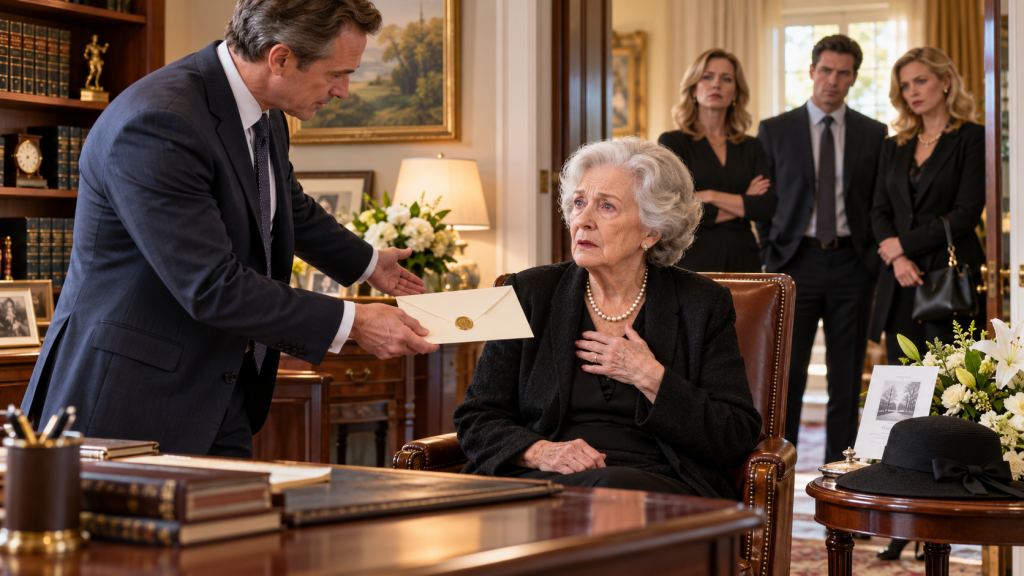
Mr. Bennett sat across from me in the little private lounge at the nursing home with his leather briefcase resting against his shoe.
Outside the window, rain ran slowly down the glass.
Arthur had hated rainy afternoons.
He always said they made everyone in the building look as though they had already been turned into memories.
A week earlier, he had been sitting beside me.
Now his side of the room was empty.
His jazz records were stacked in a cardboard box.
His reading glasses still rested on the table beside our bed because I had not been able to move them.
And in my hands was a letter telling me the man I had loved had carried a secret even heavier than the illness that killed him.
I looked at Mr. Bennett.
“What does this mean?”
He lowered his eyes.
“Keep reading.”
“I’m asking you.”
“I know.”
“Did you know?”
A pause.
“Yes.”
My fingers tightened around Arthur’s letter.
“For how long?”
“About three years.”
Longer than Arthur and I had been married.
Before the chess games.
Before the courtyard.
Before he took my hand and asked me to become his wife.
Before I knew anything about his children except their names.
I felt something sharp move through me.
“Then why am I only learning now?”
Mr. Bennett answered carefully.
“Because Arthur asked me not to tell you while he was alive.”
“Why?”
“He said you had already given him companionship without asking what he owned.”
“He did not want the darkest part of his family history becoming the foundation of your marriage.”
I looked back at the letter.
Arthur’s handwriting was shakier near the bottom.
I recognized the way his fingers had trembled during the last year.
He had still insisted on writing birthday cards by hand.
Still filled out his own chess scores.
Still signed every document slowly and angrily whenever one of his children implied his mind had become weak simply because his body had.
I kept reading.
My dearest Margaret,
If Bennett has given you this letter, then I am gone, and you have already done more for me than I ever had the right to expect from another human being.
My eyes blurred.
I stopped.
Mr. Bennett reached toward the box of tissues.
I shook my head.
“I’m not crying yet.”
I was.
He wisely said nothing.
I continued.
You sat beside me when I could no longer finish a page without falling asleep. You listened to Coltrane with me even though I know you secretly prefer Ella Fitzgerald. You beat me at chess more often than you admit. You held my hand when my children brought papers instead of conversation. Most importantly, you never once looked at me as though I were an account waiting to close.
I covered my mouth.
Arthur.
Still teasing me about chess from the grave.
Still noticing everything.
Then the letter changed.
There is something I did not tell you because I wanted you to be able to love me without inheriting my anger too early. Eleanor did not die in the way I was told she died.
Eleanor.
Arthur’s first wife.
Forty-eight years of marriage.
The woman whose photograph remained on his dresser even after we married.
I had never resented her.
How could I?
I met Arthur after she had already become part of his memory.
He told me about their first apartment.
Her terrible driving.
Her peach pie.
The way she could not keep a houseplant alive but insisted on buying new ones every spring.
He never spoke of her death in detail.
Only once.
“Heart trouble,” he said.
“Then an infection.”
“She went quickly.”
At the time, I thought the shortness of the explanation meant pain.
Now I understood it meant uncertainty.
I kept reading.
Eleanor developed pneumonia after a minor procedure. She had been weak, but she was not dying. She had clearly stated that she wanted treatment if anything reversible happened. I believed she was transferred to hospice because her doctors told me treatment had failed. I later learned that was not true.
My heart began to pound.
Our oldest son, Charles, had obtained a copy of a medical power-of-attorney that Eleanor had revoked years earlier. He used it to tell the private care facility not to transfer her back to the hospital when her oxygen levels fell and fever returned. He told staff that she wanted comfort measures only. She did not.
I stopped.
My hands were shaking so badly that the paper crackled.
“No.”
Mr. Bennett closed his eyes.
“Margaret—”
“No.”
The word came out harder.
“Arthur told me Eleanor died peacefully.”
“He believed that for several years.”
I looked at the letter again.
By the time I learned the truth, Charles had already convinced himself that he had merely prevented suffering. But the records showed another reason he was in such a hurry. A family trust Eleanor established for the children released a substantial distribution upon her death. Charles had debts I did not know about.
I felt sick.
Diane knew he had overridden Eleanor’s instructions. She says she did not know he used an invalid document. I do not know whether I believe her. Peter claims he knew nothing. On this point, I believe Peter.
Three children.
Charles.
Diane.
Peter.
All of them had stood at Arthur’s funeral.
Charles in a charcoal suit, accepting condolences as though he were chief executive of grief.
Diane wearing pearls that had belonged to Eleanor.
Peter farther back, quiet, barely speaking.
I remembered thinking Peter looked devastated.
I had mistaken Charles’s composure for strength.
Arthur’s letter continued.
When I confronted Charles, he told me I was rewriting Eleanor’s last days because I could not accept losing her. I nearly believed him. Then Bennett found the nursing notes. Eleanor repeatedly asked to be taken to the hospital. One note records her saying, “Arthur would want them to treat this.” That sentence has lived in my head ever since.
I pressed the paper against my chest.
Arthur had carried that.
No wonder he was terrified when his children began arriving with attorneys.
No wonder he reacted so violently the first time Charles suggested he sign a broad medical power-of-attorney.
I had been there.
Arthur had thrown the document on the floor.
“Get out.”
Charles stared at him.
“Dad, you’re being ridiculous.”
“I said get out.”
“Somebody needs authority if you decline.”
“I have authority.”
“You’re eighty-two.”
Arthur’s face had changed.
Not anger.
Fear.
I thought it was fear of losing control.
It was.
I just had not understood why.
I continued reading.
Margaret, I did not marry you because I needed a weapon against my children. I married you because I loved you. But I would be lying if I said I did not also feel safer knowing the law recognized you as family. I wanted the person beside my bed to be someone who would ask what I wanted before asking what would be easiest.
I had to stop again.
For months after Arthur proposed, I worried about what people thought.
The whispers.
The glances.
A poor woman from the state-funded wing suddenly marrying the richest resident in the building.
Even some staff had looked at me differently.
Arthur once found me crying in the bathroom after a visitor called me “clever.”
He sat beside me and said:
“Margaret, anybody who thinks you married me for my money has clearly never watched you refuse to let me buy you a better cardigan.”
I hit him with a towel.
He laughed until he coughed.
Now I understood another part of his relief.
Marriage gave me more than his room.
It gave him somebody he trusted to speak if he could not.
Arthur’s letter continued.
After Eleanor died, I failed her twice. First because I did not know what Charles had done. Second because when I learned, I wanted so badly to keep my family intact that I waited too long to confront it. By then, records had disappeared, memories had blurred, and Charles had built a story everyone found easier to believe.
Do not repeat my mistake with me.
I swallowed.
Bennett has everything.
I looked up.
Mr. Bennett placed his hand on the leather briefcase.
“Everything?”
“Everything Arthur was able to preserve.”
“What does that include?”
He opened the case.
Inside were five thick folders.
Not one.
Five.
Arthur had planned this carefully.
I almost became angry with him.
Dead men should not be allowed to surprise their wives with five folders.
The first contained medical records from Eleanor’s final week.
The second held copies of bank statements.
The third contained correspondence between Charles and a private care administrator.
The fourth held recordings Arthur had made after he confronted his children.
The fifth was labeled:
MARGARET — ONLY IF NEEDED.
I stared at it.
“What is that?”
Mr. Bennett’s mouth tightened.
“Evidence of Arthur’s capacity.”
I frowned.
“Capacity?”
“Cognitive evaluations.”
“Independent physicians.”
“Video recordings of estate-planning meetings.”
“Your prenuptial agreement.”
“Documentation showing you had separate counsel before the marriage.”
“Statements from staff.”
“Letters Arthur wrote before he proposed.”
“Why?”
Mr. Bennett looked almost embarrassed.
“Because he knew his children would challenge you.”
Of course.
I looked down at my wedding ring.
The ring was modest.
Arthur could have bought diamonds large enough to signal aircraft.
I refused.
We chose a plain gold band.
At the time, I thought simplicity protected us from gossip.
It had not.
Nothing protects an elderly wealthy man’s second wife from gossip.
Especially if she was poor before the wedding.
“What exactly did he leave me?”
I asked.
Mr. Bennett leaned back.
“The answer is more complicated than the children realize.”
“That usually means I’m about to hear something terrible.”
“Not terrible.”
He paused.
“Large.”
I almost laughed.
“Arthur was very wealthy.”
“I knew that.”
“You knew part.”
Apparently not enough.
Mr. Bennett opened another document.
Arthur owned a home outside the city.
Not merely a home.
A seventy-acre property called Hawthorne Ridge.
I had seen photographs.
Stone house.
Pond.
A barn Arthur no longer used.
His children had assumed it would be sold after his death and divided with the estate.
It would not.
Arthur had transferred Hawthorne Ridge into an irrevocable trust eighteen months before our wedding.
I was the lifetime beneficiary.
I had the right to live there.
Or lease it.
Or permit the trustees to sell under certain conditions if I agreed.
The trust would pay taxes, insurance, necessary maintenance, medical care, and a lifetime income to me.
After my death, the remaining property and principal would not pass directly to Arthur’s children.
Most would go to trusts for his grandchildren and great-grandchildren.
A significant portion would fund elder legal advocacy.
Another portion would support nursing-home companion programs for residents without family.
The three children each received a fixed bequest.
Not nothing.
Not close to what they expected.
“How much?”
I asked.
Mr. Bennett told me.
Enough that nobody sane could call them disinherited.
Not enough to control me.
I looked at him.
“And the $3.7 million they moved?”
“Separate matter.”
“Arthur recovered much of it before he died.”
“How?”
“Civil demand.”
“Account freezes.”
“Negotiation.”
“Some funds remained disputed.”
“Charles said the money was repayment for family loans and management services.”
“Arthur disagreed.”
I thought of Charles at the funeral.
His hand on my elbow.
“Margaret, if you need anything, call me.”
Suddenly kind.
Arthur had predicted it.
One of them would be kind after he was gone.
Do not trust them.
The letter continued.
You are not obligated to expose Eleanor’s history publicly. Bennett will explain the legal options. I have already given the relevant records to an investigator through counsel. I did this before I became too ill to manage the consequences. What happens next is no longer yours to carry alone.
I exhaled.
Good.
For one second, I had imagined Arthur leaving me the responsibility of deciding whether to accuse his son of causing his first wife’s death.
He had not.
Even in the letter, he protected me from that weight.
Then I reached the final page.
His handwriting became larger.
More uneven.
Margaret, there is one last thing I need you to understand.
You may hear people say I married you because I was afraid.
I was afraid.
You may hear people say I changed my estate because I was angry.
I was angry.
Neither means I did not love you.
Tears fell onto the paper.
People think motives must be pure to be real. They are wrong. I married you because I loved our chess games. Because you looked at sunsets instead of your phone. Because you corrected my grammar. Because you did not flinch the first time I needed help getting dressed. Because you could sit beside silence without trying to fill it.
And yes, I married you because when I imagined losing the ability to speak for myself, you were the only person whose voice I wanted in the room.
I could not see anymore.
Mr. Bennett waited.
I wiped my eyes.
The final lines were almost impossible to read.
Do not spend your remaining years defending me.
Live them.
That is the only inheritance I care whether you accept.
Arthur
I pressed the letter to my mouth.
Mr. Bennett looked away.
For several minutes, neither of us spoke.
Then someone knocked on the lounge door.
A nurse opened it.
“Mrs. Whitmore?”
Arthur had insisted I use his surname only if I wanted.
I did.
It had made him ridiculously happy.
“Yes?”
“Your stepson is here.”
Mr. Bennett and I looked at each other.
“Which one?”
“Charles.”
Arthur had been dead eight days.
And suddenly his son wanted to see me.
I almost laughed.
“Tell him I’ll be there in five minutes.”
The nurse left.
Mr. Bennett gathered the folders.
“Do not discuss the trust.”
“I know.”
“Do not discuss Eleanor.”
“I know.”
“Do not sign anything.”
I looked at him.
“I’m seventy-eight, not seven.”
He almost smiled.
“Arthur said exactly the same thing.”
That hurt.
Everything still led back to Arthur.
I entered our suite.
Charles stood beside the balcony.
He was fifty-eight, tall like his father had been before age bent him, with silver beginning at his temples.
Diane sat in a chair.
Peter was not there.
On the coffee table sat a white bakery box.
I stared at it.
Charles noticed.
“Lemon cake.”
I almost laughed.
Arthur liked lemon cake.
I hated lemon cake.
Eight days after his father died, Charles had brought his father’s favorite cake to his father’s widow.
That told me more than he intended.
Diane stood.
“Margaret.”
She hugged me.
Too quickly.
Too tightly.
Arthur’s warning repeated itself.
If my children are suddenly kind to you after I’m gone, do not trust them.
I stepped back.
“What can I do for you?”
Charles looked surprised.
“I thought we could talk.”
“About?”
“Dad.”
“Then talk.”
He glanced toward the closed lounge door.
“Privately.”
“Mr. Bennett is staying.”
His face tightened.
“Of course.”
There.
A crack in the kindness.
Charles sat.
“We all know Dad made some unusual financial decisions near the end.”
I folded my hands.
“Do we?”
Diane shifted.
“Margaret, nobody is accusing you of anything.”
Arthur had once told me that whenever a person begins with nobody is accusing you, an accusation is already unpacking its suitcase.
Charles continued.
“We understand you meant a great deal to him.”
I smiled.
“That is generous.”
He did not hear the sarcasm.
“We also understand the two of you married under unusual circumstances.”
“What circumstances?”
“Well…”
He looked around the private suite.
“You met here.”
“In a nursing home?”
“Yes.”
“Many people here meet each other.”
“I’m not suggesting—”
“Then don’t.”
Diane intervened.
“We’re trying to avoid something ugly.”
Mr. Bennett spoke for the first time.
“What would become ugly?”
Charles looked at him.
“You know exactly what.”
“I prefer clarity.”
Arthur had chosen his lawyer well.
Charles exhaled.
“We are prepared to offer Margaret a settlement.”
I looked at the bakery box.
There it was.
The cake was not a cake.
It was wrapping paper around a negotiation.
“A settlement for what?”
I asked.
Charles stared.
“For not contesting Dad’s estate plan.”
Mr. Bennett’s expression did not move.
“You understand that Mrs. Whitmore is the beneficiary under existing trusts and testamentary instruments.”
“Yes.”
“So she has nothing to contest.”
Charles’s jaw tightened.
“You know what I mean.”
“Again, I prefer clarity.”
Diane closed her eyes.
Charles finally said:
“If Margaret voluntarily disclaims certain trust benefits, we will not challenge the marriage.”
I stared at him.
For a moment, I actually thought I had misunderstood.
Then something inside me became very calm.
“You’re offering not to accuse me of marrying your father for money if I give you his money.”
Diane flinched.
Charles said:
“That’s an unfair characterization.”
“No.”
I shook my head.
“That is exactly what you said.”
His face hardened.
“We have concerns about Dad’s capacity.”
Mr. Bennett reached down and touched the briefcase.
“I’m sure you do.”
Charles noticed.
“What’s in there?”
“Documents.”
“What documents?”
“Relevant ones.”
I almost smiled.
Charles looked at me.
“Margaret, think carefully.”
“I am.”
“Dad was vulnerable.”
I felt heat rise in my chest.
“Your father was dying.”
“That is not the same thing as being stupid.”
“I didn’t say stupid.”
“You said vulnerable like it canceled his mind.”
He leaned forward.
“He married a woman he had known barely two years.”
“Three years and four months before the wedding.”
Charles blinked.
I continued.
“We were married two years.”
“You visited him how often in the three years before our wedding?”
His face changed.
Diane looked at the floor.
“Margaret.”
I looked at her.
“How often?”
She whispered:
“Not enough.”
There.
The first honest sentence.
Charles stood.
“This is pointless.”
“Then take your cake.”
His face flushed.
Mr. Bennett said calmly:
“Charles, if you intend to challenge Arthur’s estate plan or marital status, direct future communications through counsel.”
Charles turned.
“Is that what she wants?”
Mr. Bennett looked at me.
Good lawyer.
He did not answer for me.
I said:
“Yes.”
Charles stared.
Then:
“Dad didn’t know what he was doing.”
Something inside me snapped.
Not loudly.
I stood.
“Your father knew exactly what he was doing the last night of his life.”
Charles froze.
I continued.
“He asked me to open the balcony door because the room was too warm.”
“He asked for Miles Davis.”
“I put on the wrong album.”
“He corrected me.”
“He asked what time it was.”
“He asked whether Peter had called.”
“He asked me if the oak tree had started losing leaves.”
“He told me not to let the nurse wake him for blood pressure unless it was medically necessary.”
“Then he held my hand.”
I felt tears.
“He knew he was dying.”
“He knew who I was.”
“He knew who you were.”
Charles went pale.
“So if you want to argue that your father did not understand his life, you are going to have to do it without me helping you make him smaller.”
Silence.
Diane began crying.
Charles picked up nothing.
Not even the cake.
He walked out.
Diane remained.
For several seconds, she stared at her hands.
Then:
“Did Dad leave something about Mom?”
Mr. Bennett looked at me.
I looked at Diane.
Arthur said one of them knew.
His letter suggested Diane knew Charles had overridden Eleanor’s instructions.
I wanted to ask:
How much?
Instead I said:
“Why are you asking?”
She cried harder.
“Because Charles said Dad was obsessed with it.”
“Obsessed with what?”
She closed her eyes.
“Mom’s last night.”
There.
Mr. Bennett stood.
“Diane, you should have counsel before discussing this.”
She laughed bitterly.
“I have had lawyers around me my whole life.”
Then looked at me.
“Did he hate me?”
The question surprised me.
“Arthur?”
“My father.”
“No.”
Immediate.
I knew that much.
Arthur could be furious with his children.
Wounded.
Suspicious.
He did not hate them.
Diane wiped her face.
“I should have told him sooner.”
Mr. Bennett said:
“Told him what?”
She looked at him.
Then at me.
“I knew Charles had called the facility.”
My chest tightened.
Diane continued.
“He called me that afternoon.”
“He said Mom had developed pneumonia.”
“He said the doctors wanted to transfer her.”
“He said Dad was exhausted and couldn’t make decisions.”
I stared.
“Arthur was never called.”
She shook her head.
“No.”
“How do you know?”
“Charles said he had handled it.”
“What does handled it mean?”
“He said Mom didn’t want another hospital.”
“Did she?”
Diane covered her face.
“No.”
Silence.
I felt the room tilt.
“How do you know?”
“Because she told me two weeks earlier.”
Diane cried.
“She said if anything treatable happened, she wanted to go back.”
“She said she wasn’t ready to die.”
My throat closed.
Mr. Bennett sat slowly.
“Did you tell Arthur this?”
“Not then.”
“Why?”
Diane whispered:
“Because Charles said Dad would panic and put Mom through more procedures.”
“That she’d suffer.”
“That it would only buy weeks.”
“And you believed him?”
“I wanted to.”
There it was.
People often say they believed someone when what they mean is the belief was easier.
Diane continued.
“Then Mom died that night.”
“I asked Charles whether Dad had agreed.”
“He said yes.”
“I didn’t find out until years later that Dad had never even been told about the hospital transfer.”
I stared.
“And you said nothing?”
She looked at me.
“For too long.”
“How long?”
“Four years.”
I stood.
Four years.
Four years Arthur believed his wife’s treatment had simply failed.
Four years his daughter knew something was wrong.
Diane whispered:
“I told him eventually.”
“That’s when everything changed.”
Of course.
That was when Arthur stopped trusting Charles.
When the old records were requested.
When Bennett entered the story.
“When did the money start moving?”
I asked.
Her face changed.
“What?”
“The $3.7 million.”
Mr. Bennett said my name softly.
“Margaret.”
“No.”
I looked at Diane.
“When?”
She knew what I meant.
“After Dad started investigating Mom’s care.”
My stomach dropped.
The children did not merely begin controlling Arthur because he was aging.
They had begun moving money after he started asking questions.
Charles may have feared more than inheritance delay.
He feared exposure.
Diane whispered:
“Charles said Dad was becoming paranoid.”
“I let myself believe that too.”
Mr. Bennett asked:
“Did you receive any of the transferred funds?”
She nodded.
“Some.”
“How much?”
She named the amount.
Significant.
Not millions.
Enough.
“Did you know where it came from?”
“I knew it came from Dad.”
“Did he authorize it?”
“I thought Charles had authority.”
“Did he?”
Diane began crying again.
“I don’t know.”
Mr. Bennett’s face changed.
He knew.
Probably no.
Diane stood.
“I need to go.”
I did not stop her.
At the door, she turned.
“Margaret.”
“Yes?”
“Dad really loved you.”
My eyes filled.
“I know.”
She nodded.
“I’m glad.”
Then she left.
That sentence mattered.
Not enough to erase.
Enough to remember.
The estate challenge arrived nine days later.
Charles filed first.
Diane did not join.
Peter did not either.
Charles alleged Arthur lacked capacity when he created portions of the trust.
He alleged undue influence.
He alleged that our marriage had been driven by coercion and fear.
He did not call me a gold digger in the filings.
His lawyer used more expensive words.
The newspaper used the cheaper ones.
WEALTHY WIDOWER’S FAMILY CHALLENGES NURSING-HOME MARRIAGE
I became a story.
Photographers waited outside the facility once.
A reporter called the main desk.
Someone in the state-funded wing whom I barely knew asked whether I had “hit the jackpot.”
I went to my old shared room and cried in the bathroom.
Not because I regretted marrying Arthur.
Because for two years I had been his wife.
Now strangers were trying to turn me back into the poor woman who married well.
The nurses became protective.
One receptionist told a reporter:
“She beat him at chess. That’s the scandal.”
I loved her for that.
Mr. Bennett prepared.
Arthur had prepared more.
The capacity folder contained two independent geriatric psychiatric evaluations.
Both concluded he understood:
His assets.
His family.
The consequences of marriage.
The consequences of his trust.
The fact that I was financially less secure.
The fact that his children might challenge him.
One evaluation included a direct question:
Why do you wish to marry Margaret Hale?
Arthur’s answer:
Because I love her, and because when I am frightened she makes me feel less alone. If you require a more sophisticated answer, bill someone else.
I laughed until I cried.
Then came the video.
Arthur sitting in a conference room.
Blue sweater.
White hair.
Cane beside him.
Mr. Bennett off-camera.
An independent lawyer asking questions.
“Mr. Whitmore, do you understand Margaret currently has significantly fewer assets than you?”
Arthur:
“Yes. Most countries also have fewer assets than I do. It is not a character defect.”
“Do you understand marriage may create financial rights?”
“Yes.”
“Is Margaret requiring you to marry her?”
Arthur looked offended.
“I have been trying to convince her for four months.”
The lawyer asked:
“What does Margaret receive if you do not marry?”
Arthur answered:
“Hopefully another chess partner with worse openings.”
Even Mr. Bennett laughed on the recording.
Then:
“Why are you altering your estate structure?”
Arthur’s face became serious.
“Because I no longer trust my children to distinguish my money from their future money.”
That line became central.
He continued.
“I want Margaret secure.”
“I want my grandchildren protected.”
“I want my children to receive enough that no one can honestly claim I punished them with poverty.”
“But I will not give them control over me while I am alive.”
Clear.
Measured.
Arthur.
Charles watched that video in a deposition months later.
Mr. Bennett told me he stopped smiling after the first three minutes.
I did not attend.
I was learning something important.
You do not have to watch every person discover they underestimated you.
Sometimes you can drink tea.
Peter visited during the lawsuit.
Alone.
He was the youngest.
Fifty-one.
He looked more like Eleanor than Arthur.
Soft face.
Dark eyes.
He brought no cake.
Good start.
“I’m sorry.”
He said it before sitting.
“For what?”
“For not coming more.”
I waited.
“I lived across the country.”
“That’s distance, not an excuse.”
He nodded.
“No.”
“I was angry at Dad for years.”
“Why?”
“He accused Charles of killing Mom.”
The word hit hard.
“Did he?”
“Not literally.”
Peter rubbed his face.
“He said Charles had made choices that shortened her life.”
“I thought grief had made him cruel.”
“Charles told us Dad was obsessed.”
“Diane wouldn’t talk about it.”
“So I stayed away.”
His eyes filled.
“I told myself I was avoiding family drama.”
The universal excuse.
Then:
“By the time I realized Dad might be right, he had stopped trusting me too.”
“Did you apologize?”
“Yes.”
“When?”
“Six months before he died.”
I had not known.
Arthur never told me.
That was his relationship with Peter.
Not mine.
“Did he forgive you?”
Peter smiled weakly.
“He said, ‘Come back next Thursday and we’ll see.’”
That sounded exactly like Arthur.
“Did you?”
“Every Thursday I could.”
I remembered.
Arthur had started receiving mysterious Thursday phone calls.
He would go quiet afterward.
Now I knew why.
Peter looked around the suite.
“He loved this room.”
“He complained about the wallpaper.”
“He complained about every wallpaper.”
Good.
Then Peter handed me something.
A chess piece.
Black knight.
Arthur’s.
“He gave it to me the last time I visited.”
I stared.
“Why?”
“He said I spent my life jumping over problems instead of walking through them.”
I laughed.
“That is cruel.”
“Accurate.”
Peter smiled.
Then:
“He told me to give it to you after the lawsuit started.”
I took it.
“When did he know there’d be a lawsuit?”
Peter looked almost embarrassed.
“Dad knew Charles.”
Yes.
He did.
The financial investigation grew alongside the estate challenge.
I learned more than I wanted.
Arthur had once given Charles limited authority to manage a family investment account during an illness.
That authority ended.
Transfers continued afterward through documents Charles claimed remained valid.
Diane received money.
Peter did not.
Charles used some to cover business losses.
Some went into property.
Some paid personal debts.
The total was close to the $3.7 million Mr. Bennett had mentioned.
Not all recoverable.
Enough documented to become serious.
Then came Eleanor’s medical records.
The former private-care nurse, Marian Bell, was still alive.
She testified that Eleanor repeatedly asked to be taken to the hospital.
She had written:
Patient states husband would want active treatment. Son Charles instructs no transfer. POA provided.
Another note:
Patient asks for Arthur. Family representative says he is resting and should not be disturbed.
Arthur had been at home.
Waiting for an update.
Charles told him Eleanor was comfortable.
The lie had a timestamp.
That was what broke something in Peter.
He called me after reading the records.
“He kept Dad from talking to Mom.”
“Yes.”
“I didn’t know.”
“I know.”
“Do you?”
“Yes.”
Arthur believed him.
So did I.
Peter cried.
“Charles told us Dad missed her call because he was asleep.”
I looked toward Arthur’s empty chair.
So many families are destroyed by sentences no one thinks to verify.
Peter whispered:
“I wasted years defending the wrong person.”
I said nothing.
Some grief should not be interrupted with reassurance.
Months later, Charles offered settlement.
Not the estate.
The financial dispute.
He would withdraw his challenge if the trust released certain claims and increased his fixed bequest.
Mr. Bennett brought me the offer.
“What do you think?”
he asked.
“I think Arthur would swear.”
“Almost certainly.”
“What do the trustees think?”
“They reject it.”
“Then why ask me?”
“Because Charles wants you to recommend acceptance.”
I laughed.
“He still thinks I control the money.”
“Apparently.”
I looked at the terms.
Then put them down.
“No.”
Mr. Bennett nodded.
“You’re sure?”
“Yes.”
“Why?”
“Because the trust is not mine.”
He smiled.
Exactly.
I was a beneficiary.
Not an owner with the right to rewrite Arthur’s intentions because litigation was unpleasant.
Charles had spent two years accusing me of manipulating Arthur.
Now he wanted me to manipulate Arthur’s trust in his favor.
No.
The challenge went to court.
I testified.
That frightened me more than Arthur’s death in some ways.
Grief is private.
Court turns love into answers.
Charles’s lawyer asked when I learned Arthur was wealthy.
“After we became friends.”
“How long after?”
“I don’t remember.”
“Weeks?”
“Maybe.”
“Months?”
“Maybe.”
“Did his wealth interest you?”
“Yes.”
The lawyer paused.
He expected denial.
I continued.
“It interested me because it explained why his children spoke to staff differently.”
The judge looked up.
The lawyer changed direction.
“Did Arthur pay your nursing-home expenses after the marriage?”
“Yes.”
“Did your quality of life improve?”
“Yes.”
“Significantly?”
“Yes.”
“Did you move from a shared room into his private suite?”
“Yes.”
“Did you gain access to comforts you previously could not afford?”
“Yes.”
Mr. Bennett had told me:
Do not be ashamed of facts.
So I wasn’t.
The lawyer leaned closer.
“Mrs. Whitmore, are you asking this court to believe money had nothing to do with your decision to marry him?”
“No.”
That caused murmurs.
The lawyer looked pleased.
Then I said:
“Money was one reason I almost refused.”
His smile disappeared.
I explained.
“I knew what people would think.”
“I knew his children would suspect me.”
“I knew Arthur could buy almost anything I had gone without.”
“That frightened me.”
“So before I married him, I had my own lawyer.”
“I signed an agreement.”
“I waived rights beyond what Arthur insisted on separately providing.”
“I asked him three times whether he was sure.”
“And every time he became more annoyed.”
A few people laughed.
The judge almost did.
The lawyer said:
“But you accepted.”
“Yes.”
“Why?”
“Because I loved him.”
“How can the court know that?”
I looked at him.
“You can’t.”
Silence.
“Neither can you measure grief.”
“Or loyalty.”
“Or loneliness.”
“Courts can examine documents.”
“Doctors can evaluate capacity.”
“Witnesses can describe behavior.”
“But if you are asking me to prove I loved my husband the way I can prove a bank balance, I cannot.”
I looked toward Charles.
“All I can tell you is I was there.”
“When he was funny.”
“When he was frightened.”
“When he was incontinent.”
“When he forgot which book we had started but remembered every move of a chess game from three days earlier.”
“When his children sent lawyers.”
“When he woke at two in the morning afraid he would die like Eleanor.”
Charles looked down.
His lawyer froze.
Mr. Bennett had warned me not to introduce Eleanor unless asked.
Too late.
I continued carefully.
“I was there when none of his accounts mattered.”
“That is what marriage was to us.”
The lawyer sat.
The capacity doctors testified.
Nurses testified.
The chaplain who performed our small wedding testified.
My old roommate testified.
That was humiliating.
She told the court:
“Margaret spent six months saying no to him because she thought people would call her a fortune hunter. It became exhausting.”
I glared at her.
She smiled.
Traitor.
The estate challenge failed.
Not dramatically.
No judge slammed a gavel and condemned Charles as a villain.
The court found Arthur had capacity.
His estate structure had been planned over years.
Independent counsel existed.
Medical evaluations supported him.
I had not isolated him.
In fact, facility visitor logs showed his children had visited more often after our marriage than before, because I repeatedly encouraged Arthur to see them even when he was angry.
That detail mattered.
The trust stood.
The will stood.
Our marriage did not need a judge’s blessing.
But legally, no valid basis existed to unravel it.
Charles did not appeal.
The financial case was different.
He faced separate consequences related to the transfers and document use.
I will not turn those into entertainment.
Some funds were restored.
Property was liquidated.
Civil judgments followed.
There were criminal proceedings.
Charles eventually entered an agreement that required accountability.
He lost far more than money.
His relationship with Peter ended for years.
Diane nearly stopped speaking to him.
His own adult children learned things about their father they had not known.
Punishment spreads.
That is why I stopped enjoying any part of it.
Diane cooperated.
Returned money.
Admitted what she knew.
Faced consequences of her own.
She also came to see me six months after the court ruling.
We sat beneath the old oak tree.
Arthur’s chess table between us.
She stared at the board.
“Dad taught me here.”
“When?”
“I was seven.”
I smiled.
“He cheated?”
“All the time.”
“That sounds right.”
Then she cried.
“I wore Mom’s pearls to his funeral.”
“I noticed.”
“She gave them to me.”
“I know.”
“I almost didn’t wear them because I thought Dad would think I had no right.”
I said nothing.
She looked at me.
“Do you think I have a right?”
“To pearls?”
“To miss her.”
The question broke my heart.
“Yes.”
Immediate.
Diane cried harder.
“You can fail someone and still miss them.”
“You can love someone and still fail them.”
“Those are separate truths.”
She nodded.
“Dad said something like that once.”
“He was annoyingly repetitive.”
We smiled.
Then she asked:
“Did he forgive me?”
I could have offered comfort.
Instead I told truth.
“I don’t know.”
She looked crushed.
“He loved you.”
“I know.”
“He was trying.”
“I know.”
“Maybe that’s what you get.”
She stared at the chessboard.
“Maybe.”
Then:
“Can I ask about the trust?”
My body tightened automatically.
She noticed.
“No.”
She raised both hands.
“Not money.”
I relaxed slightly.
“The elder advocacy part.”
“Yes?”
“I want to help.”
I stared.
“Why?”
“Because Mom should have had someone independent checking those documents.”
“And Dad should have had somebody beside him before he found you.”
I almost laughed.
“Arthur had Bennett.”
“Dad treated lawyers like houseplants.”
“Useful only when watered with invoices.”
Accurate.
Diane continued.
“I don’t want money from the program.”
“I want to volunteer.”
“That isn’t my decision.”
“I know.”
“Apply.”
She did.
The trust’s board made her wait a year before taking her.
Good.
Accountability should not be bypassed because intention improved.
Eventually, she began volunteering with families navigating medical powers-of-attorney and care decisions.
She told her story carefully.
Not as redemption theater.
As warning.
People can change.
But change is not a refund.
Peter became part of my life.
That surprised both of us.
He visited Arthur’s grave with me once.
Then we both decided we disliked cemeteries.
Arthur would have too.
He preferred the courtyard.
So every year on his birthday, Peter and I met under the oak tree.
Chess.
He was terrible.
I told him.
He said:
“Dad left you the skill.”
“Genetics failed you.”
We laughed.
For the first few years, Charles did not contact me.
Then a letter arrived.
No return address.
I recognized his name.
I almost threw it away.
Didn’t.
Inside:
Margaret,
I am writing because every apology I have rehearsed sounds like a request for something. I am trying not to make this one that.
Good start.
I blamed you because accepting Dad’s decisions meant accepting that he distrusted me before you ever entered his life. It was easier to believe you changed him than to accept I did.
I stopped.
Read that again.
I told myself what happened with Mom was mercy. I used that word because it sounded better than control.
My hands shook.
I believed she was dying soon regardless. I believed Dad would keep pursuing treatment because he could not let go. I believed I understood what she wanted because I needed to believe that.
Then:
The money made everything worse.
At least he wrote it.
I had debts. The trust distribution mattered to me. I did not sit beside Mom thinking, “I want her dead for money.” I need you to know that, though I understand I have no right to ask you to believe me. But once money became part of the situation, I stopped being able to trust my own motives, and instead of stepping back, I took more control.
I felt sick.
That was the tragedy.
Not a cartoon villain.
A man making one decision, then another, then building explanations around them.
When Dad started investigating years later, I panicked. I moved money I had no right to move because I convinced myself I was protecting family assets from his anger. Again: control disguised as protection.
He understood the pattern.
Late.
Still.
You asked nothing of me. I will ask nothing of you.
I am sorry I tried to turn Dad’s love for you into evidence against you.
Charles
No request.
No forgiveness.
No signature flourish.
I put the letter in Arthur’s folder.
Did not answer for almost a year.
Then one afternoon, I did.
Three lines.
Charles,
I believe you understand more now than you did then.
Use that understanding somewhere useful.
Margaret
That was all.
I never became his mother.
Never his friend.
Arthur had not asked me to.
Good.
Hawthorne Ridge became my home eventually.
Not immediately.
For three months after Arthur died, I stayed in our suite.
Technically, the facility expected me to move.
The trust could have moved me anywhere.
I could have gone to Arthur’s estate the first week.
I couldn’t.
Our room still smelled like him.
I needed time to become one person again.
Then one morning, a new resident accidentally entered our suite looking for the dining room.
She apologized.
I laughed.
After she left, I looked around.
Arthur’s sweater.
Arthur’s books.
Arthur’s empty chair.
I realized I had begun preserving the room instead of living in it.
That afternoon, I called Peter.
“Will you drive me to Hawthorne Ridge?”
He arrived in two hours.
The property was more beautiful than the photographs.
Stone house.
Wide lawn.
An old barn.
A pond.
Rows of trees.
Too much for one seventy-nine-year-old widow.
I stood on the porch.
“This is ridiculous.”
Peter laughed.
“Yes.”
“Your father lived here?”
“Until Mom died.”
“Why leave?”
“He couldn’t stand the silence.”
I understood.
Inside, everything had been maintained.
Furniture covered.
Photographs stored.
The house smelled like wood and time.
In the library, I found a photograph of Eleanor.
Young.
Laughing.
Arthur beside her.
I sat down.
Peter stood in the doorway.
“You okay?”
“Yes.”
“She was beautiful.”
“Yes.”
“I’m not threatened.”
“I didn’t say you were.”
“I’m telling myself.”
Fair.
I walked through twenty rooms I did not need.
Then opened a smaller sunroom overlooking the pond.
Two chairs.
A little table.
Chessboard.
Of course.
Arthur had told the caretaker to set it up.
There was a note beneath the black king.
Margaret — I assume you’re complaining about the size of the house. Use fewer rooms. — A
I laughed so hard Peter had to sit down.
That was Arthur.
Dead and still arguing.
I moved into Hawthorne Ridge two months later.
Not all of it.
I closed the formal wing.
Used the kitchen.
Sunroom.
One bedroom.
Library.
Peter joked I lived in ten percent of the estate.
“I spent seventy-eight years needing less than ten percent.”
He shut up.
I invited my old roommate from the state-funded wing for a weekend.
She stood in the entrance hall.
“You married very well.”
I said:
“He died.”
She smacked my arm.
“Not what I meant.”
I knew.
I used trust income comfortably.
Not extravagantly.
Better doctors.
Private assistance when my knees worsened.
Travel once.
A music system Arthur would have considered excessive.
I bought exactly one absurd thing.
A grand piano.
I cannot play piano.
Arthur loved live music.
I hired local musicians twice a month.
Small gatherings.
Residents from the nursing home came by bus.
That became a tradition.
Jazz at Hawthorne.
Somebody called it that in a flyer.
Arthur would have pretended to hate the name.
The elder advocacy program grew.
We called it the Eleanor Project.
That was my idea.
Not Arthur’s.
The first wife deserved her name in something that protected choices.
The program paid for independent legal review for older adults facing contested medical powers-of-attorney, guardianships, coercive financial transfers, and family control disputes.
Not every family was malicious.
Most weren’t.
Sometimes adult children were simply overwhelmed.
Sometimes older parents had actually lost capacity.
Sometimes everyone was frightened and talking past one another.
The goal was not to defeat families.
It was to ask:
What does this person want?
Arthur would have liked that.
The nursing home courtyard received new chess tables from the trust.
One plaque.
No grand statue.
Arthur hated statues.
The plaque said:
ARTHUR WHITMORE COURTYARD
Sit. Listen. Ask Before You Decide.
The last line was mine.
Peter cried when he saw it.
Diane touched the plaque.
Charles did not attend the dedication.
I noticed.
Then let it go.
A year later, an envelope arrived from him.
Inside was a photograph of the plaque.
No note.
That was enough.
My life after Arthur lasted much longer than I expected.
He used to tell me I was stubborn enough to outlive granite.
He may have been right.
At eighty-two, I started using a cane.
At eighty-four, I hired a live-in companion three nights a week.
Her name was Rosa.
She cheated at cards.
At eighty-five, I stopped driving.
That was my decision.
Peter asked.
Diane asked.
Rosa asked.
Nobody took keys.
That mattered more than they understood.
At eighty-six, I visited the nursing home where Arthur and I met.
A new resident sat under the oak tree.
Man.
Maybe eighty.
He stared at the chessboard alone.
I sat across from him.
“Play?”
He looked surprised.
“You any good?”
“Terrible.”
Lie.
I destroyed him in twenty-three moves.
Arthur would have been proud.
Afterward, the man asked:
“Did your husband teach you?”
“No.”
“I taught him.”
Also lie.
Marriage improves storytelling.
At eighty-eight, Peter asked me something I had expected years earlier.
“What happens to Hawthorne when you die?”
I looked at him.
“What happened to hello?”
He laughed.
“I’m serious.”
“So am I.”
Then:
“The trust says.”
“I know.”
“Do you want it?”
He stared.
“Can I?”
“Not directly.”
Depending on trust terms, after my death the trustees could sell or dedicate it to program use.
Arthur had deliberately prevented a child from simply inheriting the estate intact.
Peter said:
“No.”
“I don’t want the house.”
“Why ask?”
“Because I wanted to know if you were worried.”
About what?”
“Leaving.”
That surprised me.
Hawthorne had become mine.
Not legally in the simplest sense.
Emotionally.
I had lived there nearly ten years.
My books.
My piano.
My chair.
Arthur’s photographs.
Eleanor’s photograph.
The pond.
I looked around.
“Sometimes.”
Peter nodded.
“Dad was afraid of leaving too.”
“How do you know?”
“He told me once the worst thing about dying was everybody else deciding what your things meant afterward.”
That sounded like Arthur.
I smiled.
“Then we should decide.”
We did.
I worked with the trustees.
After my death, the main house would become a residential retreat connected to the Eleanor Project.
Short-term stays for older adults and spouses navigating care transitions.
Not a nursing home.
Not an institution.
A place to breathe while legal and medical plans were sorted.
The sunroom remained a reading and chess room.
The grand piano stayed.
Peter suggested naming a wing after me.
“No.”
“Why?”
“I already got Arthur’s name.”
He groaned.
“That is not how naming works.”
“Too late.”
Eventually, they named the library:
Margaret’s Room
I complained.
Nobody listened.
A taste of my own medicine.
Diane became one of the Eleanor Project’s most dedicated volunteers.
Years passed before I realized she had begun forgiving herself.
Not completely.
Maybe we never do.
One afternoon, she sat beside me in the library.
“I used to think Dad leaving less money to us meant he loved us less.”
I closed my book.
“And now?”
“I think he stopped using money as proof.”
Good.
She continued.
“He gave me enough.”
“More than enough.”
“What I wanted was evidence I was still his daughter.”
My throat tightened.
“You were.”
“I know now.”
Then:
“Did he ever talk about me near the end?”
“Yes.”
She looked afraid.
I remembered.
Arthur had asked after her grandson.
Complained that Diane overcooked turkey.
Said she had Eleanor’s stubborn chin.
Once, near the end, he whispered:
“She should have told me.”
Then after a long silence:
“But I should have made it easier for her to tell me.”
That was Arthur.
Angry.
Still examining himself.
I told Diane.
She cried for a long time.
“Thank you.”
“You’re welcome.”
That was the last piece of Arthur I needed to deliver.
Charles finally came to Hawthorne when I was eighty-nine.
No lawyer.
No gift.
He stood on the porch.
Older.
Much older than the years justified.
I almost did not recognize him.
“What do you want?”
I asked.
“To see the pond.”
I stared.
“My mother taught me to swim there.”
I stepped aside.
We walked slowly.
I used my cane.
He matched my pace.
At the pond, we sat.
For a long time, neither spoke.
Then Charles said:
“I remember Mom yelling at Dad because he bought me a canoe.”
I smiled.
“Why?”
“I was twelve.”
“Reasonable.”
“He said boys needed danger.”
“That sounds like Arthur.”
“He fell out of it before I did.”
We laughed.
Then quiet again.
Charles looked at the water.
“I think about her last day every day.”
I said nothing.
“I used to tell myself if she had gone back to the hospital, she would have died anyway.”
“Maybe.”
He looked at me sharply.
I continued.
“Maybe she would have.”
“That’s not the point.”
“No.”
His eyes filled.
“The point is it was her decision.”
“Yes.”
He cried.
Quietly.
“I took it.”
“Yes.”
No comfort.
Not yet.
Then:
“I took Dad’s decision later too.”
“With the estate.”
“Yes.”
“With the money.”
“Yes.”
He wiped his face.
“I kept doing the same thing.”
“Calling control protection.”
I looked at him.
“That is what your letter said.”
“You read it.”
“Yes.”
“I wasn’t sure.”
“I answered.”
“I know.”
He took a breath.
“I don’t want forgiveness.”
“Good.”
A faint smile.
“I want to tell you something.”
“What?”
“Dad was right to marry you.”
That hurt unexpectedly.
I looked at the pond.
“He was.”
Charles laughed.
“You don’t do false modesty?”
“Waste of remaining time.”
He nodded.
“I’m glad he had you.”
I thought.
Then:
“I’m glad Eleanor had you before you became afraid enough to control her.”
His face broke.
Hard sentence.
Needed.
He whispered:
“Me too.”
We sat until sunset.
When he left, I did not hug him.
He did not ask.
That was the beginning of the only relationship we ever had.
A few letters.
Birthday card.
Once, a photograph of his granddaughter.
That was enough.
Arthur had told me not to spend my remaining years defending him.
I think, eventually, I understood what he meant.
At first I thought he meant:
Do not fight the children.
But that was not it.
Some fights were necessary.
The trust had to be defended.
Eleanor’s truth had to be examined.
Financial exploitation had consequences.
What Arthur meant was:
Do not let conflict become the rest of your life.
A strange thing happens when someone hurts you after you are widowed.
Anger gives you company.
It fills empty rooms.
It wakes up with you.
It creates appointments.
Court dates.
Letters.
Calls.
Documents.
For a while, grief hides behind activity.
Then the case ends.
The paperwork stops.
And you are alone with love again.
That is harder.
I had to learn how to miss Arthur without turning his children into a permanent project.
I did.
Mostly.
Every morning at Hawthorne, I drank tea in the sunroom.
One cup.
One chair.
The second chair remained.
Not as a shrine.
I sometimes put laundry on it.
Arthur would have appreciated the disrespect.
His chessboard stayed.
I played visitors.
Lost occasionally.
Hated it.
Arthur would have loved that more.
On the tenth anniversary of our wedding, I opened the sealed envelope again.
Paper had softened at the folds.
I read the line:
Do not spend your remaining years defending me. Live them.
Ten years.
I had.
That realization gave me more peace than any court ruling.
I had traveled.
Hosted music.
Argued with Peter.
Forgiven Diane enough to love her.
Understood Charles without excusing him.
Built something in Eleanor’s name.
And laughed.
A lot.
That mattered.
Grief stories forget laughter too often.
Arthur was funny.
Marriage to him was not two years of solemn bedside devotion.
He snored.
Cheated at cards.
Complained about soup temperature.
Once accused a nurse of moving his slippers when he was wearing them.
He proposed marriage by saying:
“You are already bossy enough to be my wife.”
I said:
“That is the worst proposal I have ever heard.”
He answered:
“How many have you had?”
I married him anyway.
That was our love.
Not noble.
Alive.
Before I died—yes, I can say that now because by ninety-three, death stops being rude conversation—I arranged one final thing.
I asked the Eleanor Project to install a second plaque beneath Arthur’s courtyard sign.
Not my name.
A sentence.
Autonomy is not abandonment. Asking what someone wants is a form of love.
Diane cried when she saw it.
Peter said it sounded like me.
Charles attended quietly.
The three siblings stood together for the first time in years.
Not reconciled completely.
Families rarely repair in one photograph.
But together.
That was enough.
After the dedication, we sat around Arthur’s old chess table.
Peter asked:
“Who wants to play Margaret?”
Charles said:
“Not me.”
“Coward.”
Diane laughed.
For one moment, they sounded like siblings instead of litigants.
Arthur would have been happy.
Or annoyed.
Possibly both.
I looked at them and thought about inheritance.
When Arthur died, everyone asked what he left.
House.
Trust.
Money.
Income.
Property.
Those were the easiest things to inventory.
His real inheritance was more inconvenient.
Questions.
What does love look like when control is tempting?
When does protection become domination?
Can someone hurt you and still have loved you?
Can you forgive without restoring access?
Can money provide security without becoming a leash?
Can late truth still matter?
Arthur left all of us those questions.
It took years to answer even a few.
My own answer came quietly.
One spring evening, sitting by the pond, I opened Arthur’s last letter once more.
The page was fragile.
I no longer cried at every sentence.
Progress.
Then I reached:
I married you because when I imagined losing the ability to speak for myself, you were the only person whose voice I wanted in the room.
For years, I thought that was the most romantic thing he ever wrote.
Then I understood something.
He had not wanted me to replace his voice.
He wanted me to protect it.
That was different.
That was the heart of everything.
Eleanor lost control of her own voice when other people decided they understood her wishes better than she did.
Arthur spent the rest of his life terrified of the same fate.
And I, without knowing any of that, had given him the one thing wealth could not guarantee.
I asked.
“Do you want the window open?”
“Yes.”
“Do you want Charles here?”
“No.”
“Do you want morphine now or after Peter calls?”
“After.”
“Do you want me to read?”
“No.”
“Music?”
“Yes.”
“Which record?”
“Not that one, Margaret. The other one.”
Until his last hours, he chose.
Small things.
Large things.
His.
That was why he trusted me.
Not because I was wiser.
Not because I was poorer.
Not because I loved him more than his children did.
Because I listened when he answered.
If you ask me now whether Arthur married me to protect himself from his family, the answer is yes.
If you ask whether he married me for love, the answer is also yes.
People want one motive.
Life gives many.
He was afraid.
He was lonely.
He was angry.
He was in love.
So was I.
I was lonely.
I was afraid of poverty.
I was embarrassed by the difference between our lives.
I loved him.
All true.
Purity is for fairy tales.
Marriage belongs to human beings.
On Arthur’s final night, he woke around three.
The room was dark except for the monitor light.
I asked:
“Are you hurting?”
“A little.”
“Do you want the nurse?”
“In a minute.”
He looked toward the balcony.
“Open it.”
“It’s cold.”
“Margaret.”
“You’ll complain.”
“I’m dying.”
“Very manipulative.”
He smiled.
I opened the balcony door.
Cold air came in.
The oak tree moved below.
Arthur closed his eyes.
Then:
“Chess tomorrow?”
I knew there would be no tomorrow.
Maybe he did too.
“Yes.”
I said.
He squeezed my hand.
“Don’t let me win.”
“Never.”
Those were nearly his last words.
Not money.
Not children.
Not Eleanor.
Chess.
That comforts me.
Death did not get to make his final moment about fear.
He had spent years afraid others would control his ending.
In the end, he chose the open door.
The cold air.
My hand.
And one more imaginary game.
Years later, when I finally became too frail to remain at Hawthorne full-time, I moved—not because Peter decided, not because Diane decided, not because a doctor handed my family a brochure.
I chose a small residential community connected to the Eleanor Project.
Private room.
Garden.
Chess table.
Peter helped me move.
He asked:
“You sure?”
“Yes.”
“Really?”
“Yes.”
“Want me to ask again?”
“No.”
Good.
Diane labeled boxes.
Charles sent flowers.
No one made the decision for me.
Arthur would have approved.
On my first evening there, a young aide asked if she could unpack my nightclothes.
I said no.
She nodded.
No offense.
No argument.
Five minutes later I called her back.
“Actually, yes.”
She smiled.
Choice.
Tiny.
Everything.
I placed Arthur’s black knight on my bedside table.
His letter in the drawer.
Eleanor’s photograph beside one of Arthur and me beneath the oak tree.
People found that strange.
“Why keep his first wife’s picture?”
Because she was part of the story.
Because loving Arthur did not require removing the woman he loved before me.
Because the Eleanor Project bore her name.
Because her lost voice helped teach all of us to listen better.
Because families become dangerous when they erase inconvenient people.
I would erase no one.
Not Eleanor.
Not Arthur.
Not Charles.
Not myself.
One afternoon, a new resident asked me whether I had children.
“No.”
Then I thought.
“Not exactly.”
Peter visited like a son sometimes.
Diane called.
Charles wrote.
Arthur’s grandchildren brought babies.
Family became a word less interested in biology as I aged.
That was fitting.
Arthur and I had begun as two strangers sitting at a chessboard.
No blood.
No obligation.
Just choice.
That had been enough to change both our lives.
Near my ninety-fifth birthday, Peter brought me a new chess set.
Large wooden pieces.
Easy for arthritic hands.
I stared.
“What is wrong with Arthur’s?”
“You lost two pawns.”
“I know where they are.”
“Where?”
“Somewhere.”
He laughed.
We played.
He finally beat me.
Once.
I accused him of cheating.
He said:
“Dad would be proud.”
Maybe.
I looked out the window.
Oak leaves.
Not the same tree.
Close enough.
Then Peter said:
“Margaret.”
“Yes?”
“Do you ever wish you hadn’t opened the envelope?”
I thought for a long time.
Arthur’s truth had brought court.
Pain.
Eleanor.
Charles.
Years of complexity.
Would ignorance have been easier?
Absolutely.
“No.”
Peter nodded.
“Why?”
“Because truth is not always kinder.”
“But it gives you an honest life.”
He smiled.
“That sounds like Dad.”
“Your father stole all my best lines.”
We finished the game.
I lost.
Still irritating.
That night, I opened Arthur’s letter one final time.
The paper had become almost transparent along the folds.
I did not need to read it.
I knew it.
Still, I traced his handwriting.
Then I took out a blank card.
Wrote something for the Eleanor Project archive.
Not a legal instruction.
Just a note.
Arthur once believed wealth would protect him. It did not. Wealth gave him options, but people still tried to choose for him. What protected him in the end was simpler: his wishes were written down, witnessed, and carried by people willing to listen.
Then:
If you love someone who is aging, ask before you arrange. Ask before you sign. Ask before you decide. Do not mistake slowness for stupidity, illness for incapacity, dependence for surrender, or inheritance for ownership.
I stopped.
Then added:
And if they beat you at chess, assume they cheated.
Perfect.
I signed:
Margaret Whitmore
His wife.
Not his nurse.
Not his beneficiary.
Not his shield.
His wife.
That was enough.
Arthur’s children once believed I had entered their father’s life and taken something that belonged to them.
Years later, I think even Charles understood the truth.
Arthur was never something that belonged to any of us.
Neither was Eleanor.
Neither am I.
Love is not ownership.
Care is not authority.
Money is not permission.
Family is not control.
The best thing we can give the people we love near the end of their lives is not the promise that we will make every decision for them.
It is the promise that we will keep listening as long as they can still answer.
Arthur answered until almost the end.
And I listened.
After his funeral, his lawyer handed me an envelope and warned that the truth might be difficult to process.
He was right.
The truth was terrible.
Complicated.
Painful.
But inside that envelope, beneath the secrets and accusations, Arthur had left me something much larger than Hawthorne Ridge.
He had left me permission.
To stop defending why he chose me.
To stop apologizing for being loved by a wealthy man.
To stop measuring my worth against his children’s resentment.
To stop believing I needed to spend my remaining years proving I had not wanted his money.
And most of all, to live.
So I did.
For Arthur.
For Eleanor.
For myself.
And every time I sat at a chessboard beneath an oak tree, I left the chair across from me empty for one move before inviting someone new to sit down.
Not because I believed Arthur was coming back.
Because he had taught me something before he left.
A life does not end when one chair becomes empty.
Someone else eventually sits down.
The game changes.
You make another move.
And you keep living.
THE END STORIES! THANK YOU FOR READING GOOD LUCK !❤️
Related Posts