➡️ PART 3 ENDING PART➡️
“They already have.”
The words left my mouth quietly.
Thomas said nothing.
For one second, all I could hear through the phone was his breathing.
Not panicked.
Not confused.
Thinking.
That frightened me more than if he had shouted.
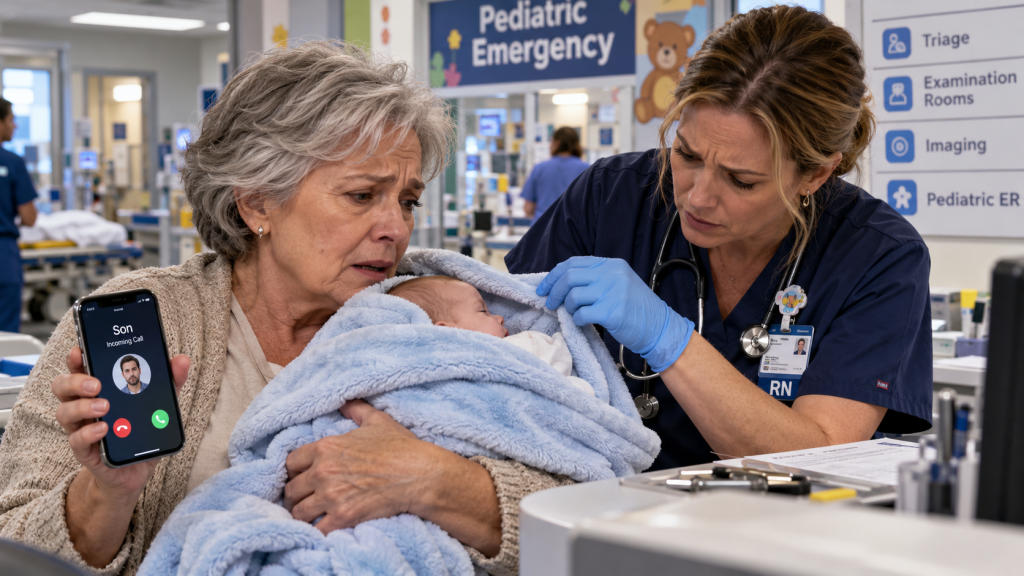
The nurse beside me—her badge said NORA BENNETT, RN—had stopped pretending this was an ordinary emergency-room conversation. Her hand remained near the security phone while another nurse stood beside Mason’s stretcher, keeping one palm gently over the blue blanket.
Thomas finally spoke.
“Mom, you’re making this worse.”
I stared at the tiny face beneath the fluorescent lights.
Mason had cried so hard that his eyelids looked swollen. His mouth opened once, but only a thin sound came out now.
“No,” I said.
My voice surprised me.
Steady.
“I think somebody already made it worse.”
“Do not accuse me of something you don’t understand.”
I had not accused him.
That was the moment I knew.
A mother remembers sentences.
A grandmother remembers silences.
But fear remembers what people defend before anyone has attacked them.
I looked at Nurse Bennett.
She heard it too.
Thomas continued.
“Where exactly are you in the hospital?”
I did not answer.
“Mom?”
The pediatric doctor who had arrived beside us held out one hand.
Not for the phone.
For permission.
I nodded and placed the call on speaker.
Thomas said my name again.
“Helen.”
The doctor spoke.
“This is Dr. Elena Marquez. I’m part of the pediatric emergency team at St. Vincent’s.”
Silence.
Then Thomas’s tone transformed.
Polite.
Controlled.
Professional.
“Oh. Doctor. Hi. I’m Mason’s father.”
“Yes, Mr. Russell.”
“How is he?”
There.
Finally.
How is he?
But even that came after:
Where are you?
Why did you undress him?
Don’t call police.
I hated myself for noticing the order.
Dr. Marquez answered carefully.
“Your son is being evaluated for injuries that require further testing. We need you and Mason’s mother to come to the hospital.”
Thomas inhaled.
“Are you saying my mom hurt him?”
My knees almost gave out.
Nurse Bennett’s head lifted sharply.
Dr. Marquez did not react emotionally.
“No one here has said that.”
“I’m just trying to understand.”
“We’ll speak when you arrive.”
“Can you tell me what she told you?”
“No.”
A pause.
Then Thomas said:
“We’re on our way.”
The call ended.
I stared at the dark screen.
Nurse Bennett took the phone gently from my hand and placed it on the counter.
“Helen.”
I looked at her.
“Is there anyone you trust who can come sit with you?”
I almost laughed.
I was sixty-four years old.
I had raised three children.
Buried a husband.
Worked twenty-eight years in a middle-school cafeteria.
Sat beside my sister through breast cancer.
I had always been the person other people called.
Now a nurse was asking who could sit with me.
“My daughter.”
I whispered.
“Call her.”
My daughter Rachel lived twenty minutes away.
I called.
She answered after half a ring.
“Mom?”
I must have sounded wrong because she immediately stopped whatever she was doing.
“What happened?”
“I’m at St. Vincent’s with Mason.”
“What happened?”
“I don’t know yet.”
That was technically true.
Then my voice broke.
“Rachel, I need you.”
“I’m coming.”
No questions.
No hesitation.
That is what safe people sound like.
Dr. Marquez ordered imaging and bloodwork.
A hospital social worker arrived.
Then a child-abuse pediatric specialist was consulted.
Nobody used dramatic language in front of me.
No one declared guilt.
They documented.
Measured.
Asked.
Observed.
That professionalism almost made the situation more terrifying.
When medical workers become calm around something horrific, you understand they have seen versions of it before.
I stood near Mason’s stretcher while they worked.
“Can I touch him?”
I asked.
The nurse nodded.
“Absolutely.”
I placed one finger against his tiny hand.
His fingers curled around it.
Barely.
Two months old.
Not old enough to know the word grandmother.
Old enough to know pain.
My stomach turned.
Dr. Marquez came back after the first imaging study.
Her expression told me before she spoke.
“Helen, Mason has more than the bruise you saw.”
I gripped the rail.
“What?”
“We’re seeing injuries that concern us.”
“What kind?”
She hesitated only because she was choosing language.
“Several rib injuries appear to be healing.”
My ears rang.
“Healing?”
“Yes.”
“So they didn’t happen today?”
“That would be our concern.”
I stared at Mason.
His ribs.
Tiny ribs beneath a cotton onesie.
Injuries I had not known existed.
Dr. Marquez continued.
“We’re also evaluating the abdominal injury more closely. There appears to be internal bruising that we need to monitor.”
“Is he going to die?”
The question came out like a child’s.
Her face softened.
“Right now, he is stable.”
Not fine.
Stable.
“We’re admitting him.”
“To intensive care?”
“For close observation at first.”
I closed my eyes.
“How do babies get rib injuries?”
Dr. Marquez’s pause answered more than the words.
“There are different mechanisms.”
She said.
“But in an infant this young, especially with injuries at different stages of healing, we have to consider non-accidental trauma.”
There it was.
Medical language for the thing my mind still refused to name.
Someone hurt him.
Not once.
More than once.
My son’s baby.
My grandson.
The room tilted.
I sat down.
Rachel arrived ten minutes later wearing slippers.
She had forgotten shoes.
When she saw my face, she did not ask what was wrong.
She hugged me.
Then looked through the glass partition at Mason.
“Oh my God.”
I told her.
Not everything.
I could barely form sentences.
Bruising.
Ribs.
Thomas warning me not to undress him.
Police.
Rachel stared at me.
Then:
“Where’s Thomas?”
“Coming.”
Her expression changed.
“Mom.”
“I know.”
“Do you?”
“I don’t know anything.”
I snapped.
The words came sharper than I intended.
Rachel stepped back.
I covered my face.
“I’m sorry.”
“It’s okay.”
“No.”
I lowered my hands.
“I don’t know if my son hurt his baby.”
There.
The sentence existed now.
My son.
His baby.
Hurt.
Rachel’s eyes filled.
“We’ll find out.”
I looked at her.
“What if we already know?”
She did not answer.
Because daughters sometimes know when mothers need truth without comfort.
Hospital security called the nurses’ station about twenty minutes later.
Thomas and Ellie had arrived.
They were asked to wait in a separate consultation room.
Not because anyone had been arrested.
Because the hospital wanted interviews conducted without the parents influencing each other.
Thomas objected.
Of course.
I heard his voice from down the hall.
“My son is here.”
Then:
“You can’t stop me from seeing my own child.”
A security officer responded calmly.
A social worker appeared.
Doors closed.
The hallway became quiet again.
Ellie entered another room.
I saw her for only a second.
Twenty-nine years old.
Pale.
Hair tied up.
No makeup.
She looked toward me.
Our eyes met.
Then she looked away.
That mattered.
I did not know why yet.
Detective Aaron Pike arrived from the special-victims unit.
Beside him came a younger detective, Marisol Vega.
They introduced themselves.
Asked me to tell them exactly what happened from the moment Thomas handed me Mason.
No conclusions.
No theories.
Just sequence.
I told them.
2:16 p.m.
Diaper bag.
Bottle.
“Don’t take his onesie off.”
Crying.
Rigid body.
The stiff swelling.
Opening the snaps.
The bruise.
Driving.
Phone call.
“Don’t let them call police.”
Detective Vega wrote everything.
Then asked:
“Has your son ever shown anger around the baby?”
My mouth went dry.
“No.”
Then memories arrived.
Thomas at Thanksgiving, joking that Mason “screamed like an air-raid siren.”
Thomas saying newborns should “learn not to run the house.”
Thomas once taking Mason from Ellie when he cried and saying:
“Give him here before you make him soft.”
I had rolled my eyes.
Said:
“He’s six weeks old, Thomas.”
Thomas had laughed.
Had there been something in his grip?
No.
I would remember.
Wouldn’t I?
Detective Vega asked:
“Helen?”
I realized I had stopped speaking.
“He gets impatient.”
I said.
“How?”
“Always has.”
“Since childhood?”
“Yes.”
I hated the answer.
Thomas was my second child.
Bright.
Charming.
Competitive.
He hated losing board games so much at eight years old that his father once packed Monopoly away for six months.
As a teenager, he punched a hole in a bedroom door after being grounded.
We made him repair it.
He apologized.
He grew up.
Or I thought he did.
He never hit siblings.
Never hurt animals.
Never struck me.
But anger was always fast in him.
A match.
Bright and gone.
I told myself temperament was not destiny.
It isn’t.
But pretending temperament means nothing is also a lie.
Detective Pike asked:
“Has Ellie ever mentioned being afraid of Thomas?”
“No.”
“Any domestic disturbances?”
“Not that I know.”
“Any calls to police?”
“No.”
“Have you noticed bruises on Ellie?”
I shook my head.
Then remembered.
A long-sleeved shirt in July.
No.
That was nothing.
Maybe.
I did not know.
“I don’t know.”
I said.
For once, I refused to convert uncertainty into innocence.
The detectives thanked me.
Then left to interview the parents separately.
An hour passed.
Then another.
Mason was moved upstairs.
Rachel and I went with him.
The pediatric unit had painted clouds on the walls.
Whoever designed children’s hospitals must understand that bright pictures cannot make frightening rooms less frightening, but maybe they can stop fear from owning every inch.
Mason slept under monitoring equipment.
His face looked peaceful.
That seemed unfair.
At 9:40 p.m., Detective Vega returned.
Her expression had changed.
She sat.
“Helen, I can’t tell you every detail of an active investigation.”
I nodded.
“But I need you to understand that Thomas and Ellie are giving different accounts.”
My heart tightened.
“What did Thomas say?”
“I can’t go into the full interview.”
She paused.
“He said Mason may have been injured accidentally during bathing or dressing.”
I laughed once.
A terrible sound.
“Finger marks?”
Vega did not answer.
“What did Ellie say?”
The detective looked at me carefully.
“She has asked for an attorney before continuing.”
That told me nothing.
And everything.
Then:
“Neither parent will be leaving with Mason tonight.”
My body went cold.
“Where will he go?”
“He’s staying admitted.”
“After the hospital?”
“That will be determined by child protective services and the court.”
I stood.
“No.”
Rachel touched my arm.
I looked at Vega.
“He is not going into foster care.”
“Helen—”
“I will take him.”
The words came before any practical thought.
I was sixty-four.
Arthritis in one knee.
A two-bedroom ranch.
Part-time job at the church office because retirement bored me.
No crib.
No infant car seat.
No diapers except the bag beside the hospital bed.
“I’ll take him.”
Detective Vega nodded.
“Tell the caseworker.”
“I’m telling everyone.”
Rachel almost smiled through tears.
“That part is true.”
A county child-protection caseworker named Samantha Brooks arrived before midnight.
She looked exhausted.
Not uncaring.
Just like somebody whose job exposed her to too many broken evenings.
She explained kinship placement.
Background checks.
Home safety assessment.
Emergency court orders.
Medical training because Mason might need follow-up care.
I answered yes to everything.
“Do you understand this could be more than a few days?”
“Yes.”
“Potentially months?”
“Yes.”
“Possibly longer?”
My throat tightened.
“Yes.”
Rachel said:
“And I can help.”
Samantha looked at her.
“Relationship?”
“Aunt.”
“Good.”
Then she looked back at me.
“Helen, I need to ask whether you would follow a court order restricting Thomas’s contact with Mason, even though Thomas is your son.”
There are questions that split a person in half.
Mother.
Grandmother.
I saw Thomas at three years old, asleep in a laundry basket because he had insisted it was a boat.
Thomas at twelve with a broken wrist.
Thomas at college graduation.
Thomas calling me the night Mason was born, crying:
“Mom, he’s perfect.”
Then Mason beneath the hospital blanket.
Finger-shaped bruises.
Healing ribs.
“Would you follow the order?”
Samantha repeated gently.
I looked at her.
“If the court says he cannot see Mason, he will not see Mason.”
“Even if he comes to your house?”
“Yes.”
“Even if he says he just wants five minutes?”
“Yes.”
“Even if he tells you you’re betraying him?”
My voice broke.
“Yes.”
Samantha nodded.
That was the first decision I made that night that cost me my son.
Not legally.
Emotionally.
I chose the baby who could not protect himself.
I would choose him again.
At 1:12 a.m., Thomas called me from an unknown number.
His phone had apparently been retained temporarily during part of the investigation? Better not assume seizure. Maybe borrowing Ellie’s? Let’s keep “hospital hallway phone”? Hmm. We can say from his attorney’s office? But too soon. Simpler: from his own number after leaving police interview. I had his number. Fine.
I stared at the screen.
Rachel said:
“You don’t have to answer.”
“I know.”
I answered anyway.
“Mom.”
He sounded exhausted.
“Where are you?”
“With Mason.”
Silence.
Then:
“They won’t let me see him.”
“I know.”
“Ellie is lying.”
My stomach tightened.
“What did she say?”
“I don’t know.”
That contradicted itself.
“How do you know she’s lying if you don’t know what she said?”
Thomas became quiet.
Then:
“Mom, listen to me. Babies get hurt.”
I closed my eyes.
“Not like this.”
“You’re not a doctor.”
“No.”
“Then stop acting like one.”
I looked at Mason sleeping.
“Did you hurt him?”
The line went silent.
My heart broke before he answered.
“Mom.”
“Yes or no.”
“You don’t understand how hard it has been.”
I stopped breathing.
Not no.
He continued.
“He screams for hours.”
“I work twelve-hour shifts.”
“Ellie panics.”
“She hands him to me and he keeps screaming.”
I gripped the phone.
“Thomas.”
“I never meant—”
My knees weakened.
Rachel stood.
I raised a hand.
“Never meant what?”
Silence.
Then:
“I grabbed him.”
The world disappeared.
“How?”
“I don’t know.”
“Thomas.”
“He wouldn’t stop crying.”
His voice cracked.
“I held him too hard.”
The hallway lights seemed to dim.
“When?”
“Today.”
I stared at the monitor.
“Only today?”
Silence.
I whispered:
“Thomas.”
He started crying.
My son.
Thirty-four years old.
Crying like the boy I remembered.
“I don’t know.”
I closed my eyes.
That answer was the last piece.
“You do know.”
“Mom, please.”
“Did you hurt him before today?”
“I was frustrated.”
“Yes or no.”
“Once.”
Then:
“Maybe twice.”
My stomach turned.
Rachel looked at me.
She could see everything in my face.
“Did Ellie know?”
Silence.
“Thomas?”
“She saw me grab him once.”
“And today?”
“She was there.”
I nearly dropped the phone.
“She was there?”
“She told me to stop.”
His voice rose.
“She acts like she did nothing, but she left me alone with him every night.”
“What does that have to do with anything?”
“She knew I was exhausted.”
“So?”
“I needed help.”
“You needed to put him down.”
I said.
The words came from somewhere outside me.
“You needed to put your baby somewhere safe and walk away.”
“He was screaming.”
“He is a baby.”
“You don’t understand.”
Something in me snapped.
“No.”
“I understand exactly enough.”
I lowered my voice because Mason was sleeping.
“He is two months old.”
“He had no weapon.”
“No choice.”
“No way to leave.”
“No way to tell you to calm down.”
“And you were supposed to be the adult.”
Thomas sobbed.
“Mom, don’t do this.”
“Do what?”
“Turn against me.”
There it was.
As though the central event was my loyalty.
Not Mason’s body.
I whispered:
“I am not turning against you.”
“Then help me.”
“I am helping the person you hurt.”
He went silent.
Then:
“I’m your son.”
Tears filled my eyes.
“I know.”
That was the worst part.
“I know exactly who you are.”
He hung up.
I sat down.
Rachel was crying.
I stared at the phone.
Then remembered the detective.
Evidence.
I called Detective Vega.
Told her everything.
Every word I could remember.
She asked whether I had recorded it.
No.
Ohio recording law? Don’t need get legal. I hadn’t.
She asked me to write down the conversation immediately.
I did.
Time.
Language.
Sequence.
My hand shook.
But I wrote.
Two days later, Thomas was arrested.
Not because of my phone call alone.
Because evidence had begun to line up.
Medical findings.
Separate statements.
Text messages.
Ellie’s eventual account.
And Thomas’s own admissions during follow-up questioning with counsel present? We need plausible. He may enter later. Let’s not overdetail.
Ellie’s truth came slower.
She had seen Thomas lose his temper.
The first time Mason was about three weeks old, Thomas squeezed him too tightly around the torso while trying to stop him from squirming.
Mason screamed.
Ellie yelled.
Thomas apologized.
They convinced themselves nothing had happened.
A week later, Mason developed unexplained fussiness.
They did not seek medical care.
Then another incident.
Thomas grabbed him during prolonged crying.
Again he apologized.
Again Ellie said:
“This cannot happen again.”
Again they did not tell anyone.
Then the day I came over, Mason had been crying before I arrived.
Thomas lost control.
Ellie saw him grip Mason around the middle.
Hard.
Mason screamed.
Thomas froze.
A bruise began appearing.
They bathed him.
Dressed him quickly.
And then I knocked.
They had somewhere they were supposed to be.
A friend’s engagement lunch.
They did not want to cancel.
That detail nearly killed me.
An engagement lunch.
They handed an injured infant to his grandmother because they did not want awkward questions about missing plans.
Thomas told me not to remove the onesie.
Ellie said nothing.
Silence became part of the harm.
The hospital’s complete evaluation showed evidence that at least some injuries predated that afternoon.
Doctors could not date every injury to an exact moment.
They could say the pattern was highly concerning for repeated inflicted trauma.
That phrase entered our family vocabulary and never left.
Repeated.
Not one terrible second.
A pattern.
The county obtained emergency custody while the case proceeded.
I passed the home assessment.
Background check.
Fire extinguisher.
Locked medications.
Safe sleep training.
Infant CPR refresher.
Rachel helped me set up a crib.
My neighbor brought bottles.
The church ladies produced enough diapers to supply a military unit.
Three days after Mason entered the hospital, Samantha Brooks stood in my living room and said:
“If discharge goes as planned tomorrow, he can come here under emergency kinship placement.”
I sat down.
“Here?”
“Yes.”
I had been demanding it for three days.
The moment it became real, terror arrived.
“What if I do something wrong?”
Samantha smiled slightly.
“You will.”
I stared.
“All caregivers make mistakes.”
“Your job is to make ordinary mistakes.”
That sentence became sacred to me.
Ordinary mistakes.
Wrong diaper size.
Bottle too cool.
Forgetting where I put the pacifier.
Not injuries hidden beneath clothing.
Not fear.
Ordinary.
Mason came home to me the next afternoon.
I carried him through my front door.
He weighed barely eleven pounds.
Everything had changed because of eleven pounds.
I placed him in the crib.
Then sat beside it.
He slept.
I watched his chest rise.
Fall.
Rise.
Fall.
I did not trust sleep anymore.
Every sound frightened me.
Every silence frightened me more.
The first night, I checked his breathing twenty-two times.
At 3:00 a.m., Rachel found me sitting on the floor beside the crib.
“You have to sleep.”
“I’m fine.”
“You’re seventy percent hallucination.”
“I’m sixty-four.”
“Exactly.”
She took the next feeding.
I slept ninety minutes.
It felt like betrayal.
That is what trauma does.
It makes rest feel irresponsible.
Mason’s injuries healed.
His ribs.
His abdominal bruising.
The dark marks faded from purple to green to yellow and then disappeared.
I hated that.
Part of me wanted them to stay long enough for the whole world to see.
Then I realized that was selfish.
His body did not owe anyone permanent evidence.
Medical records existed.
Photographs existed.
He deserved skin that forgot.
The first weeks were filled with appointments.
Pediatric follow-up.
Development checks.
Specialist evaluation.
Home visits.
Court dates.
I carried a binder everywhere.
Medication list.
Feeding schedule.
Caseworker numbers.
Court orders.
I became organized with the fury of a woman who could not undo yesterday and therefore controlled folders.
Thomas remained in custody initially, then later was released under strict conditions pending further proceedings.
No contact with Mason.
No unsupervised contact with children.
No contact with me except through attorneys regarding necessary matters.
The first letter he sent came through his lawyer.
I did not open it immediately.
It sat on my table for three days.
Finally, I read it.
Mom, I know you hate me.
I stopped.
Already wrong.
I did not hate him.
That would have been easier.
I loved him.
That was the unbearable fact.
I loved my son and feared what he had done.
Both.
The letter continued.
He wrote about exhaustion.
Work stress.
Mason’s crying.
Feeling trapped.
Feeling like a failure.
He said he never intended serious harm.
He said he needed help and did not know how to ask.
Then:
I know none of that excuses it.
That sentence saved the letter from the trash.
I read on.
When you asked if I hurt him before, I wanted to lie. I think I’ve been lying to myself since the first time.
I cried.
Please don’t tell Mason I never loved him.
That destroyed me.
Because I believed Thomas loved Mason.
And he still hurt him.
Love is not a safety certificate.
That may be the hardest truth I learned.
People can love badly.
Dangerously.
Possessively.
Love without regulation, accountability, humility, and control can still injure the person receiving it.
I never answered the letter.
Not then.
Ellie’s situation was different.
She was not charged with physically injuring Mason, based on the evidence investigators developed.
But child-protection proceedings focused heavily on her failure to protect him and the delay in seeking medical care.
She had watched warning signs.
Seen injury.
Helped conceal the latest bruise.
Allowed me to take Mason without telling me he needed a doctor.
She cried through nearly every hearing.
At first, I resented her tears.
Then one day Samantha said:
“You do not need to decide whether Ellie is a monster.”
I looked at her.
“Good, because I’m working on it.”
Samantha almost smiled.
“You need to decide what boundaries keep Mason safe.”
That was different.
Ellie entered individual therapy.
Parenting classes.
Domestic-violence education, because professionals believed there were signs Thomas controlled and intimidated her too.
That complicated everything.
She described Thomas punching walls during arguments.
Blocking doorways.
Taking her phone when she threatened to call me.
Calling her weak when Mason cried.
Telling her nobody would believe she could not protect her own baby.
She had been afraid.
And she had still failed Mason.
Both.
The system did not ask me to erase either truth.
Ellie received supervised visitation after several months.
The first one happened in a family-services center.
I was not in the room.
That was deliberate.
A professional supervisor observed.
Mason was five months old by then.
He did not know who any of us were in the adult way we wanted him to.
He knew warmth.
Voices.
Smell.
Familiarity.
After the visit, Ellie came into the lobby.
Her face was swollen from crying.
I held Mason.
She stopped several feet away.
“Helen.”
I said nothing.
“Can I ask one thing?”
“What?”
“Does he sleep okay?”
My anger flared.
Then I looked at her.
She was not asking for forgiveness.
Not access.
Sleep.
“Yes.”
I said.
“Most nights.”
She nodded.
“Good.”
Then:
“Thank you for taking him.”
That sentence almost made me angrier.
“You should have protected him.”
“I know.”
“No.”
I stepped closer.
“You knew then.”
Her face crumpled.
“Yes.”
Silence.
I continued.
“You do not get to make yourself the person who learned only after the hospital.”
She cried.
“I know.”
“Stop saying that unless you mean what comes after it.”
She looked at me.
“What comes after it?”
“Change.”
That was the last thing I said before leaving.
I worried later that it was too harsh.
Maybe it was.
She did change.
Slowly.
Not perfectly.
She stopped blaming Thomas’s stress.
Stopped calling the injuries “accidents.”
Stopped saying:
“I should have noticed.”
and began saying:
“I saw and was afraid.”
That distinction mattered.
Truth became more exact.
Thomas’s criminal case lasted more than a year.
His attorney challenged parts of the medical interpretation.
Experts reviewed imaging.
Records.
Timelines.
That was his right.
I hated it anyway.
The defense floated theories.
Handling injuries.
Accidental pressure.
Unusual fragility.
The medical team stood by their findings.
Eventually, after negotiations, Thomas entered a guilty plea to serious child-abuse-related charges.
The agreement spared us a trial.
More importantly, it meant Mason’s medical records would not be dissected in open court for weeks.
Thomas admitted under oath that he had used excessive force on his infant son more than once and that he had knowingly delayed medical care after the final incident.
I attended sentencing.
Rachel sat beside me.
Ellie sat on the opposite side.
Thomas wore a gray suit.
He looked older.
Not dramatically.
Just as though the year had finally put weight on him.
When he turned and saw me, his face broke.
I looked away.
The prosecutor described Mason’s injuries.
Briefly.
Clinically.
The judge spoke about helplessness.
Trust.
The extraordinary power adults hold over infants.
Then Thomas was invited to speak.
He stood.
Hands shaking.
I recognized those hands.
My father? No. My son.
I had held them when they were smaller than Mason’s.
Thomas said:
“I hurt my son.”
No passive language.
No:
He got hurt.
“I hurt him.”
The courtroom became still.
“I was angry at crying that was normal.”
“I treated helplessness like defiance.”
My chest tightened.
“I told myself I was overwhelmed.”
“I was.”
“But overwhelmed is not the same as entitled to use force.”
He looked toward me.
Then Ellie.
“I scared my wife.”
“I taught her that keeping me calm mattered more than telling the truth.”
Ellie covered her face.
Thomas continued.
“I love my son.”
His voice broke.
“And I know now that saying that does not reduce what I did.”
That sentence mattered.
The judge imposed a prison sentence followed by supervision, mandatory treatment, and strict restrictions regarding contact with Mason unless a future court ever determined otherwise.
I cried when they led Thomas away.
Rachel squeezed my hand.
“You okay?”
“No.”
The honest answer.
Outside the courthouse, a reporter approached.
“Mrs. Russell, do you have a statement about your son’s sentence?”
I stared at her.
My son.
My grandson.
A microphone between them.
“No.”
Then I stopped.
“One sentence.”
She waited.
I said:
“My grandson being safe is not a punishment against my son.”
Then I walked away.
That became the sentence local news used.
Fine.
It was true.
The family court moved separately.
Thomas’s parental rights were eventually terminated after additional proceedings and findings about the severity and pattern of harm.
That process took time.
Nothing about losing a parent, even an unsafe parent, should be treated casually.
The court considered evidence.
Services.
Risk.
Mason’s best interests.
The decision was not vengeance.
I had to remind myself of that whenever anger wanted simplicity.
Ellie’s path remained more complicated.
For nearly two years, she worked through a reunification plan.
Supervised visits.
Therapy.
Stable housing.
Parenting education.
Accountability work.
She separated permanently from Thomas.
Filed for divorce.
Obtained her own protective order after disclosing more about their marriage.
Some relatives believed that should erase her failure to protect Mason.
It did not.
Others believed her failure meant she should never be allowed near him again.
The court did not accept simple formulas.
Neither did I, eventually.
Ellie’s visits expanded slowly.
From one supervised hour.
To two.
Then community visits with supervision.
Then, after long review, limited unsupervised daytime contact.
Every step terrified me.
I did not pretend otherwise.
I asked too many questions.
Samantha once told me:
“Helen, safety planning is not the same as controlling everything.”
“I’m his grandmother.”
“Yes.”
“Control is in the job description.”
“No.”
Annoying woman.
Right.
Mason was nearly three when the court approved permanent guardianship with me while allowing Ellie structured contact.
By then, “temporary” had become our life.
I stood before the judge.
Answered questions.
Promised to support Mason’s safe relationship with Ellie as permitted.
Promised not to use guardianship to punish either parent.
Promised to keep medical care.
School.
Stability.
I signed.
The judge signed.
That was it.
No music.
No applause.
A stamp.
A file number.
A little boy’s future altered by paperwork.
We walked outside.
Mason held my hand.
He looked up.
“Nana, snack?”
I laughed.
“Of course.”
He had no idea he had just become legally anchored to me.
Children live in the immediate.
Goldfish crackers outrank court orders.
Thank God.
His early development was watched closely.
Trauma specialists warned that babies can carry stress without conscious memory.
We could not know what Mason’s body would remember.
So we gave him predictability.
Same bedtime.
Same songs.
Same pediatrician.
Same daycare.
No forced affection.
If he did not want a hug, he did not hug.
If he wanted the hall light on, the hall light stayed on.
Not because every preference was trauma.
Because control over small things teaches a child the world can respond without hurting him.
At four, Mason hated shirts being pulled over his head.
He panicked once.
Screamed.
I froze.
Old image.
Onesie.
Bruise.
St. Vincent’s.
Then his occupational therapist said:
“Could be sensory.”
Not every hard thing belonged to the past.
That lesson mattered.
We switched to button shirts for a while.
Later, he grew out of it.
Ordinary.
Let him be ordinary.
That became my prayer.
Do not make every scraped knee a prophecy.
Do not make every tantrum an echo.
Let him be a child, not a case file.
I struggled with that.
When he fell off a scooter at five, I nearly took him to the ER for a scraped elbow.
He looked at me.
“Nana.”
“Yes?”
“It’s blood.”
“I see that.”
“I need a Band-Aid.”
He was right.
Band-Aid.
Not trauma team.
We both learned.
Ellie became more consistent too.
She never missed a scheduled visit without explanation.
Never pressured Mason to call her Mom before he chose.
Never complained to him about me.
Those things mattered.
At five, he began calling her Mommy Ellie.
His own invention.
The first time I heard it, my stomach tightened.
Then I looked at his face.
Happy.
Safe.
Not my title to manage.
Ellie cried after he left that day.
In the parking lot, she said:
“I don’t deserve that.”
I answered:
“Then keep earning the trust around it.”
She nodded.
No offense.
Good.
Thomas wrote to me from prison twice a year.
I read every letter.
I answered none for the first three years.
His letters changed.
At first, explanations.
Then accountability.
He completed anger-management programming.
Parenting education.
A trauma course.
He wrote about learning that babies’ crying is designed to provoke adult response but not adult retaliation.
He wrote:
I thought Mason was doing something to me. I understand now he was asking something from me.
That line sat in my drawer for months.
When Mason was seven, Thomas wrote:
Please do not tell him I loved him unless you believe it will help him. I used to need him to know I loved him because I wanted love to reduce my guilt. I don’t think that’s fair anymore. Tell him the truth when it is good for him, not for me.
That was the first letter I answered.
Three sentences.
Thomas, I received your letter. Mason is safe and doing well. Continue the work because it matters whether or not he ever chooses to know you.
I signed:
Mom.
I stared at that word for a long time.
Still Mom.
Protecting Mason did not cancel motherhood.
It changed what motherhood required.
Sometimes loving your child means refusing to rescue them from consequences that belong to them.
That was a brutal kind of love.
But still love.
Rachel remained my anchor through everything.
She moved closer when Mason started kindergarten.
Not because I asked.
Because she wanted to.
She became the aunt who knew every dinosaur name and forgot every permission-slip deadline.
Mason adored her.
My oldest son, Daniel, struggled more.
He lived in Arizona and flew home after Thomas’s arrest.
For months, he could not speak Thomas’s name without anger.
“I hope he stays in prison forever.”
I said:
“You can hate what he did.”
“I do.”
“Do not make me agree to hate my son.”
Daniel stared at me.
“He hurt a baby.”
“I know.”
“Mom.”
“I know.”
Tears filled my eyes.
“I am allowed to love him and still say he should not be near Mason.”
Daniel looked away.
Years later, he apologized.
“I thought loving Thomas meant you were minimizing.”
“I know.”
“I understand now.”
“Good.”
Families fracture after abuse not only because of the person who caused it.
They fracture because everyone wants grief to have one correct shape.
There isn’t one.
Some people rage.
Some withdraw.
Some forgive.
Some never do.
The important boundary is not emotional uniformity.
It is safety.
Thomas served most of his sentence and was released under supervision when Mason was nine.
The notification arrived by certified mail.
My hands shook reading it.
Nine years old.
Almost the age Thomas had been when he broke the Monopoly board because he lost.
I hated that memory now.
Then hated myself for weaponizing childhood.
Kids have tantrums.
Not every angry child becomes an abusive parent.
Do not rewrite every past event into destiny.
I called Mason’s therapist.
By then he knew an age-appropriate version of his history.
Not details.
He knew his father had hurt him as a baby.
That adults and doctors had made sure he was safe.
That I became his guardian.
That Ellie failed to protect him at first but later worked hard to become safer and rebuild trust.
Truth in pieces appropriate to age.
His therapist helped.
When I told Mason Thomas was leaving prison, he looked at the floor.
“Is he coming here?”
“No.”
“Can he?”
“No.”
“What if he tries?”
“We have plans.”
He thought.
“Does he know where I go to school?”
“No.”
“Good.”
Then:
“Do I have to meet him?”
“No.”
That answer came immediately.
Mason looked up.
“Ever?”
“That will be your decision when you’re old enough and when the adults responsible for safety agree it’s appropriate.”
He frowned.
“So maybe?”
“Maybe.”
“I don’t like maybe.”
“Nobody does.”
He thought.
Then:
“Can I have cereal?”
Children rescue adults from impossible conversations with cereal.
“Yes.”
Thomas did not come near us.
He followed the order.
Reported to supervision.
Worked at a warehouse.
Continued therapy.
Sent letters through approved channels.
Years passed.
At twelve, Mason asked to read one.
His therapist and I discussed it with him.
Then gave him a recent letter.
Not the earliest ones full of excuses.
The recent one.
Thomas had written:
Mason, I am not writing to ask you to forgive me or meet me. I hurt you when you were a baby. The adults who removed you from me were right to do it. Your grandmother protected you when I did not. Your mother failed to stop me soon enough but later did work I hope made her safer. I am responsible for what I did. None of it happened because you cried too much. Babies are supposed to cry.
Mason stopped.
Read that line again.
Then kept going.
At the end:
You do not owe me a relationship because I am your biological father. If you ever want answers, I will answer honestly. If you never do, I will respect that.
Mason folded the letter.
I waited.
“What do you think?”
I asked.
He shrugged.
“I don’t know.”
“Good answer.”
Then:
“Was he always bad?”
There it was.
Children want categories too.
“No.”
I said.
“He was funny.”
“Smart.”
“He loved baseball.”
“He annoyed his brother.”
“He once cried because he stepped on a frog.”
Mason smiled a little.
“Seriously?”
“Yes.”
“Then why did he hurt me?”
My throat tightened.
“Because people can do terrible things without being terrible every second of their lives.”
“That’s confusing.”
“Yes.”
He looked at the letter.
“Did he love me?”
I took a long breath.
“I believe he did.”
Mason’s eyes filled.
“Then why?”
The question has no satisfying answer.
So I did not invent one.
“Because love by itself does not make someone safe.”
He stared.
I continued.
“People also need self-control.”
“Responsibility.”
“The ability to step away when they’re overwhelmed.”
“The willingness to ask for help before they hurt someone.”
“Your father did not do those things.”
Mason nodded slowly.
Then:
“Do you love him?”
“Yes.”
He looked shocked.
“Still?”
“Yes.”
“Even after?”
“Yes.”
He thought.
“Do you love me more?”
I smiled sadly.
“Love is not a scoreboard.”
“That’s a grandma answer.”
“It is.”
He rolled his eyes.
I leaned closer.
“But when safety required a choice, I chose yours.”
He nodded.
That was the answer he needed.
At fourteen, Mason met Thomas for the first time he could remember.
His choice.
Not mine.
Not Thomas’s.
Not Ellie’s.
A therapist supervised.
Neutral room.
I sat in the lobby.
My hands shook worse than they had in the hospital twelve years earlier.
Rachel sat beside me.
“You okay?”
“No.”
“Good.”
“Why does everyone say that?”
“Because lying is exhausting.”
Fair.
The meeting lasted thirty-eight minutes.
Mason came out first.
Face unreadable.
Thomas remained inside.
I stood.
“Well?”
Mason shrugged.
“Can we get burgers?”
I almost screamed.
“Yes.”
In the car, halfway through fries, he said:
“He looks like me.”
I swallowed.
“You have his eyes.”
“I hate that.”
“You don’t have to.”
He stared out the window.
“Does looking like someone mean anything?”
“Sometimes.”
“Not enough.”
He nodded.
Then:
“He apologized.”
I waited.
“I told him I’m not forgiving him today.”
“What did he say?”
“He said okay.”
I breathed.
“Good.”
Mason looked at me.
“You wanted him to argue?”
“No.”
“I wanted to know whether he respected your answer.”
“He did.”
That mattered.
Thomas and Mason had limited, supervised contact afterward.
Not frequent.
Not automatic.
Sometimes months passed.
Mason controlled pace with professional guidance.
Thomas never regained parental rights.
That door remained closed.
Relationship and legal parenthood were separate.
He had lost one.
He might earn pieces of the other.
Never entitlement.
Ellie eventually remarried.
A woman named Lauren.
Kind.
Quiet.
Mason liked her.
That family structure would have scandalized some of the older women at my church.
They survived.
So did the church.
Ellie became part of Mason’s life in a healthier way.
By high school, he spent occasional weekends with her under an updated arrangement everyone had worked toward for years.
He still lived with me.
Home remained my little ranch.
The same house where a crib once stood beside my bed.
Eventually, the crib became a toy shelf.
Then a desk.
Time changes furniture before hearts are ready.
When Mason turned sixteen, he found the original blue blanket in my linen closet.
He brought it to the kitchen.
“Nana?”
I looked.
My breath caught.
Faded now.
Still soft.
“This mine?”
“Yes.”
“From when I was a baby?”
“Yes.”
He smiled.
“Why do you look weird?”
Because I could see a hospital triage desk.
Nurse Bennett.
Purple marks.
My phone glowing with Thomas’s name.
I sat down.
“That blanket was with you on a very bad day.”
Mason’s expression changed.
“The day?”
“Yes.”
He looked at it.
Then at me.
“Should we throw it away?”
I thought.
“No.”
Then:
“Unless you want to.”
He rubbed the fabric.
“It’s just a blanket.”
Exactly.
He took it upstairs.
Later, I found it folded at the foot of his bed.
That felt like victory.
The object did not own the memory anymore.
Mason graduated high school with honors.
Not because trauma made him exceptional.
I refuse that story.
He worked.
Studied.
Procrastinated.
Failed geometry once.
Retook it.
Played terrible guitar.
Had one heartbreak so dramatic I thought he might join a monastery.
Ordinary boy.
Ordinary young man.
That was all I ever wanted.
At graduation, Thomas attended.
At Mason’s invitation.
He sat three rows behind Ellie.
No family reunion.
No pretending.
Boundaries remained.
When Mason walked across the stage, I stood so fast my knee screamed.
He looked toward us.
Me.
Ellie.
Rachel.
Thomas.
Lauren.
A strange row of people assembled by pain, law, therapy, and stubborn love.
He smiled.
Afterward, he hugged me first.
That mattered to me more than I admitted.
Then Ellie.
Rachel.
Lauren.
He looked at Thomas.
Paused.
Then offered his hand.
Thomas took it.
No hug.
Enough.
Later that night, Thomas found me near the parking lot.
“Helen.”
He had stopped calling me Mom in public years earlier.
Not because I asked.
Maybe because shame altered language.
I looked at him.
“You did good.”
I said.
He stared.
“At what?”
“Giving Mason the space he asked for.”
Tears filled his eyes.
“That’s a low bar.”
“Yes.”
I smiled slightly.
“Still clear it.”
He laughed once.
Then:
“Thank you.”
“For what?”
“For not telling him I was a monster.”
I looked at my son.
“I told him what you did.”
“I know.”
“That was enough.”
Thomas nodded.
Then:
“I’m sorry, Mom.”
He had apologized before.
Many times.
This one landed differently.
Maybe because I no longer needed it.
“I know.”
I said.
“Keep being sorry in useful ways.”
He nodded.
Dad? no father. That’s something Arthur from prior story. Here Helen husband maybe dead. Could mention my late husband, Jack, would have had complicated feelings. Not needed.
Mason went to college.
Nursing.
That surprised everyone except me.
At eighteen, he said he wanted pediatric nursing.
I froze.
“Because of what happened?”
He rolled his eyes.
“Not everything is because of what happened.”
Fair.
“Why then?”
“I like kids.”
“I’m good at science.”
“Nurses helped me when I was little.”
Then:
“And hospitals need people who notice stuff.”
That last sentence touched the past.
But it belonged to him.
I let it.
He became a pediatric nurse.
Years later, on one of his first rotations, he called me after work.
“Nana.”
“What?”
“I had a baby patient today.”
My stomach tightened automatically.
“Okay.”
“He was fine.”
I exhaled.
“Thank you for leading with that.”
Mason laughed.
“The grandmother kept apologizing because she brought him in for something small.”
“What did you say?”
“I told her small things are allowed to matter.”
My eyes filled.
He continued.
“I thought of you.”
Of course he did.
I thought of Nurse Bennett.
Dr. Marquez.
Everyone who changed their posture the moment they realized the problem was not small.
Mason said:
“I get why you drove now.”
“What do you mean?”
“I always knew.”
“But today I understood.”
I sat quietly.
Then:
“I’m glad.”
A few years later, Mason married.
A woman named Priya.
Pediatric physical therapist.
Very patient.
Far too good for his guitar playing.
At their wedding, I sat in the front row.
Thomas sat several rows back.
Ellie and Lauren beside each other.
Rachel at my side.
During vows, Mason said:
“I promise that when I am overwhelmed, I will tell you before I turn fear into silence.”
My throat closed.
Priya squeezed his hands.
That was all.
No one else knew why that sentence mattered.
Maybe she did.
Enough.
When their first baby was born, I was seventy-eight.
A girl.
Nora.
Named partly after Nurse Bennett.
That made me cry for two days.
Mason called.
“Do you want to come over?”
“Are you sure?”
“Yes.”
I walked into his house.
Not spotless.
Thank God.
Laundry basket.
Coffee cups.
Burp cloth on the sofa.
Life.
Mason placed Nora into my arms.
For one terrible second, time collapsed.
Thomas.
Mason.
The onesie.
The warning.
I froze.
Mason saw.
“Nana?”
I looked at him.
He understood.
He placed one hand on my shoulder.
“You can take her onesie off.”
I started crying so hard I scared the baby.
Mason laughed.
“Oh no.”
“Sorry.”
Priya smiled from the sofa.
“She’s fine.”
I looked down at my great-granddaughter.
Warm.
Safe.
Squirming.
No secrets beneath cotton.
I kissed her forehead.
Mason sat beside me.
“I thought about saying something else.”
he said.
“What?”
“Nothing.”
“What?”
He smiled.
“I was going to say, ‘Don’t take her onesie off.’”
I stared.
He laughed.
I hit his arm.
“You are terrible.”
“Nana.”
“Absolutely terrible.”
We both laughed until Priya told us to lower our voices.
Then Mason became serious.
“Do you ever think about that day?”
“Yes.”
“How often?”
“Less.”
He nodded.
“Me too.”
That surprised me.
“You don’t remember it.”
“Not like you.”
He looked at Nora.
“But I remember growing up around the story.”
I stiffened.
He noticed.
“That isn’t bad.”
he said.
“You all told me carefully.”
“I knew enough.”
“I didn’t feel like it was hidden.”
He smiled.
“I think that helped.”
I looked at him.
At the man who had once been an injured two-month-old beneath hospital lights.
At the nurse he became.
At the father he was now.
“What are you most afraid of?”
I asked.
“With her?”
He looked down.
“Getting overwhelmed.”
My stomach tightened.
Mason continued.
“Not because I think I’m Dad.”
“I don’t.”
“But babies cry.”
“People get tired.”
“I know I have the capacity to be angry because everyone does.”
I waited.
“So Priya and I made a plan.”
“What kind?”
“If either of us feels overwhelmed, we say it.”
“We put Nora safely in the crib if we need a minute.”
“We switch.”
“We call someone.”
“No shame.”
“No proving we can handle it.”
My eyes filled.
“Good.”
Mason smiled.
“See?”
“What?”
“Your panic has a retirement plan.”
I laughed.
Maybe.
Years earlier, Thomas had believed needing help was weakness.
Ellie had believed speaking up would destroy the family.
I had believed I should have somehow known everything without being told.
All of us were wrong in different ways.
Healthy families are not families where nobody becomes overwhelmed.
They are families where overwhelm can be spoken before somebody gets hurt.
Thomas met Nora months later.
Only because Mason chose it.
I did not attend.
Not my relationship to supervise anymore.
Afterward, Mason called.
“How was it?”
I asked.
“Weird.”
“Good weird?”
“No.”
“Bad weird?”
“Just weird.”
Fair.
“Did he hold her?”
“Yes.”
My chest tightened.
Mason heard my silence.
“Nana.”
“I’m fine.”
“You are lying.”
“Yes.”
He laughed.
“He was careful.”
“I know.”
“Priya was there.”
“I know.”
“I was there.”
“I know.”
“And I wanted him to.”
I breathed.
“Then that matters.”
Mason said:
“He cried.”
“Thomas cries.”
“He apologized again.”
“For what?”
“For making holding his granddaughter complicated.”
That got me.
I sat down.
Mason continued.
“I told him complicated isn’t the same as impossible.”
I closed my eyes.
My grandson had become kinder than the story that began his life.
Not naive.
Not forgetful.
Kind.
There is a difference.
Thomas never became the father he might have been.
That loss remained.
He did become a man who stopped demanding that other people repair what he broke.
That counted for something.
Ellie became a steady presence.
She never reclaimed the years she lost.
No one can.
But she showed up for the years available.
Graduations.
Birthdays.
Holiday lunches.
Not every holiday.
Boundaries remained even after anger softened.
Forgiveness did not turn history into a blank page.
It only stopped history from writing every future page by itself.
When I turned eighty, my children and grandchildren threw me a party.
Thomas came.
So did Ellie.
They greeted each other politely.
Nothing more.
Mason gave a speech.
I told him not to.
He ignored me.
Runs in the family.
He stood with Nora on one hip.
“Nana taught me many things.”
I groaned.
“Here we go.”
Everyone laughed.
“She taught me that crockpots can apparently cook anything.”
True.
“That socks are not decorations.”
Debatable.
“And that if something feels wrong, you do not need permission to take it seriously.”
The room became quiet.
Mason looked at me.
“I am alive because when I could not speak, she listened to my body.”
I started crying.
Thomas looked down.
Ellie covered her mouth.
Mason continued.
“But I am not only alive because of that one day.”
“I grew up because she made ordinary days safe.”
That sentence meant more than anything.
Not the hospital.
Not the police.
Not the court.
Ordinary days.
Breakfast.
School.
Band-Aids.
Bad report cards.
Locked doors that belonged to the person inside.
Apologies.
Questions.
Choices.
Safety is boring when it works.
Beautifully boring.
Mason raised his glass.
“To Nana.”
Everyone did.
I hated it.
Loved it.
Both.
Later, when the party ended, Thomas helped me stack chairs.
Old habit.
He was fifty-four by then.
Gray at the temples.
We worked in silence.
Then he said:
“Mom.”
“Yes?”
“Thank you for choosing him.”
I stopped.
He looked at me.
“When I couldn’t.”
My eyes filled.
“That choice broke me.”
“I know.”
“I thought I was losing both of you.”
“I know.”
He swallowed.
“I think you saved whatever was left of me too.”
I stared.
“Do not put that on me.”
He nodded.
“Fair.”
“Your work saved what was left of you.”
“Yes.”
I softened.
“But I’m glad you did it.”
Thomas cried.
I hugged him.
My son.
Not the boy he was.
Not only the man who hurt his baby.
The man who had to live knowing what he did and decide whether guilt would become another form of selfishness or a reason to change.
I loved him.
I never forgot.
Those truths learned how to stand in the same room.
After everyone left, I found Mason in the kitchen washing glasses.
I said:
“Leave them.”
“Nana.”
“I’m eighty.”
“Exactly.”
I sat.
He dried his hands.
Then pulled a chair beside me.
For a moment, neither of us spoke.
I said:
“I used to wonder what would have happened if I listened to Thomas.”
“What do you mean?”
“If I left the onesie on.”
Mason looked at me.
“If you assumed he was colicky.”
“If I didn’t go to the hospital.”
He reached across the table.
Covered my hand.
“Nana.”
“I know.”
“I don’t live there anymore.”
“Good.”
I looked at him.
“But sometimes I visit.”
He smiled sadly.
“I think everyone visits the worst road they didn’t take.”
That was better phrased than anything I would have said.
“You’re annoyingly wise.”
“Nurse.”
“Same disease.”
He laughed.
Then became serious.
“You know what I think?”
“What?”
“You didn’t save me because you were a perfect grandmother.”
I stared.
“You saved me because you noticed one thing that didn’t fit and didn’t talk yourself out of it.”
My throat tightened.
Thomas’s warning.
Don’t take his onesie off.
At the time it had sounded small.
Odd.
Nothing.
Then Mason screamed.
I touched the fabric.
Opened the snaps.
Everything followed.
I said:
“I wish I’d noticed sooner.”
“How?”
“I don’t know.”
“Exactly.”
He squeezed my hand.
“You found out when you found out.”
“Then you did something.”
There are sentences we spend decades trying to earn.
That one came from the child I had spent years afraid I failed before I ever understood there was something to fail.
I cried.
Mason let me.
No reassurance.
Just presence.
Good.
When I finally stopped, I looked toward the window.
Dark yard.
Quiet street.
No sirens.
No fluorescent lights.
No blue blanket.
Just home.
I said:
“Your father once told me not to let the police get involved.”
Mason nodded.
“I know.”
“I thought calling them would destroy the family.”
“Did you?”
“No.”
“What did?”
I looked at him.
“Secrets.”
He nodded.
That was it.
Not police.
Not doctors.
Not court orders.
Secrets.
The first injury.
Hidden.
The second.
Explained.
The third.
Covered.
A onesie snapped over a bruise.
A grandmother instructed not to look.
Silence can preserve the appearance of a family long after safety has already left it.
The truth did not destroy ours.
The truth exposed what was already broken.
Then gave us something honest enough to rebuild.
Not the same family.
A different one.
Messier.
Boundaries everywhere.
Court orders once.
Therapy appointments.
Supervised visits.
Awkward birthdays.
People apologizing years too late.
People changing anyway.
Love without entitlement.
Forgiveness without access.
Access without forgetting.
Grandchildren who knew they could say no.
Parents who knew exhaustion was not shame.
A baby girl whose onesie was just clothing.
That was the family we became.
Sometimes I still remember Nurse Bennett’s face.
The moment she pulled back the blanket and stopped smiling.
That was the instant the world changed.
Not because she knew everything.
She didn’t.
Because she saw enough to stop treating the situation as ordinary.
Maybe that is what protection often looks like.
Not certainty.
Attention.
A pause.
A question.
A willingness to say:
This does not look right.
Then act before every explanation arrives.
I was sixty-four when I learned that.
Old enough to think I understood children.
Old enough to discover experience does not make you immune to being fooled by someone you love.
My son had looked me in the eye and told me not to remove a piece of clothing.
Part of me wanted to obey because he was the parent.
Because he was my son.
Because boundaries matter.
But Mason’s cry mattered too.
His body mattered.
Something under the cotton did not feel right.
So I looked.
I will never apologize for looking.
Years later, when Nora was two months old, Mason sent me a photograph.
She was asleep on his chest.
Onesie covered in tiny yellow ducks.
His caption said:
She finally stopped screaming after forty minutes. I put her safely in the crib, drank water, called Priya, and took five minutes in the hallway. Everyone survived.
I stared at the message until tears filled my eyes.
Then I replied:
That is what strong looks like.
Mason answered:
I know. Someone taught me.
Maybe I did.
Maybe doctors did.
Maybe therapists.
Maybe even Thomas, through the terrible lesson of what happens when a person refuses to step away.
We learn from the people who care for us.
We also learn from the people who fail us.
The important thing is what we choose to repeat.
Mason repeated none of the harm.
That was enough.
More than enough.
And if I could return to that first afternoon, to the spotless apartment that smelled like bleach, to Thomas placing Mason in my arms and saying:
“Don’t take his onesie off. He just got out of the bath.”
I would notice the way his eyes avoided mine.
I would notice Ellie standing too quietly near the door.
I would notice the word we in:
“We got him calm.”
But I would not waste time trying to become a detective.
I would do exactly what I did.
Hold the baby.
Listen.
Look.
And when something felt wrong, I would choose his safety over everyone’s comfort.
Again.
Every time.
Because Mason grew up.
Because he laughed.
Because he failed geometry.
Because he loved bad guitar.
Because he became a nurse.
Because he married.
Because he held his daughter gently.
Because an entire ordinary life existed on the other side of one decision made beneath fluorescent hospital lights.
That is what I remember now.
Not the bruise.
Not the police.
Not my son’s sentence.
The life that came after.
A life no one got to hide beneath cotton.
THE END STORIES! THANK YOU FOR READING GOOD LUCK !❤️
Related Posts