➡️ PART 3 ENDING PART➡️
“Good,” I said. “And Marcus? Don’t clean anything else.”
For the first time since I had known him, my son-in-law did not have an immediate answer.
There was silence on the line.
Not confusion.
Calculation.
I knew that silence.
I had heard it in interview rooms.
Conference rooms.
Courthouse hallways.
It was the silence of someone discovering that the person standing across from him had information he had not accounted for.
Then Marcus laughed.
Too lightly.
“What are you talking about?”
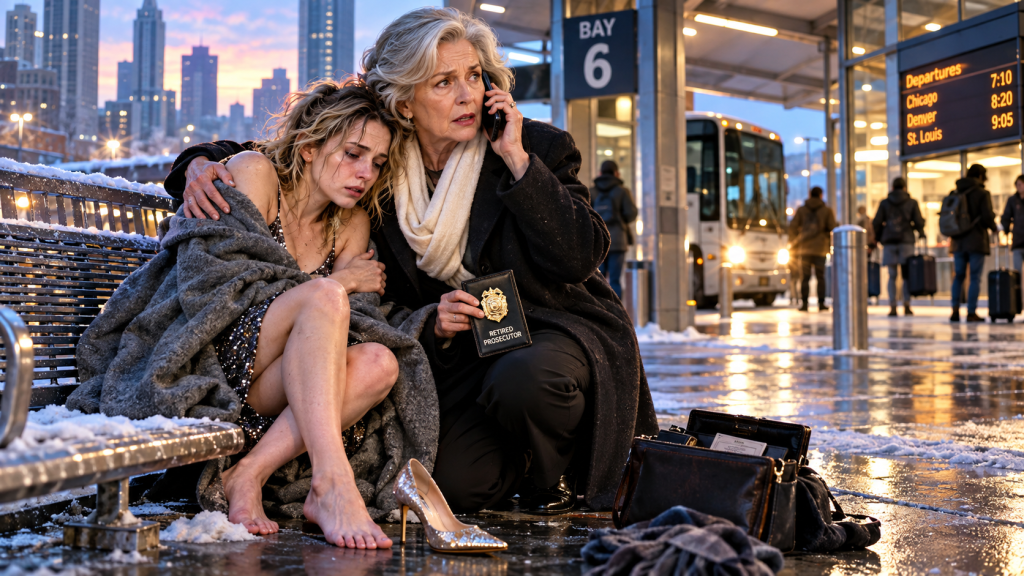
I watched the ambulance doors close around my daughter.
“You know exactly what I’m talking about.”
“Eleanor, Chloe is unstable.”
My jaw tightened.
“Careful.”
“I’m serious. She went crazy last night.”
“Then I’m sure you’ll be very eager to tell that story to the officers on their way to your house.”
The silence changed.
“What officers?”
I said nothing.
His voice sharpened.
“What did she tell you?”
Again, I said nothing.
People reveal remarkable things when you refuse to fill quiet for them.
Marcus tried another direction.
“I don’t know what she told you, but she attacked my mother.”
There it was.
The story Chloe had warned me about.
I looked at the patch of frost where she had been lying only minutes earlier.
No coat.
One shoe.
Blue fingers.
Unconscious.
“Is Sylvia injured?”
I asked.
A pause.
“Her wrist.”
“Has she sought medical care?”
Another pause.
“No.”
“Did you?”
“What?”
“You say your wife became violently unstable. Did you call 911?”
“No, because I was trying to protect her.”
I almost closed my eyes.
Protect.
Another word ruined by convenient people.
“So you protected her by leaving her outside a bus terminal in freezing weather?”
“She demanded to leave.”
“At five in the morning?”
“It was earlier than that.”
Interesting.
I had not given him a time.
Marcus realized what he had done.
His voice dropped.
“Eleanor.”
“Yes?”
“Don’t make this into something it isn’t.”
I looked at the ambulance disappearing around the corner.
“You should start worrying about what it is.”
Then I ended the call.
A young patrol officer named Reyes stayed with me until another unit arrived.
He had kind eyes and a notebook he treated as though every word deserved its own line.
“What did your daughter tell you?”
he asked.
I gave him the facts.
No courtroom voice.
No conclusions.
No dramatic labels.
Chloe said Marcus and Sylvia hurt her.
Chloe said Marcus had another woman.
Chloe said they wanted her gone before Thanksgiving dinner.
Chloe said Sylvia cleaned the house.
Chloe said Marcus kept her phone.
Chloe said she had recorded part of the confrontation.
Chloe said Marcus intended to claim she had attacked him.
Officer Reyes wrote everything.
Then he looked at the old badge in my lockbox.
“You were federal?”
“Prosecutor.”
“How long?”
“Twenty-seven years.”
He nodded.
Then I said the most important thing I could say.
“I’m not asking for special treatment.”
He looked at me.
“I’m asking you to treat her exactly like the evidence says you should.”
Something in his face softened.
“Understood.”
I closed the lockbox.
That badge had not given me power anymore.
It gave me memory.
Procedure.
Discipline.
And the knowledge that anger, no matter how righteous, is a terrible substitute for facts.
The emergency room smelled the same as every hospital in America.
Disinfectant.
Coffee.
Fear.
Chloe was awake when I reached her room.
Barely.
A heated blanket covered her to the chin.
Her hair had dried in tangled strands against her forehead.
A nurse was examining one of her hands.
The blue had faded from her fingers.
Some.
Not enough for me.
“Mom.”
I crossed the room.
“I’m here.”
Her face crumpled.
That was when my daughter finally cried.
Not at the terminal.
Not in the ambulance.
Here.
Warm enough to feel safe.
I sat beside her and gathered her carefully against me.
She shook.
I could feel every tremor through the blanket.
“I’m sorry.”
she whispered.
I pulled back.
“For what?”
“For ruining Thanksgiving.”
For one second, I could not speak.
Twenty-eight years old.
Injured.
Half frozen.
And some part of her still believed she owed the holiday an apology.
“No.”
I said.
I touched her cheek.
“You listen to me.”
“You did not ruin Thanksgiving.”
Her eyes filled.
“You do not apologize for surviving something somebody else did to you.”
She cried harder.
I held her.
And inside me, somewhere beneath the mother and beneath the widow and beneath the retired prosecutor, something ancient and furious stood up.
Not revenge.
Protection.
There is a difference.
I had spent an entire career learning it.
The doctor came in twenty minutes later.
Dr. Patel.
Calm.
Direct.
He explained Chloe had hypothermia significant enough to require observation.
Dehydration.
A mild concussion was suspected.
Bruising.
A sprained wrist.
Nothing he described sounded immediately life-threatening now.
That word mattered.
Now.
She had been lucky.
Or stubborn.
Perhaps both.
He wanted imaging.
More observation.
A forensic examination by a trained clinician because of the assault allegation.
I agreed to nothing for Chloe.
Important.
She was conscious.
She was an adult.
So when the nurse asked permission for photographs, documentation, and an advocate to come in, everyone looked at her.
Not me.
Chloe hesitated.
Then nodded.
“Yes.”
That single word hurt and healed me at the same time.
Her choice.
I sat beside her while professionals did their work.
Not prosecutor.
Mother.
Around eight, Detective Marisol Vega arrived.
She was in her forties, hair pulled back, no wasted motion.
I liked her immediately.
That made me distrust myself.
I had prosecuted enough cases to know familiarity can become bias.
So I said:
“I’m Eleanor Hart.”
“Chloe’s mother.”
“I’m also retired from federal prosecution.”
Her expression changed only slightly.
“Thank you for telling me.”
“I want to be clear.”
I continued.
“I’m family first.”
“I don’t want to interfere with your investigation.”
“Good.”
she said.
“Because I won’t let you.”
I almost smiled.
Excellent.
She turned toward Chloe.
“Can you talk?”
Chloe looked at me.
I squeezed her hand.
“You can ask me to leave.”
She shook her head.
“Stay.”
So I stayed.
Detective Vega pulled a chair close to the bed.
No rush.
No performance.
“Start wherever you can.”
Chloe closed her eyes.
Then began.
The affair had been going on at least four months.
Her name was Vanessa Cole.
She worked in marketing at Marcus’s company.
Chloe had suspected something for weeks.
Not because of lipstick.
Not because of perfume.
Because Marcus stopped putting his phone face down.
That sounds backward.
But Chloe knew her husband.
When he had something ordinary to hide, he guarded it.
When he had decided he was entitled to whatever he was doing, he stopped bothering.
Vanessa’s messages appeared on the lock screen.
Late-night jokes.
Restaurant plans Marcus claimed were work events.
Then, three days before Thanksgiving, Chloe saw a message:
Still saving my seat Thursday?
She asked Marcus who Vanessa was.
He said:
“A coworker.”
She asked why a coworker believed she had a seat at their family Thanksgiving.
Marcus laughed.
Called her insecure.
Then Sylvia arrived Wednesday afternoon.
Unannounced.
As usual.
Sylvia adored Marcus with the type of devotion that turns every fault into somebody else’s misunderstanding.
When Chloe tried to discuss the messages again, Sylvia told her not to humiliate Marcus before his CEO’s visit.
Chloe went upstairs to pack a bag.
Not to leave forever.
To stay with me.
Marcus followed.
The argument escalated.
Chloe’s voice trembled as she told it.
“He stood in the doorway.”
“What did he say?”
Detective Vega asked.
“That I wasn’t leaving until I apologized.”
“For?”
“Accusing him.”
“Then?”
“I tried to walk around him.”
Chloe swallowed.
“He grabbed my wrist.”
I held perfectly still.
Every instinct wanted to ask more.
Detective Vega did not let me.
Good.
“Then what happened?”
“Sylvia came upstairs.”
“She said I had made enough scenes.”
“She took my suitcase.”
“Marcus said Vanessa was coming for Thanksgiving.”
Detective Vega’s pen paused.
“He said that directly?”
“Yes.”
“What did you say?”
“I asked whether he was insane.”
For one tiny second, Chloe almost smiled.
Then it vanished.
“I told him if Vanessa walked into our house, I’d tell every person at the table why.”
Her breathing changed.
“Sylvia slapped me.”
My hand tightened beneath hers.
Detective Vega kept her voice even.
“What happened after that?”
Chloe looked toward the ceiling.
“I pushed Sylvia away.”
Good.
Important.
Truth.
Not perfect victim.
A human person reacting.
“She stumbled into the hallway table.”
“The vase fell.”
“The rug got stained.”
“The five-thousand-dollar rug.”
Chloe laughed once, bitterly.
“She cared more about that rug than my face.”
Detective Vega asked:
“Then?”
“Marcus grabbed me.”
“I fought him.”
“He kept saying, ‘Stop making this worse.’”
“I remember falling.”
“Then the bathroom.”
I frowned.
“The bathroom?”
Chloe nodded.
“They put me in the guest bathroom.”
“How long?”
“I don’t know.”
“Maybe an hour.”
“Maybe more.”
“Did they lock the door?”
“Yes.”
“From outside?”
“Yes.”
My stomach turned.
Detective Vega continued calmly.
“How did you get out?”
“They opened it.”
“Marcus said I was leaving.”
“Where was your coat?”
“Closet downstairs.”
“Did you ask for it?”
“Yes.”
“What did he say?”
Chloe’s voice dropped.
“He said, ‘Maybe the cold will sober you up.’”
My vision blurred.
I looked away.
Not because I could not hear.
Because I could.
Too clearly.
Chloe had hidden her phone in her sweater at first.
While she was in the bathroom, she turned on a voice recording.
She said she did not know whether it captured much.
Then Marcus discovered the phone after opening the door.
He took it.
But Chloe had an automatic cloud backup enabled for recordings and photographs.
Maybe the recording had synchronized before he seized it.
Maybe not.
Detective Vega did not speculate.
Neither did I.
That was another discipline.
Facts later.
Then Marcus drove Chloe downtown.
Sylvia came too.
Chloe had only one shoe because the other came off while they were moving her through the garage.
She asked them to go back for it.
Sylvia told Marcus not to bother.
At the bus terminal, Chloe said Marcus put her on the bench and dropped her purse beside her.
No phone.
No coat.
He told her:
“Call your mother.”
Chloe pointed out she did not have a phone.
Marcus said:
“Figure it out.”
Then they drove away.
She used a stranger’s phone first.
No answer.
Then borrowed another from the terminal guard after the doors opened.
That call came to me at 5:02.
Marcus.
Not Chloe.
Of course.
Apparently he had waited until he was home.
Then called me himself.
To control the first story.
That detail mattered.
Detective Vega wrote it down.
When Chloe finished, she looked smaller than I had ever seen her.
“Do you believe me?”
she asked Detective Vega.
The detective did not give her the sentimental answer people think victims need.
She gave a professional one.
“My job is to investigate what happened.”
Then:
“What you’ve told me gives us specific things to check.”
Chloe nodded.
That was better than blind reassurance.
Then she looked at me.
I did not have to be neutral.
“Yes.”
I said.
“I believe you.”
She closed her eyes.
Tears escaped anyway.
At 9:37 a.m., police reached Marcus’s house.
I know the exact time because Detective Vega told us later.
Thanksgiving preparations were in full swing.
The caterers were there.
Two folding banquet tables had been set in the dining room.
Crystal glasses.
Candles.
A floral centerpiece large enough to hide behind during a deposition.
Sylvia was wearing pearls.
Marcus was in a white shirt.
Vanessa Cole was already there.
That detail would have been funny under different circumstances.
The seat Chloe was supposedly too unstable to occupy had apparently been filled with impressive efficiency.
Marcus’s CEO had not arrived yet.
Neither had most guests.
But the turkey was in the oven.
The table was set.
And police came through the front door.
Not crashing.
Not guns drawn.
Not movie nonsense.
They knocked.
Identified themselves.
Explained they were investigating a reported domestic assault.
Then the Thanksgiving production stopped.
That was enough.
Marcus initially refused to turn over Chloe’s phone.
He said he did not know where it was.
Then Sylvia said it was probably in the laundry room.
Then Marcus said Chloe must have left it somewhere.
Inconsistency.
Old enemy.
Police obtained what lawful authority they needed as the investigation progressed.
I was not involved in those decisions.
That mattered.
I did not call a judge.
Did not invoke old friendships.
Did not ask anyone to “do me a favor.”
Twenty-seven years in federal court had taught me something simple:
If you need to bend the process to make your case work, your case is weaker than you think.
So I waited.
The first corroboration came from the bus terminal.
Security cameras.
A vehicle matching Marcus’s arrived before dawn.
Two people got out.
A woman matching Chloe’s description was left near Bay 6.
The vehicle departed.
Nobody needed my badge to interpret that.
Then came photographs of Chloe’s injuries.
Medical documentation.
The missing shoe later found in Marcus’s garage.
The broken hallway vase.
The rug Sylvia had tried to clean.
None of those things alone proved the whole story.
Together, they began to form one.
Then came the phone.
Marcus had not destroyed it.
Perhaps arrogance saved evidence more often than caution ever did.
It was recovered from a drawer in his home office.
And the recording had backed up.
Not everything.
Enough.
Detective Vega let Chloe listen with her attorney present weeks later.
I did not.
I had no need.
I read the transcript after Chloe asked me to.
That was hard enough.
Sylvia’s voice:
You will not ruin my son’s career because you cannot keep a husband happy.
Chloe:
I am leaving. Move.
Marcus:
You’re not walking into your mother’s house and turning this into a spectacle.
Chloe:
Get away from me.
Then noises.
Movement.
A crash.
Chloe crying out.
Sylvia:
Look what you did to my rug.
Chloe:
You hit me.
Marcus:
Stop acting like a victim.
Then another section.
Chloe asking for her coat.
Marcus refusing.
Sylvia saying:
Vanessa will be here by eleven. I’m not having Chloe poisoning the room when Mr. Whitmore arrives.
Marcus:
Just get her out.
Later:
If anyone asks, she attacked Mom.
Those words ended most of the mythology Marcus had planned to build.
Not all.
Courts are not magic.
People can explain.
Challenge.
Argue context.
That is why evidence gets tested.
But his first version was no longer standing alone.
The CEO arrived while officers were still there.
His name was George Whitmore.
I never met him.
I know about him because Marcus later blamed his career collapse on “public embarrassment.”
That was inaccurate.
George did not fire him because police appeared on Thanksgiving.
The company placed Marcus on leave because the allegations were serious and because Vanessa worked under a related chain of supervision that created its own corporate problems.
An internal investigation followed.
Apparently Marcus had used company travel and expense accounts during part of the affair.
That was not my case.
Not Chloe’s case.
Not something I celebrated.
Consequences have a way of finding neighboring rooms once one locked door opens.
Marcus ultimately lost his job.
He blamed me for months.
But I had not submitted his expense reports.
I reminded myself of that whenever guilt tried to become responsibility.
Sylvia called me from the police station that afternoon.
I did not answer.
She left a voicemail.
“Eleanor, this has gone too far.”
Classic opening.
Then:
“Families handle things privately.”
I listened once.
Deleted it.
There are sentences unworthy of storage.
Marcus was arrested that day.
Not for being arrogant.
Not for cheating.
Not for ruining Thanksgiving.
For conduct investigators believed supported criminal charges.
The exact charging decisions came later from the local prosecutor’s office.
I stayed away from them.
Far away.
A former colleague offered to “make sure they understood who I was.”
I told him:
“No.”
Chloe deserved a case built around what happened to her.
Not around who her mother used to be.
That was one of the hardest things I did.
Power is seductive when your child is hurt.
Restraint is a form of love too.
Sylvia was charged later.
The investigation took longer for her.
She had not driven the final decisions the same way Marcus had.
She had, however, participated.
The prosecutor believed there was sufficient evidence involving assault and interference with evidence.
Her attorney disagreed.
That is how the system works.
No one was convicted because I had an old badge in a lockbox.
Good.
Chloe stayed in the hospital two nights.
On Thanksgiving afternoon, while Marcus’s turkey sat cooling in a house full of police questions, my daughter ate broth from a plastic hospital bowl.
I sat beside her.
The television showed a parade rerun.
A nurse brought me a turkey sandwich wrapped in cellophane.
“This is depressing.”
Chloe whispered.
I looked at the sandwich.
“Criminal.”
She laughed.
Then winced because her ribs hurt.
I almost apologized for making her laugh.
Stopped.
She needed laughter too.
A volunteer brought two slices of pumpkin pie.
The crust was terrible.
We ate every bite.
At six, Chloe asked:
“Do you still have your pie at home?”
“Yes.”
“Can we have it when I get out?”
“Of course.”
She looked toward the window.
Then whispered:
“I don’t ever want to go back there.”
“You don’t have to.”
“My clothes.”
“We’ll deal with them.”
“My work laptop.”
“We’ll deal with it.”
“My grandmother’s necklace.”
“We’ll deal with that too.”
She looked at me.
“You keep saying we.”
“Yes.”
“Are you going to take over everything?”
There it was.
I stopped.
Because perhaps the Eleanor who had once stood in federal courtrooms could become another Sylvia if I was not careful.
A woman deciding what happened for somebody “for their own good.”
“No.”
I said.
“You decide.”
“I help.”
Her eyes filled.
“Okay.”
That became our rule.
Chloe came home with me.
To the house where she grew up.
The room had become my sewing room after she married.
I changed it back carefully.
Not into her childhood room.
That mattered.
She was not moving backward.
We cleared a closet.
Bought new sheets.
Put her work desk near the window.
She chose everything.
The first night, she woke screaming.
I was beside the bed before I knew I had moved.
She sat upright, breathing too fast.
“Mom.”
“I’m here.”
Then I stopped.
“Do you want me to stay?”
She nodded.
So I sat.
No questions.
No advice.
Just stayed.
The protective order came next.
Then attorneys.
Then divorce filings.
Then insurance.
Then work leave.
Pain becomes administrative very quickly.
Paperwork can feel obscene when a marriage has just ended violently.
Chloe stared at forms.
“Date of separation.”
“Property inventory.”
“Emergency contact.”
She laughed bitterly.
“Twenty-seven boxes to explain one night.”
I touched her hand.
“One box at a time.”
Her attorney was a woman named Priya Shah.
Excellent.
Calm.
She never treated my career as a reason to defer to me.
Another reason I liked her.
At our first meeting, she said:
“Mrs. Hart, Chloe is my client.”
I answered:
“I know.”
She looked relieved.
Apparently mothers are a known occupational hazard.
Marcus sent messages through counsel.
Apologies.
Explanations.
Requests to talk.
Chloe ignored them at first.
Then one arrived that said:
I never meant for you to get hurt.
She stared at it for a long time.
“What does that even mean?”
I knew exactly what it meant.
A sentence built to acknowledge outcome while escaping action.
But I did not tell her how to interpret it.
“What does it mean to you?”
She thought.
“That he still thinks intent is the only thing that counts.”
I nodded.
“Then trust your reading.”
She deleted nothing.
Priya kept records.
But Chloe stopped rereading.
That mattered.
Evidence should not become a shrine.
Vanessa contacted Chloe once.
I expected rage.
Chloe surprised me.
She took the call with Priya’s approval and recorded through proper channels because Vanessa wanted to provide information.
I was not present.
Afterward Chloe came into my kitchen.
Her face was strange.
“What happened?”
“Vanessa didn’t know.”
I frowned.
“About you?”
“She knew he was married.”
Chloe gave a painful laugh.
“Of course she knew that.”
“She didn’t know he was throwing me out that night.”
“Marcus told her we were separated.”
I waited.
Chloe continued.
“She thought I had moved out two weeks earlier.”
“Did you believe her?”
“I think so.”
Then:
“She left him.”
I almost said good.
Stopped.
This was not a scoreboard.
Vanessa gave investigators messages showing Marcus had been planning for months to make Chloe appear unstable during their separation.
Not some elaborate criminal conspiracy.
More mundane.
Comments.
“I’m worried about her mental state.”
“She’s becoming erratic.”
“If she leaves, I’m afraid she’ll make accusations.”
Seeds.
He had been building a version of Chloe before he ever needed it.
That frightened me more than his Thanksgiving arrogance.
Violence is terrible.
Narrative control can prepare the room for it.
Chloe began therapy.
She hated it for three weeks.
Then hated it slightly less.
At first she talked about Marcus.
Then Sylvia.
Then childhood.
Then me.
That surprised me.
One evening she sat across from me at dinner.
“Can I tell you something without you defending yourself?”
Painful sentence.
“Yes.”
“You scared me sometimes growing up.”
I stared.
“What?”
“Not like them.”
She said quickly.
“But you were…”
She searched.
“Certain.”
I almost laughed.
Then realized she was serious.
“You always knew what the correct thing was.”
“School.”
“College.”
“Jobs.”
“Money.”
“You never hit me.”
“You never insulted me.”
“But sometimes I felt like disappointing you was impossible because you had already built the argument for why I was wrong.”
I looked down.
Federal prosecutor.
Of course.
I had spent decades finding weak points in stories.
Apparently I sometimes brought cross-examination home.
“I’m sorry.”
Chloe’s eyes filled.
“You’re not going to explain?”
My instinct was to explain.
I almost did.
Then smiled sadly.
“No.”
She laughed.
Then cried.
“So therapy is ruining both of us.”
“Expensive hobby.”
We reached across the table.
Held hands.
Healing did not only expose what Marcus had done.
It exposed all the ways love can accidentally become pressure.
I needed that too.
The criminal case took eleven months.
Much longer than television.
There were motions.
Hearings.
Continuances.
Arguments over evidence.
Defense theories.
Expert testimony anticipated.
Then plea negotiations.
Chloe was consulted.
Not obeyed.
Consulted.
That distinction mattered too.
The prosecutor explained options.
Trial risk.
Sentencing exposure.
Uncertainty.
Chloe listened.
Then chose what she could live with.
Marcus ultimately entered guilty pleas to several charges arising from the assault, unlawful confinement, and the effort to misrepresent what happened.
I will not pretend the legal labels mattered as much to me as people imagine.
The important thing was that the record no longer said:
Hysterical wife.
It said something closer to the truth.
Sylvia resolved her case separately.
She admitted wrongdoing related to her own conduct and the attempted cleanup.
Neither outcome restored Thanksgiving.
Neither restored Chloe’s marriage.
Law can name harm.
Sometimes punish it.
Sometimes restrain future harm.
It cannot return the night before the injury.
People often expect too much from courtrooms.
I learned that while standing in them.
At sentencing, I sat behind Chloe.
Not beside the prosecutor.
Behind my daughter.
Marcus looked thinner.
Older.
He turned once.
Saw us.
For a moment, his face became the man I first met six years earlier.
Polite.
Ambitious.
Bringing flowers to my house.
Calling me Mrs. Hart even after I told him to stop.
Then the expression vanished.
People are not born in the moment they become dangerous.
That makes it harder.
The judge spoke.
Marcus listened.
Chloe did not read a victim-impact statement aloud.
She submitted one in writing.
Her choice.
Afterward, outside court, a reporter approached because Marcus’s company fallout had given the case some local attention.
“Ms. Hart, do you feel justice was done?”
I almost answered from habit.
Chloe stepped forward.
“This isn’t my mother’s case.”
The reporter turned toward her.
Chloe continued.
“I’m not discussing details.”
Then walked away.
I followed.
Pride nearly split my chest.
Not because she sounded like a prosecutor.
Because she did not need one.
The divorce was finalized four months later.
Chloe kept her retirement accounts.
Received her lawful share of marital assets.
Marcus kept what was his under the settlement.
The house was sold.
Chloe did not fight for it.
People were surprised.
“You put years into that house.”
I said once.
She looked at me.
“It stopped being a home before I left.”
True.
Some assets cost too much emotionally to call victories.
She used part of her settlement to rent an apartment.
Small.
Third floor.
Terrible parking.
She loved it.
The first night, I brought pizza.
No furniture except a mattress, folding chairs, and two boxes.
Chloe sat on the floor.
“I own nothing.”
she said.
I raised an eyebrow.
“You own the folding chairs.”
“Mom.”
“You paid twenty-nine dollars.”
She laughed.
Then her face changed.
“I mean…”
“I know.”
I sat beside her.
She looked around.
“I’m happy.”
That word.
Simple.
Unbelievable.
I kissed her temple.
“Good.”
She went back to work after four months.
Engineering had always been the part of her life Marcus understood least.
He liked telling people she was an engineer.
He did not like when her work required late calls or travel.
The first week back, Chloe called me.
“I solved something today.”
“What?”
She began describing load calculations and stress tolerances.
I understood approximately twelve percent.
But I listened.
At the end she said:
“You have no idea what I’m talking about.”
“Absolutely none.”
She laughed.
“Thanks.”
“For?”
“Asking anyway.”
That line hurt.
I had spent my life insisting people listen to facts.
Apparently listening without understanding could be an act of love too.
Thanksgiving returned.
Calendars are rude that way.
One year later, the week arrived again.
Chloe became quiet.
I noticed.
Did not ask immediately.
Progress.
Then on Monday she said:
“I hate that Thursday exists.”
“Reasonable.”
“What are you doing?”
“Cooking.”
“For who?”
“You.”
She looked panicked.
“No.”
“No?”
“I don’t want a table.”
I understood.
“Okay.”
“No turkey.”
“Fine.”
“No candles.”
“Excellent.”
“No guests.”
“Wonderful.”
She stared.
“What do you want?”
I smiled.
“Pizza.”
So on Thanksgiving Day, one year after I found my daughter at Bay 6, we ordered pizza.
We ate in pajamas.
Watched terrible movies.
At five in the morning, Chloe woke.
I heard her bedroom door.
She came into the kitchen.
I was already awake.
Old age has some benefits.
I made tea.
She sat.
Neither of us mentioned the bus terminal.
At 5:47, she looked at the clock.
Her face changed.
I reached across the table.
Not touching.
Offering.
She took my hand.
At 5:48, she whispered:
“I’m still here.”
I swallowed.
“Yes.”
“You are.”
That was our Thanksgiving prayer.
Two years later, Chloe wanted turkey again.
Her choice.
Small dinner.
Me.
Her.
Two friends from work.
Priya came because lawyers also need food.
Detective Vega did not, despite my invitation.
She said boundaries existed for a reason.
Annoyingly correct.
Chloe made stuffing.
Burned it.
We ate it anyway.
At the table, nobody mentioned Marcus.
Not once.
That felt like victory.
Not because the past disappeared.
Because it no longer required every chair.
Sylvia wrote me a letter after finishing her sentence requirements.
Not an apology.
Not really.
She wrote:
I lost my son, my standing, my friends, and my family because you could not leave private matters private.
I read it twice.
Then wrote nothing.
For years, my career had trained me to answer arguments.
Every claim invited rebuttal.
Every distortion demanded correction.
Age taught me another skill.
Some people do not write because they are reachable.
They write because they want you back inside the argument.
I shredded the letter.
No closing statement.
No final word.
Freedom.
Marcus wrote Chloe a different letter.
Years later.
Not through an attorney.
After all orders allowed lawful contact only under limited conditions and Chloe had consented to receive one written communication.
She debated whether to open it.
“Do you want to?”
I asked.
“I don’t know.”
“Then wait.”
She waited three weeks.
Then opened it alone.
Later she told me one sentence.
He had written:
I spent years thinking that if I could control how everyone saw you, I could avoid looking at what I was becoming.
I did not ask for more.
Chloe folded the letter.
Put it away.
“Do you forgive him?”
I asked once.
She thought.
“I don’t know what that word means anymore.”
Fair.
Then:
“I don’t want revenge.”
“I don’t want him back.”
“I don’t wake up imagining arguments.”
“I hope he becomes somebody safer.”
She shrugged.
“Maybe that’s enough.”
It sounded enough to me.
Marcus eventually moved away.
New state.
New work.
I heard through legal channels first.
Then not at all.
Good.
Some endings are healthiest when people become ordinary strangers.
I never confronted him again.
People find that disappointing when they hear the story.
They imagine the retired prosecutor destroying him in court.
A dramatic cross-examination.
A final speech.
No.
That would have made me central.
This was Chloe’s life.
The best thing I could do was refuse to turn her pain into my performance.
The law had professionals.
She had lawyers.
She had a therapist.
She needed a mother.
So I became one again.
Not a prosecutor with a daughter.
A mother.
I kept the old badge in the lockbox.
For years.
Sometimes I considered displaying it.
Then laughed.
Retired prosecutors do not need shrines.
One day, Chloe found me cleaning the closet.
The box was open.
She picked up the badge.
“He really didn’t know?”
“No.”
“How?”
“He never asked.”
She turned it over.
“You never told him?”
“No.”
“Why?”
I thought.
“At first, it didn’t seem important.”
“Then I noticed he liked underestimating people.”
“And I suppose some stubborn part of me refused to correct him.”
Chloe smiled.
“That sounds healthy.”
“Very.”
Then she became serious.
“Did having this make you less scared that morning?”
I looked at the badge.
“No.”
“What did?”
I thought of Bay 6.
Her blue fingers.
Her eyes rolling back.
“Nothing.”
I said.
“I was terrified.”
She stared.
“But you sounded so calm.”
“I was trained to sound calm.”
“Different thing.”
She smiled.
“Good to know.”
I returned the badge to the box.
Then closed it.
That chapter of my life had helped me.
It was not the reason I saved her.
I saved her because she called.
Because I went.
Any mother could have done that.
The rest belonged to systems and evidence and Chloe’s own courage.
Chloe eventually started dating again.
Four years later.
I hated him immediately.
Not because he was bad.
Because I was a mother with a memory.
His name was Aaron.
Physical therapist.
Quiet.
Made terrible jokes.
The first time I met him, he shook my hand and said:
“Chloe says you used to be a federal prosecutor.”
I looked at her.
She grinned.
“Apparently we disclose important facts now.”
I almost laughed.
Aaron said:
“I’m going to assume every conversation is under oath.”
“Smart.”
Over time, I relaxed.
Slowly.
Aaron never demanded Chloe’s passwords.
Never explained her feelings to her.
Never answered questions directed at her.
Small things.
Important things.
One night after dinner, he asked:
“Would you like me to drive you home or would you rather take your car?”
Chloe froze for half a second.
Choice.
Then smiled.
“I’ll drive.”
“Okay.”
That was it.
No offense.
No pressure.
I looked away so nobody would see me cry.
They married when Chloe was thirty-six.
Small ceremony.
No Sylvia.
No Marcus.
No ghosts invited out of obligation.
At the reception, Chloe came to me.
“Mom.”
“Yes?”
“Dance with me.”
I laughed.
“I have two left knees.”
“Genetics.”
We danced badly.
Halfway through, she whispered:
“I used to think the worst thing that ever happened to me was that Thanksgiving.”
I held her hand.
“And now?”
“It’s still one of the worst.”
Good.
I hated redemption stories that demand gratitude for suffering.
Then she continued:
“But it isn’t the most important thing that happened afterward.”
My eyes filled.
“What is?”
She looked across the room.
Aaron was laughing with coworkers.
Priya was eating cake.
Detective Vega had actually come this time, off duty, and looked deeply uncomfortable dancing.
Chloe smiled.
“I learned I get to choose who sits at my table.”
That sentence almost stopped my heart.
I hugged her.
We stopped dancing altogether.
No one cared.
Years passed.
My hair became completely white.
My knees betrayed the Constitution.
Chloe visited every Sunday she could.
Sometimes Aaron came.
Sometimes not.
No obligation.
One Thanksgiving, a decade after Bay 6, we had twelve people in my house.
A ridiculous turkey.
Too many side dishes.
A Persian-style rug in the dining room because Chloe saw it in a store and said:
“We should buy that just to annoy history.”
We did.
Not five thousand dollars.
I raised a financially responsible child.
During dinner, someone spilled cranberry sauce on it.
Everyone froze.
Then Chloe started laughing.
Not polite laughter.
Wild.
Helpless.
I understood first.
Then I laughed too.
Aaron looked confused.
“What?”
Chloe wiped tears from her face.
“Nothing.”
She looked down at the stain.
“Absolutely nothing.”
We never removed it completely.
Good.
Some stains deserve to become jokes.
My badge stayed in the lockbox until I was eighty-one.
Then I gave it to Chloe.
She frowned.
“Why?”
“Because I’m tired of moving the box every time I clean.”
“That is not sentimental.”
“I raised you better.”
She smiled.
Then:
“What am I supposed to do with it?”
“Whatever you want.”
“Keep it.”
“Donate it.”
“Throw it away.”
She stared.
“You really don’t care?”
I thought.
“No.”
“That badge represented work I was proud of.”
“But it isn’t me.”
Chloe looked at it.
Then said:
“I’m keeping it.”
“Why?”
Her eyes filled.
“Because on the worst morning of my life, you opened that box and remembered who you were.”
I shook my head.
“No.”
She frowned.
“I remembered who you were.”
She cried.
So did I.
Apparently age does not improve tear control.
I want to be clear about something.
I did not “bring Marcus down.”
People use that phrase when they hear what happened.
No.
Marcus brought his own actions into a room where evidence could see them.
That is different.
I made calls.
I gave facts.
I knew which questions mattered.
I knew enough not to let anger ruin the process.
But Chloe survived.
Chloe spoke.
Detectives investigated.
Doctors documented.
Lawyers worked.
Prosecutors made decisions.
A judge sentenced.
A therapist helped rebuild what court could not.
And time did the slow work no badge can command.
That is how it happened.
Less cinematic.
More truthful.
If I regret anything, it is the three years before Thanksgiving.
The jokes I ignored.
The comments.
Sylvia correcting Chloe at dinner.
Marcus talking over her.
The day I watched him hand her a plate and say:
“You’re better at cleaning up.”
The way Chloe went quiet when he entered certain rooms.
I noticed.
Not enough.
I told myself marriage has friction.
I told myself adult daughters need space.
I told myself she would come to me if something was wrong.
Sometimes people do not come because they have been trained to doubt whether “wrong” is wrong enough.
I wish I had asked better questions.
Not:
“Everything okay?”
Too easy.
Instead:
“Do you feel safe disagreeing with him?”
“Can you leave a room when you want?”
“Does he punish you with silence, money, threats, or humiliation?”
“Do you still recognize yourself?”
Questions matter.
I learned too late for prevention.
Not too late for rescue.
Chloe never blamed me.
I sometimes blamed myself anyway.
Therapy corrected that slowly.
Yes.
I went too.
Retired federal prosecutors can sit on couches and discuss feelings without civilization collapsing.
Annoying but true.
My therapist asked:
“What would perfect motherhood have required?”
I answered:
“Knowing.”
She said:
“That is not motherhood.”
“That is omniscience.”
I disliked her immediately.
Then kept returning.
Good therapists are irritating.
The old lockbox still exists.
Chloe keeps it now.
Inside:
The badge.
My retirement certificate.
Harold’s wedding ring.
A photograph of Chloe at age eight missing her front teeth.
And, eventually, one more thing.
A copy of the first page of the court disposition from Marcus’s case.
Not because we celebrate it.
Because Chloe wanted proof that the story ended somewhere outside her own memory.
For years, survivors can wonder:
Was it really that bad?
Did I exaggerate?
Could I have stayed?
Paper cannot answer every emotional question.
But sometimes it can say:
This happened.
You were not imagining it.
That mattered to her.
When I think about Thanksgiving now, I no longer see Marcus’s dining room.
I do not imagine the turkey.
The CEO.
Vanessa’s empty chair becoming occupied.
Police at the door.
Those images have faded.
I see Bay 6.
Chloe on the bench.
Then I see something after.
Her first apartment.
Her wedding.
The cranberry stain.
Her laughing.
Lives should not be remembered at the point of greatest injury.
That gives the person who hurt you too much ownership.
Marcus became one chapter.
A terrible one.
Not the title.
The morning after Chloe married Aaron, she called me.
“Everything okay?”
I asked.
She laughed.
“Yes.”
Then:
“I just wanted to tell you something.”
“What?”
“I locked the bathroom door last night.”
My chest tightened.
She continued quickly.
“Not because I was scared.”
“Because Aaron keeps stealing my expensive face cream.”
I laughed so hard I nearly dropped the phone.
“Criminal.”
“Exactly.”
Then she became quiet.
“I realized I can lock a door now and know I’m the one who decides when it opens.”
I closed my eyes.
“Good.”
That one word held ten years.
Sylvia died before me.
I heard through someone else.
Chloe asked whether she should go to the funeral.
I did not answer.
“Do you want to?”
She thought.
“No.”
“Then don’t.”
“That simple?”
“Yes.”
She did not go.
No revenge.
No flowers.
No public statement.
Absence can be peaceful too.
Marcus eventually sent one final note through a lawyer after Sylvia’s death.
Only four words addressed to Chloe:
I am sorry. Truly.
Chloe showed me.
I asked:
“What do you want to do?”
She folded it.
“Nothing.”
Then put it away.
That was the answer.
Apologies do not create obligations either.
At eighty-five, I stopped driving.
My ten-year-old SUV had become a twenty-year-old SUV somehow.
Chloe tried to buy me a new car.
I refused.
Then remembered all my lectures about receiving help.
Annoying.
We compromised.
She helped me choose a small hybrid.
I paid.
She rolled her eyes.
“You know, some mothers let their children do nice things.”
“Some daughters accept that their mothers have pensions.”
“Former federal prosecutor.”
“Retired.”
“Stubborn.”
“Inherited.”
From whom, we never established.
On the twentieth Thanksgiving after Bay 6, Chloe hosted.
Her house.
Her table.
Her turkey.
I arrived early.
She was arranging place cards.
I picked one up.
“Assigned seating?”
“Yes.”
“Authoritarian.”
“Genetics.”
Then I noticed an empty place card.
No name.
I frowned.
“Who’s missing?”
“No one.”
She looked at it.
“I leave one empty.”
“For who?”
She thought.
“For anyone who needs somewhere safe to go.”
My eyes filled instantly.
“Chloe.”
“I know.”
“Too sentimental.”
“Very.”
She smiled.
Then placed the blank card at the end of the table.
That seat remained empty that year.
Good.
Sometimes the best outcome is that nobody needs rescue.
Before dinner, Chloe stood with a glass of wine.
Everyone quieted.
She said:
“I hate Thanksgiving speeches.”
Aaron whispered:
“Then why are you giving one?”
She glared.
We laughed.
Then Chloe continued.
“A long time ago, this holiday became something I was afraid of.”
The room softened.
She did not tell the whole story.
Everybody there already knew enough.
She continued:
“My mother taught me that being safe is not the same as being silent.”
I looked down.
Tears.
Again.
“And she taught me something else she probably didn’t mean to.”
I looked up.
Chloe smiled.
“You do not have to become powerful to deserve protection.”
That surprised me.
She continued.
“My mom happened to know the law.”
“She had a badge.”
“She knew who to call.”
“But none of that was why I deserved help.”
“I deserved help because I was hurt.”
“Because I asked.”
“Because I was a person.”
Silence.
My throat closed.
There it was.
The lesson beyond our particular story.
Chloe raised her glass.
“To every person who needs someone to believe they are worth coming for.”
Everyone raised theirs.
I could not speak.
Later, while washing dishes, because apparently wealth and personal growth never eliminate dishes, Chloe bumped my shoulder.
“You okay?”
“No.”
“Too emotional?”
“Your speech was manipulative.”
She laughed.
“You loved it.”
“I did.”
Then:
“You know, I almost didn’t open the lockbox that morning.”
She froze.
“What?”
“I grabbed it.”
“I thought about leaving it.”
“Why?”
“Because part of me knew once I opened it, I was becoming the prosecutor again.”
Chloe turned off the faucet.
“And?”
“I was wrong.”
I said.
“I didn’t need the prosecutor.”
“I needed what she had taught me.”
Chloe smiled.
“What’s the difference?”
I thought.
“The prosecutor wanted proof.”
“The mother wanted blood.”
Chloe laughed.
I did too.
Then I became serious.
“The woman who had been both knew which one to obey.”
“Proof.”
“Yes.”
“And after?”
“After, I learned to put the badge away again.”
She hugged me.
“That’s probably why I’m okay.”
“No.”
I whispered.
“You’re okay because you did the work.”
She shook her head against my shoulder.
“Both.”
Fair.
I am old enough now that most of my career feels like something that happened to another woman.
Courthouses.
Arguments.
Case files.
Security checkpoints.
Bad coffee.
Long nights.
Men with expensive suits underestimating me.
Women crying in witness rooms.
Verdicts that felt insufficient.
Acquittals that taught humility.
Justice is a complicated word.
I use it less now.
What happened to Chloe did not become just because Marcus was punished.
Nothing balanced.
There is no scale where pain on one side equals sentence on the other and suddenly the world is level.
What happened instead was accountability.
Truth entered the record.
Protection entered her life.
Choice returned.
That is often the closest thing we get.
It is not small.
If I could return to that 5:02 a.m. phone call, I would still answer.
Still drive.
Still kneel beside Bay 6.
Still call 911.
Still open the lockbox.
But I would whisper something to myself before taking out the badge.
Not:
Destroy him.
Not:
Make him pay.
I would say:
Bring her home.
Everything after begins there.
Not his downfall.
Her return.
Her body warming.
Her voice returning.
Her choices returning.
Her life becoming hers again.
That is the story.
Marcus thought I was just an old woman.
He was wrong.
But not because I had been a federal prosecutor.
That was the least important part in the end.
I was old.
I was a woman.
I was a mother.
I had wrinkles.
An aging SUV.
Coupons.
Pumpkin pie cooling on my counter.
None of those things made me harmless.
And none of the badge made me more entitled to protect my child than any other mother standing in a freezing bus terminal would have been.
The badge helped me remember a language.
Evidence.
Procedure.
Patience.
But love got me into the car.
For years afterward, people would tell me:
“He picked the wrong mother-in-law.”
I always disliked that.
Marcus did not deserve consequences because he underestimated me.
He deserved consequences because of what he did to Chloe.
If I had been a retired librarian, accountant, cashier, teacher, or woman who spent forty years raising children and never entered a courtroom, Chloe’s injuries would not have mattered less.
That was the most important correction to the story.
Marcus’s mistake was not failing to discover my résumé.
His mistake was believing a woman could be harmed safely if he controlled the room around her.
He was wrong.
Rooms open.
Phones record.
Cameras exist.
Neighbors notice.
Doctors document.
People speak.
And sometimes the quiet old woman you dismissed has spent a lifetime learning that facts do not need to shout to remain facts.
The old lockbox eventually passed to Chloe.
The Thanksgiving card with the blank name card rests inside it now.
She added it years after my badge.
I asked why.
She said:
“One reminds me what power looks like.”
“And the other reminds me what it’s for.”
I did not ask her to explain.
I understood.
Power is not supposed to create fear around your table.
It is supposed to make room for someone who needs a seat.
Marcus never learned that in time to save his marriage.
Chloe did.
So did I.
And that is how I remember that Thanksgiving now.
Not the police cars.
Not the charges.
Not the career lost.
Not Sylvia’s pearls or Vanessa’s chair or Marcus’s white shirt.
I remember my daughter’s blue fingers closing around my coat.
I remember her whispering:
“Mom.”
I remember answering:
“I’m here.”
Everything else was paperwork.
Necessary paperwork.
Hard paperwork.
But paperwork.
Those two words were the beginning of her life returning.
I’m here.
Years later, when I became frail enough that Chloe started worrying about me, she used them back.
After surgery.
After falls.
After nights when age made the house feel too quiet.
I would wake and find her beside me.
“Mom.”
“I’m here.”
A circle.
Not dependence.
Not control.
Presence.
The thing Marcus had mistaken for weakness.
The thing Sylvia had treated as disposable.
The thing no law can compel and no money can buy.
Someone comes when you call.
Someone sees you.
Someone believes your pain matters before knowing whether you can prove it beautifully.
Then, when proof becomes necessary, they help you find it without taking your life out of your hands.
That was the mother I finally learned to be.
And the woman Chloe finally became for herself.
So yes.
That Thanksgiving morning, I opened an old lockbox.
I removed a badge my son-in-law never knew I had.
I made the call.
Police came.
His dining room fell silent.
But the most important door that opened that day was not his.
It was my daughter’s.
And this time, no one was standing on the other side telling her she could not leave.
THE END STORIES! THANK YOU FOR READING GOOD LUCK !❤️
Related Posts