➡️ PART 3 ENDING PART➡️
“Who is Mrs. Bell?”
Mara Greene asked the question gently, but Caleb reacted as though someone had dropped a glass on the floor.
His whole body stiffened against mine.
His fingers twisted into the sleeve of my sweater.
“Don’t call her.”
Mara lowered herself into the chair across from him.
“Okay.”
Caleb stared at her.
“You won’t?”
“I didn’t say that.”
His eyes filled immediately.
Mara continued before he could panic.
“I said I’m listening.”
There was something extraordinary about the way she spoke to him.
Not sweetly.
Not like adults speak when they think a child is too young for truth.
She spoke as if his words had weight.
As if he had already earned the right to be taken seriously.
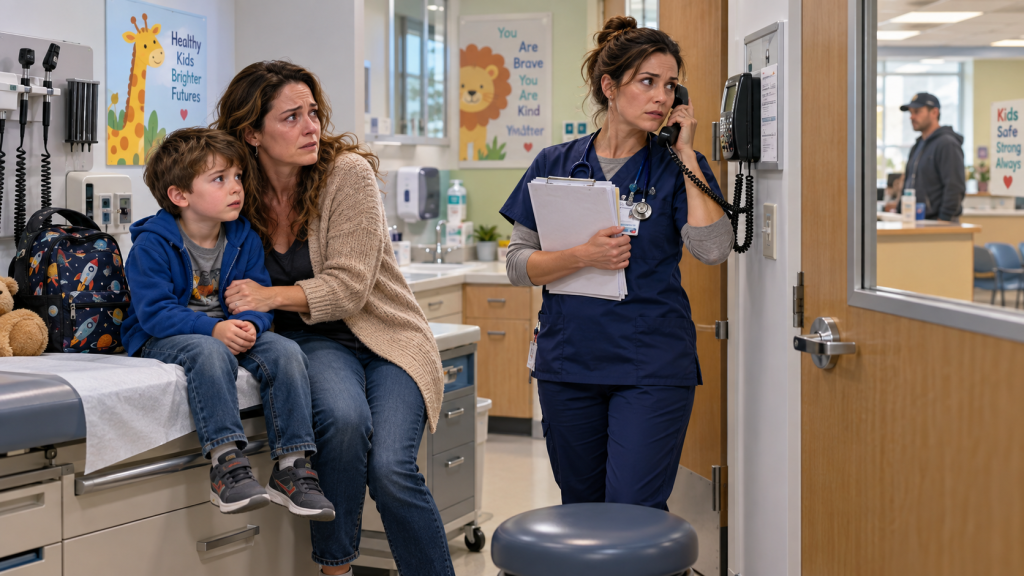
Nurse Anita stayed near the wall.
The phone was still in her hand.
Outside the closed door, I could hear a man’s voice.
Mike.
“Where is my wife?”
Then louder:
“I want to see my son.”
Caleb flinched so violently that the paper beneath him crackled.
Anita noticed.
Mara noticed.
I noticed.
How many times had I failed to notice before?
My son whispered:
“He’s not my dad.”
The sentence was so quiet I barely heard it.
Mara nodded.
“I know.”
Caleb looked toward me.
His lower lip trembled.
“He says I have to call him Dad if people ask.”
My stomach turned.
I opened my mouth.
Nothing came out.
Mara asked:
“Does Mrs. Bell know that?”
Caleb shook his head.
Then changed his mind.
A tiny nod.
Maybe.
I touched his hair.
“Mrs. Bell is your teacher?”
He nodded.
His kindergarten teacher.
A woman with silver hair, bright scarves, and the kind of handwriting that made every note home look like an invitation.
I had met her at conferences.
She had told me Caleb was imaginative.
Kind.
Good with numbers.
Sometimes anxious about transitions.
I remembered laughing.
“He gets that from me.”
Mike had been beside me.
His hand pressed against the back of my chair.
“He gets the worrying from her too.”
Mrs. Bell had looked at him.
Then at me.
I had smiled.
Because that was what I did whenever Mike made me the punch line in public.
Smile.
Make it easy.
Mara looked at Caleb’s backpack.
“Did you put that note inside?”
His face went pale.
“No.”
I stared.
“What?”
He looked at me.
Then down.
“Mrs. Bell did.”
The room seemed to shift.
Anita came closer.
“When?”
Caleb whispered:
“Yesterday.”
My heart started pounding.
“Why?”
He did not answer.
Mara said:
“Because she wanted someone to ask her?”
Another tiny nod.
I looked at the backpack.
The note had been sewn beneath the lining.
Not tossed into a pocket.
Not taped to the front.
Hidden.
Protected.
A six-year-old’s teacher had hidden a message inside his school bag.
Why?
Outside, Mike’s voice became louder.
“This is ridiculous. He has a rash.”
Anita stepped toward the door.
Mara lifted one hand.
“No.”
Anita stopped.
Mara looked at me.
“Do I have your permission to call Mrs. Bell?”
I did not even hesitate.
“Yes.”
Caleb grabbed my arm.
“No.”
I turned toward him.
“Why?”
His eyes filled.
“Mike said Mrs. Bell is trying to make you lose me.”
My chest tightened.
“What?”
He started crying.
“He said she thinks you’re a bad mom.”
I pulled him toward me.
“Caleb, look at me.”
He would not.
I touched his cheek.
“Look at me.”
Finally, those brown eyes lifted.
“Mrs. Bell has never told me that.”
“He said.”
“I know.”
“He said if I tell her stuff, people will come take me.”
My throat closed.
Mara said softly:
“What kind of stuff?”
Caleb buried his face against my chest.
“I don’t know.”
That was a child’s answer when he knew exactly what she meant and could not yet make his mouth cooperate.
I held him.
Mara did not push.
That was another thing she did right.
She pulled her chair farther back.
Made herself less large.
Less like a question.
Then she picked up the clinic phone.
“I’m going to call Mrs. Bell.”
Caleb did not protest again.
He only whispered:
“Don’t let Mike hear.”
“He won’t.”
Mara called the elementary school.
Asked for Mrs. Bell.
Introduced herself.
I could hear only her side.
“This is Mara Greene, social services, calling from Lakeshore Pediatric Clinic. I have Caleb here with his mother.”
Pause.
“Yes.”
Another pause.
Mara’s eyes lifted toward me.
Then:
“Yes, she’s here and she has given permission.”
A longer pause.
Her expression changed.
Not dramatically.
But enough.
“I understand.”
She reached for a pen.
“What date was that?”
She wrote.
Then:
“And you documented it?”
Another pause.
“Good.”
I felt something inside me begin to unravel.
“What?”
Mara held up one finger.
Wait.
I hated that finger.
I hated every second she listened while I sat there not knowing what my son’s teacher apparently knew about my own house.
Then Mara said:
“Did Caleb use those exact words?”
She wrote again.
My hands turned cold.
“What words?”
Caleb pressed closer.
Mara continued.
“And yesterday?”
She looked at the backpack.
“Yes, we found it.”
Her voice softened.
“No, you did the right thing.”
That sentence made me dizzy.
Right thing.
About what?
Then:
“I need you to preserve the drawings and your notes.”
My stomach dropped.
Drawings.
Caleb looked down.
Mara said:
“Someone may contact you today.”
Pause.
“Thank you, Mrs. Bell.”
She ended the call.
No one spoke.
I stared at her.
“Tell me.”
Mara looked first at Caleb.
Then at Anita.
Then back to me.
“Mrs. Bell says she has been concerned for approximately six weeks.”
Six weeks.
My mind immediately began counting backward.
Six weeks ago, Caleb had stopped singing in the bathtub.
Six weeks ago, his backpack started appearing beside his bed.
Six weeks ago, Mike had started saying kindergarten was making him “soft.”
“What concern?”
Mara asked Caleb:
“Can I tell Mom what Mrs. Bell told me?”
He stared at his sneakers.
Then nodded.
Mara turned to me.
“Caleb has asked to stay after school four times.”
I frowned.
“Stay?”
“Yes.”
“He likes school.”
Mara waited.
I heard how stupid that sounded.
“Did he say why?”
“Mrs. Bell says the first two times he told her he wanted to finish drawing.”
I looked at Caleb.
“The third time, he asked whether teachers sleep at school.”
My throat tightened.
“The fourth time, yesterday, he asked her if children could stay at school overnight if their house was ‘having a bad night.’”
I stopped breathing.
“No.”
The word came out automatically.
Not disagreement.
Pain.
Caleb began crying.
I pulled him against me.
“I’m sorry.”
Why was I apologizing?
Because I had not known.
Because some part of me believed mothers were supposed to know.
Because my son had been six years old, sitting in a kindergarten classroom, trying to invent reasons not to come home.
Mara continued gently.
“Mrs. Bell also said he has been keeping food in his backpack.”
I stared.
“What food?”
“Crackers. An apple. Granola bars.”
I looked at Caleb.
“Why?”
His shoulders shook.
“I get hungry.”
“You have food at home.”
He looked terrified.
I immediately regretted my tone.
“No, sweetheart. I’m not mad.”
He whispered:
“Mike says the kitchen closes after dinner.”
The room became perfectly still.
I stared at him.
“What?”
“He says if I don’t eat enough when everybody eats, then I have to wait till breakfast.”
I felt sick.
I worked three evenings a week at a dental billing office.
Mike handled dinner those nights.
He always told me Caleb had eaten well.
“Clean plate.”
“Asked for seconds.”
“Kid eats like a horse.”
I had believed him.
“Did he stop you from getting food?”
Caleb looked toward the door.
Mara said:
“You can answer Mom.”
Caleb nodded.
“How?”
“He puts the chair in front of the pantry.”
My mind pictured our kitchen chair.
Heavy oak.
Sometimes moved from the table.
I had noticed it by the pantry.
I had never asked why.
“And the fridge?”
“He says it squeaks.”
My chest hurt.
“So you weren’t allowed?”
He shook his head.
“If I wake him up, he gets mad.”
I whispered:
“What about when I’m home?”
Caleb looked confused.
“You let me.”
Of course.
Two houses inside one house.
One when I was there.
Another when I was not.
Mara waited.
Then asked:
“Mrs. Bell also mentioned a drawing.”
Caleb immediately said:
“I don’t want to.”
“Okay.”
She looked at me instead.
“She has a drawing Caleb made during a lesson about families.”
My hands tightened.
“He drew you.”
I swallowed.
“Himself.”
“Yes.”
“Mike.”
My son went rigid.
“And another adult man.”
There it was.
Everyone.
I felt the room tilt.
“What man?”
Caleb covered his face.
Mara did not answer for him.
I crouched in front of my son.
“Caleb.”
He began crying.
“Mom.”
“Who else lives at our house?”
He shook his head violently.
“Who?”
“Don’t be mad.”
“I won’t.”
“Promise?”
“I promise.”
“Mike said you’ll make him leave.”
I looked at Mara.
Then back.
“Who?”
Caleb whispered:
“Uncle Sean.”
I stared.
Mike’s brother.
Sean.
Thirty-two.
I had met him three times.
Once at our wedding.
Once at Christmas.
Once when he stopped by to borrow Mike’s truck.
He lived in Wisconsin.
Or that was what I thought.
“Sean?”
Caleb nodded.
“He doesn’t live with us.”
My son’s face crumpled.
“Yes, he does.”
The denial came from me before logic.
“He doesn’t.”
“He does.”
“Where?”
“The downstairs room.”
We had no downstairs bedroom.
We had a basement laundry room and unfinished storage area.
A cot could fit there.
My stomach twisted.
“How long?”
Caleb whispered:
“Since the snow.”
It was October.
First snow had been six weeks earlier.
Exactly when Caleb changed.
I looked at Anita.
Then Mara.
“Why don’t I know?”
Mara did not speculate.
Good.
Caleb answered.
“He goes away before you wake up.”
I felt cold.
“What?”
“Mike takes him somewhere.”
“When?”
“Before your alarm.”
I woke at six.
Mike woke at five-thirty.
Or said he did.
Gym.
Every morning.
I had believed he was at the gym.
“When does Sean come back?”
“When you work.”
My stomach dropped.
The dental office.
Three evenings.
“He comes home when you go to work?”
Caleb nodded.
“And leaves before I get back?”
“Sometimes.”
“Sometimes?”
“He sleeps downstairs if you’re tired.”
I looked away.
Our bedroom was upstairs.
Basement door off the kitchen.
If I came home at ten-thirty, exhausted, showered, went to bed—
Could someone have been below us?
Weeks.
I felt my skin crawl.
“Why was he there?”
Caleb shrugged.
“What does he do?”
“Watches TV.”
“There’s no TV downstairs.”
“On his phone.”
“Does he hurt you?”
Caleb went completely still.
Mara leaned forward slightly.
“Caleb, you do not have to answer everything right now.”
He whispered:
“No.”
Relief came too fast.
Then:
“Mike does.”
Everything inside me stopped.
No screaming.
No dramatic sound.
Just a sentence.
My six-year-old son saying it.
Mike does.
I took Caleb’s hands.
“What does Mike do?”
He pulled away.
Not from me.
From the question.
“I don’t want him to go to jail.”
My throat closed.
Mara said:
“We don’t need to talk about jail right now.”
“He said if police come, Mom will be alone.”
I looked at the ceiling.
For one second, anger became so enormous it almost separated me from my body.
Mike had not only frightened my child.
He had assigned Caleb responsibility for what happened to me afterward.
Six years old.
Protect Mom.
Keep Mike calm.
Keep the secret.
Eat at the right time.
Do not wake him.
Do not tell Mrs. Bell.
Do not say Uncle Sean lives downstairs.
Do not get Mom taken away.
That was why my son had become careful.
Not kindergarten.
Survival.
A knock came at the door.
Three quick taps.
Caleb nearly jumped off the table.
Mara said:
“It’s okay.”
Anita opened it only slightly.
Another woman stood outside.
Early fifties.
Navy cardigan.
Badge clipped to her belt.
She entered and closed the door.
“Mara?”
“Yes.”
The woman looked at me.
“My name is Lena Ortiz. I’m with child protective services.”
11:18.
That was the call.
The person I did not know.
The stranger who would become part of the worst day and, strangely, one of the safest.
I looked at Caleb.
He stared at her badge.
Then immediately whispered:
“Am I leaving Mom?”
My entire body broke.
I pulled him into me.
Lena crouched.
“No.”
Caleb stared.
“No?”
“Not based on what I know right now.”
He looked at me.
Lena continued.
“My job today is to help make sure you and your mom have somewhere safe to go.”
He whispered:
“Not home.”
“No.”
I looked at her.
“Why not home?”
Even as I asked, I knew.
Mike.
Sean.
Keys.
Control.
Lena’s voice remained calm.
“Until we understand who is there and what happened, I don’t recommend returning there with Caleb.”
“My clothes are there.”
“We can deal with clothes.”
“His medication.”
“We can get what he needs.”
“My purse is in the waiting room.”
Anita said:
“We have it.”
I looked at her.
She held up my purse.
“How?”
“Security brought it from Mike’s chair.”
Mike.
I had almost forgotten he was still outside.
Then, as if summoned by thought, his voice rose again.
“This is kidnapping!”
Caleb started shaking.
Lena stood.
“Does he have legal custody?”
“No.”
“He’s my husband. Caleb’s father is—”
I stopped.
Caleb’s biological father had left when Caleb was two.
Moved to Arizona.
Called on birthdays sometimes.
Mike had been in Caleb’s life for three years.
“He’s stepfather.”
“Any guardianship?”
“No.”
“Adoption?”
“No.”
She nodded.
That simplified one thing.
Not the important thing.
But one thing.
“We’re going to leave through the rear exit.”
My mouth went dry.
“With nothing?”
“With your son.”
The sentence landed.
Everything else suddenly became objects.
Phone.
Keys.
Clothes.
Bills.
Photos.
Furniture.
Objects.
I had my child.
Lena continued.
“Do you have somewhere Mike doesn’t have access?”
I thought.
My sister lived two hours away.
Mike knew her address.
My mother’s apartment.
Mike had a key from when she was recovering from surgery.
Friend?
When had I last spent time with a friend without Mike?
The question embarrassed me.
“No.”
That answer hurt.
Lena did not react.
“No problem.”
No judgment.
She explained there was a confidential family-violence shelter with available space.
My first instinct was horror.
A shelter?
Me?
I had a job.
A house.
A minivan.
A husband.
A laundry room.
A refrigerator with magnets on it.
Shelters were for women who had nothing.
Then I looked at my six-year-old son asking whether walls could hear.
I whispered:
“Yes.”
We left through the back.
No dramatic chase.
No Mike pounding on windows.
Security kept him in the front hallway while Anita guided us through a staff corridor.
That almost made it worse.
The ordinary efficiency of it.
Exam rooms.
Supply carts.
A break-room refrigerator.
Then a gray metal door opened to cold air.
My life before the appointment stayed on the other side.
Lena drove us.
Mara came separately.
Caleb sat in the back seat with me because he refused to let go of my hand.
Halfway there, he whispered:
“Mom.”
“Yes?”
“Are you mad?”
“No.”
“At me?”
“No.”
“Promise?”
“I promise.”
He stared out the window.
Then:
“I told Mrs. Bell.”
“I’m glad.”
“Mike said you’d cry.”
I swallowed.
“He was right.”
Caleb turned.
I touched his cheek.
“But crying is not the same as being mad at you.”
He nodded.
Then:
“He said you get confused.”
My chest tightened.
“He says that a lot.”
“I know.”
“Do you?”
Do I what?
Get confused?
The question hurt because I did not immediately know how to answer.
Mike had told me I forgot things for years.
Appointments.
Conversations.
Promises.
“You said you would.”
“You never told me.”
“You’re mixing things up again.”
At first, I argued.
Then I started writing things down.
Then Mike laughed about the notebook.
“See? Normal people don’t need evidence for conversations.”
Eventually I stopped arguing.
My son had been watching.
I said carefully:
“Everyone forgets things sometimes.”
Caleb waited.
“But Mike has told me I forget things that I don’t remember forgetting.”
That sounded absurd.
A six-year-old understood it better than I did.
“He lies.”
I looked at him.
“Yes.”
The word was difficult.
My husband lies.
Not jokes.
Not misunderstands.
Lies.
Caleb nodded.
As if that solved something.
For him, perhaps it did.
The shelter looked nothing like I imagined.
No sign.
No giant word SAFE above the entrance.
Just an ordinary building behind a locked gate.
The woman at intake was named Patrice.
She showed us a room with two twin beds.
A dresser.
A lamp.
Blue blanket.
Caleb touched the blanket.
“Do we sleep here?”
“For tonight.”
“Both?”
“Yes.”
His shoulders lowered.
That was when I understood how tired he was.
Not sleepy.
Tired of monitoring adults.
He climbed onto the bed.
Kept his backpack on.
I sat beside him.
“You can take that off.”
“No.”
“Okay.”
I did not force it.
For the next forty-eight hours, people asked me questions.
Police.
Lena.
A child-advocacy interviewer.
A lawyer from a domestic-violence organization.
A nurse practitioner who photographed the bruise and documented the rash.
Nobody asked Caleb the same thing over and over in front of me.
That mattered.
The child interviewer explained that repeating questions can affect children and increase stress.
I waited in another room.
That was one of the hardest hours of my life.
A television played silently.
There was a bowl of peppermints.
I unwrapped four.
Ate none.
When Caleb came out, he looked exhausted.
Not destroyed.
Just tired.
He climbed into my lap.
The interviewer, a woman named Dr. Shah, asked if she could speak to me privately later.
I said yes.
What she told me was worse than the bruise.
Not because there were horrors I had never imagined.
There were no weapons.
No broken bones.
No elaborate torture.
There was something quieter.
Mike had been teaching my son to disappear.
When Caleb interrupted television:
Laundry room.
When he cried too loudly:
Stand facing the wall.
When he asked for food after dinner:
Kitchen closed.
When he told me Mike had grabbed him once:
Mike later told Caleb I had nearly had a “breakdown” because of his lying.
Caleb learned that telling me the truth hurt me.
So he stopped.
The bruise came from Mike gripping his upper arm two nights before the appointment after Caleb tried to follow me into the garage when I was leaving for work.
Mike told him:
“Mom needs peace from you.”
I had never said that.
The sentence broke something inside me.
How many times had Mike translated my needs into rejection my child could understand?
Mom’s tired.
Mom can’t deal with this.
Mom gets overwhelmed.
Mom gets nervous driving.
Mom forgets.
Mom needs quiet.
Mom needs me to handle things.
He had made himself interpreter between us.
Just like he had become interpreter between me and reality.
Then there was Sean.
Caleb told the interviewer Sean slept downstairs three or four nights a week.
Sean did not hurt Caleb.
In fact, according to Caleb, Sean sometimes slipped him crackers after Mike went to bed.
That detail destroyed me.
A grown man secretly living in my basement had noticed my son was hungry before I did.
But Sean frightened him in other ways.
He and Mike drank downstairs.
Argued.
Once Sean punched a storage cabinet.
Caleb thought someone was being hurt.
Mike told him never to mention Sean because “Mom gets dramatic and will make him homeless.”
Again.
Responsibility handed to a child.
If you tell, Sean is homeless.
If you tell, Mom cries.
If you tell, police come.
If you tell, you lose Mom.
Silence disguised as protection.
Mrs. Bell arrived at the advocacy center that afternoon.
Not to question Caleb.
To give investigators her documentation.
I saw her in the hallway.
She stopped when she saw me.
For a moment, neither of us moved.
Then I walked toward her.
“Why didn’t you call me?”
It came out harsher than I intended.
Her face hurt.
“I tried.”
I stared.
“What?”
She opened a folder.
Three email printouts.
Two phone logs.
“September nineteenth.”
She slid one page toward me.
Hi, I’d like to check in regarding some changes I’ve noticed in Caleb’s behavior. Nothing urgent, but please call when you have a moment.
Sent to my email.
I had never seen it.
Below was a reply.
From my account.
Thanks. Mike and I are aware. Caleb has been struggling with attention-seeking since school started. We’re addressing it at home. Please do not reinforce dramatic behavior.
I felt sick.
“That wasn’t me.”
“I know that now.”
“How?”
“Because the next email didn’t sound like you either.”
Another.
Mrs. Bell had written after Caleb asked whether teachers slept at school.
The reply:
Please direct all concerns about Caleb to Mike going forward. I tend to catastrophize and he has better perspective.
My knees weakened.
Mike had my email password.
We shared a family tablet.
He knew everything.
Mrs. Bell continued.
“I called your number.”
“What happened?”
“Mike answered.”
Of course.
“He said you were resting.”
I thought about the date.
I had been at work.
“He said you had been having anxiety.”
My face burned.
“And I believed him.”
She shook her head.
“I should have asked more.”
“Why didn’t you?”
Her eyes filled.
“Because adults are very good at sounding reasonable.”
That sentence stayed with me.
She continued.
“Then Caleb made the family drawing.”
She opened another folder.
A page.
Crayon.
Blue house.
Stick people.
Me.
Caleb.
Mike.
A fourth figure drawn in gray near the bottom.
Label:
SEAN DOWN STAIRS
The word downstairs split into two lines.
Mrs. Bell said:
“I asked who Sean was.”
“What did Caleb say?”
“That he wasn’t supposed to be in the picture.”
My throat tightened.
“What did you do?”
“I documented it.”
“Why didn’t you report then?”
Her face changed.
“I consulted the school counselor.”
That angered me.
“You consulted?”
“Yes.”
“A child told you somebody secretly lived in his house.”
“He did not disclose harm.”
She did not defend herself angrily.
That helped.
“He said Sean was his uncle.”
“Adults sometimes have relatives stay temporarily.”
She swallowed.
“I did not have enough to know whether secrecy meant danger or simply something the family wanted private.”
I hated that answer.
Because it was reasonable.
And because reasonable things can still fail children.
Mrs. Bell continued.
“Yesterday he came to school with no lunch.”
I stared.
“What?”
“He said he forgot it.”
“I packed it.”
Caleb had taken a lunch.
Peanut-butter sandwich.
Apple slices.
Goldfish crackers.
I remembered.
Mrs. Bell said:
“He later told me Mike threw it away because Caleb had packed his backpack by the door without permission.”
I covered my mouth.
Why?
Because the backpack beside his bed annoyed Mike.
“He ate cafeteria lunch.”
She continued.
“After school, he asked me if a mom could get in trouble because a kid told something.”
My eyes filled.
“I asked what he wanted to tell.”
“He wouldn’t.”
“So I told him he could write down the name of one person he wanted a safe adult to ask.”
“And he wrote you.”
“No.”
Mrs. Bell looked toward Caleb’s room.
“He wrote me.”
Ask Mrs. Bell.
The note was not a message to adults about Mike.
It was a lifeline back to the teacher who already knew the beginning.
“Why sew it in?”
“Because he told me Mike checks his backpack.”
I closed my eyes.
“He asked if I could hide it where Mike wouldn’t find it.”
She began crying.
“I used the emergency sewing kit in the nurse’s office.”
I laughed once through my tears.
Of course.
A teacher.
A needle.
A backpack lining.
Three words.
We build rescue out of whatever is nearby.
“I’m sorry,” she whispered.
“For what?”
“For not understanding sooner.”
I looked at her.
I had the same apology inside me.
We both knew it would never be enough to change what had already happened.
But maybe apologies are not supposed to change history.
Maybe they are supposed to change the next choice.
“You helped him.”
She shook her head.
“So did Anita.”
I thought of Nurse Anita noticing a bruise I had not seen.
Closing the door.
Calling Room 4.
Back exit.
Ordinary professionals doing ordinary parts of their jobs carefully.
That night at the shelter, Caleb finally took off the backpack.
Not because I asked.
He placed it between our beds.
Then climbed under his blanket.
“Mom?”
“Yes?”
“Are we going home tomorrow?”
My throat tightened.
“No.”
He looked relieved.
Then ashamed of being relieved.
I saw both.
“Where are we going?”
“I don’t know yet.”
He nodded.
Children deserve more certainty than that.
But false certainty had already done enough damage.
“Will Mike come?”
“No.”
“Promise?”
I hesitated.
Not because I planned to let him.
Because I had learned promises should not exceed what I could control.
“I promise I will do everything I can to keep him away from you.”
Caleb stared.
“That’s a weird promise.”
“I know.”
“Okay.”
He rolled over.
Five minutes later:
“Mom?”
“Yes?”
“Can I have crackers?”
I almost cried.
Instead I smiled.
“Yes.”
It was nine-forty.
The kitchen was technically closed for residents after nine except emergencies.
I went to Patrice.
“My son is hungry.”
She opened a cabinet.
No lecture.
No punishment.
Peanut-butter crackers.
Applesauce.
A juice box.
Caleb ate all of it.
Every bite.
I sat beside him trying not to let him see my face break.
The next morning, I received eleven texts from Mike on the new phone number he was not supposed to have.
My old number had been shut off.
Somehow he had gotten the temporary line.
I later learned he called my mother pretending the clinic needed it.
First message:
This has gone far enough.
Second:
You know Caleb exaggerates.
Third:
You’re letting strangers destroy our family.
Fourth:
Please remember you get confused when you panic.
There it was.
Even now.
Then:
Sean is not “living” with us. He stayed a few nights.
Nothing happened.
You are overreacting exactly like I was afraid you would.
Then:
If you keep this up, everyone will see why I have to manage things for you.
I stared at that one.
Not anger.
Clarity.
There are sentences that, once seen from the outside, reveal an entire structure.
Why I have to manage things for you.
Not help.
Manage.
My phone.
Driving.
Passwords.
Appointments.
Money.
Caleb.
What I remembered.
What I felt.
What was reasonable.
Mike had slowly become the person who certified my reality.
I had thought marriage meant relying on someone.
I had not noticed reliance becoming permission.
Lena photographed the messages.
The attorney, Grace Miller, told me not to reply.
“Can I block him?”
“Yes.”
“What if he needs to reach me?”
“For what?”
I opened my mouth.
Nothing.
Our bills?
The house?
His feelings?
I laughed bitterly.
Grace waited.
Then said:
“You are allowed to stop being available while safety issues are being assessed.”
That sentence felt illegal.
Allowed to stop being available.
I blocked him.
For the first time in seven years, Mike could not reach me whenever he wanted.
I expected panic.
Instead I slept for three hours in the middle of the afternoon.
My body had apparently been waiting for permission too.
Police went to the house with child-protection investigators.
Sean was there.
At ten in the morning.
Not Wisconsin.
Not visiting.
Living in my basement.
They found a cot.
Clothes.
Medication.
Mail addressed to him at our house.
Three empty liquor bottles.
No crime in most of that.
Just proof.
Sean admitted he had stayed there for almost two months.
He said Mike told him I knew.
Of course.
Everyone had a version where someone else knew.
Sean also admitted he had seen Mike grab Caleb.
Once.
Maybe twice.
He minimized.
Then investigators showed him a photograph of the bruise.
His story became less certain.
“He’s strict.”
“Caleb can be difficult.”
“He gets mouthy.”
Six.
Years.
Old.
I was not there when Sean said those things.
Good.
I would not have remained calm.
Then Sean said something investigators later told my attorney:
“Mike says she’s too soft. He has to be the parent because she’s anxious.”
There it was.
His philosophy.
Not one bad night.
Authority.
He believed my softness disqualified me.
He believed fear made him necessary.
The temporary protective order was granted that afternoon.
Mike could not contact Caleb.
Could not come to the shelter.
Could not contact me except through attorneys regarding essential logistics.
The house became inaccessible to him temporarily while the order was reviewed.
I did not return immediately.
I was afraid.
That embarrassed me too.
My own house.
Kitchen.
Bedroom.
Bathroom.
I pictured the basement door.
Sean’s cot.
Chair by the pantry.
Places changed once you learn what happened in them while you were not looking.
Three days later, I went back with a police escort, Lena, and my sister Rachel.
Mike was not there.
Sean had removed most of his things.
The house smelled exactly the same.
Laundry soap.
Coffee.
The cinnamon candle Mike liked.
It offended me.
I had expected evil to leave a smell.
It did not.
Rachel squeezed my hand.
“Take what you need.”
I went to Caleb’s room first.
Backpack hook.
Empty.
Stuffed dinosaur.
Three library books.
Pajamas.
Then I opened his closet.
On the floor was a cereal bar wrapper.
Then another.
Behind his toy bin:
Two crackers in a sandwich bag.
Emergency food.
My son had been building reserves in his own bedroom.
I sat on the carpet.
Rachel found me there.
“What happened?”
I held up the crackers.
She understood.
I cried so hard no sound came out.
My sister sat beside me.
No speech.
No “you couldn’t have known.”
Good.
I could not have tolerated comfort that quickly.
After a while I said:
“I bought the food.”
Rachel looked at me.
“What?”
“I bought the crackers.”
My voice cracked.
“I put them in the pantry and somehow my kid had to hide them from my husband.”
She took my hand.
“I know.”
“I was right there.”
“You were working.”
“That’s not enough.”
“No.”
I looked at her.
I expected reassurance.
She did not give me cheap reassurance.
She said:
“You’re going to have to live with the fact that you missed things.”
That hurt.
Then:
“And you’re going to have to decide what you do with that fact.”
That saved me.
Not innocence.
Responsibility without destruction.
I could not change the weeks before Room 4.
I could change every day after.
I packed Caleb’s clothes.
His dinosaur.
School things.
Birth certificate.
My documents.
Medication.
Then I went into our bedroom.
My side of the closet looked ordinary.
Mike’s nightstand.
Wallet tray.
Chargers.
Everything.
I opened the desk drawer.
Inside was a notebook.
Not mine.
Mike’s.
I almost left it.
Then saw my name.
A page titled:
INCIDENTS
Dates.
Notes.
8/14 — forgot dentist appointment until reminded.
I stared.
I had not forgotten.
The office changed the appointment and called Mike’s number.
I remembered because I had been irritated.
Next:
8/29 — became emotional driving downtown.
He had criticized every turn until I pulled over and told him to drive.
Next:
9/3 — misplaced debit card.
He had moved it to his wallet because he bought groceries.
Next:
9/11 — accused me of moving keys. Found in her purse.
No.
I remembered that morning.
I searched for forty minutes.
Mike found them in my purse after going into the bedroom alone.
At the time I had laughed.
“I’m losing it.”
He had kissed my forehead.
“You’re lucky you have me.”
My skin crawled.
Page after page.
A record designed to prove a pattern.
Why?
Control?
Preparation?
A story for later?
I photographed every page.
Grace took the notebook.
“This matters.”
“For what?”
“At minimum, it provides context for the repeated claims that you’re confused.”
My stomach turned.
“Was he planning something?”
“We don’t know.”
That uncertainty was frightening enough.
Then we found something else.
Printed emails.
Messages between Mike and Caleb’s school.
My account.
His replies.
He had saved them.
Why?
Maybe because people who manipulate systems often feel safest when they document their own version.
In one message to the school counselor:
My wife is loving but emotionally reactive. Please copy me on behavioral concerns so I can help determine what is serious before she becomes overwhelmed.
I sat down.
He had been discrediting me before I knew there was anything to discredit.
The counselor replied:
We prefer to communicate with both guardians whenever possible.
Mike:
Of course. I’m only trying to support her.
Support.
Another word ruined.
The attorney asked whether there had been physical violence toward me.
I said no.
Then stopped.
Had there?
He had never hit me.
Never punched a wall near me.
Never shoved me.
But he had blocked doorways during arguments.
Taken my keys once because I was “too upset to drive.”
Held my wrists when I tried to leave the kitchen.
Not painfully.
Just enough.
I had not called that violence.
Grace did not force a label.
She simply wrote it down.
“Has he controlled access to money?”
“Our main account is joint.”
“Can you access it?”
“Yes.”
“Passwords?”
“He changed online banking last month.”
“Did you know the new password?”
I realized I did not.
“He said the bank made us reset.”
“Did he give it to you?”
“No.”
“Phone account?”
“His name.”
“Vehicle?”
“His.”
“House?”
“Both.”
She nodded.
Not one dramatic chain.
Many small dependencies.
That was how it happened.
Driving:
He’s better in traffic.
Phone:
Family plan is cheaper.
Banking:
He handles bills.
Email:
He knows passwords in case something happens.
Discipline:
He’s firmer.
School:
He communicates better.
Appointments:
I forget.
Piece by piece, competence had migrated away from me.
By the time Nurse Anita closed the door, I had been living in a life where my husband was the authority on whether I could trust my own reaction.
No wonder I froze when Caleb spoke.
I had been trained to doubt the first alarm.
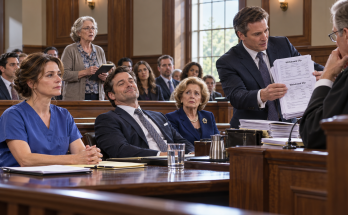
The court hearing for the longer protective order happened two weeks later.
Mike wore a navy suit.
He looked exactly like the man I married.
That was the worst part.
No monster.
No theatrical sneer.
Clean shirt.
Trimmed beard.
Wedding ring.
He looked tired.
Sad.
Reasonable.
His attorney said the situation had been “grossly misunderstood.”
Caleb was sensitive.
Mike used “appropriate physical guidance.”
Sean stayed occasionally because he was between apartments.
The food rules were “routine household structure.”
The laundry room was never locked.
Mike had only asked Caleb to stand there during time-outs.
And I—
There it was.
I suffered from anxiety.
I catastrophized.
Mike had been “compensating for instability in the home.”
His attorney introduced printed notes from the notebook.
Incidents.
Forgetfulness.
Emotional reactions.
I felt myself disappearing in real time.
Then Grace stood.
One by one, she introduced context.
Dentist appointment:
Clinic call logs showed Mike received the reschedule.
Driving:
No traffic citation.
No accident.
No medical restriction.
Debit card:
Purchase records showed Mike used it the same evening he claimed I misplaced it.
School communication:
Emails sent from my account originated from our home tablet at times I was clocked in at work.
The notebook that was supposed to prove I was unstable began proving something else.
Curation.
Narrative.
A husband documenting his wife selectively while speaking for her to others.
Then Anita testified.
Not emotionally.
Clinically.
Bruise.
Location.
Shape.
Child’s behavior.
Question:
“Can Mike hear through walls?”
Mara testified about the immediate safety assessment.
Mrs. Bell testified about the behavioral changes.
Food.
Staying after school.
The family drawing.
The hidden note.
Then Sean.
I expected him to protect his brother.
He tried.
At first.
But under questioning, he admitted he had been sleeping in the basement several nights a week.
Admitted Mike told him not to mention it to me.
Admitted he had given Caleb food at night.
Grace asked:
“Why?”
Sean shifted.
“Kid said he was hungry.”
“Was food available in the home?”
“Yes.”
“So why did he need you to give it secretly?”
Sean looked toward Mike.
Then down.
“Mike had rules.”
“What rules?”
“Kitchen closed after dinner.”
“How old was Caleb?”
Silence.
“Six.”
Then:
“Did you ever see Mike grab Caleb?”
Sean hesitated.
“Yes.”
The courtroom became very still.
“How?”
“Arm.”
“Hard?”
“I don’t know.”
“Did Caleb cry?”
Sean looked miserable.
“Yes.”
Mike stared at his brother.
That stare told me something too.
Fear travels through families in different directions.
Sean had been afraid of him as well.
Not the way Caleb was.
Not the way I had become.
But enough.
The judge extended the protective order.
Mike could not contact Caleb.
Could not return to the house while the family case proceeded.
Could communicate with me only through a monitored parenting application regarding property and legal matters.
He had no parental rights to Caleb absent adoption.
That became important.
He could not demand visitation simply because he had been stepfather.
He tried anyway.
His attorney withdrew that request quickly.
Child protection substantiated the physical and emotional maltreatment concerns.
Criminal charges followed for the incident that caused the bruise and related conduct.
The case ended months later in a plea agreement.
Probation.
Mandatory intervention program.
No contact with Caleb.
Other conditions.
Some people were angry the punishment was not larger.
I was not sure what I felt.
I did not need Mike destroyed.
I needed him away from my son.
I needed a record that said:
This happened.
I needed my child to see adults believe him.
The divorce took longer.
Money.
House.
Furniture.
Ordinary things become grotesque during divorce because people argue about lamps while their family is collapsing.
Mike wanted the house sold.
So did I.
I could not imagine living there.
We listed it.
When the photographer came, she asked me to remove personal items.
Family pictures.
School art.
I took down a photograph of the three of us at a pumpkin patch.
Caleb was five.
Mike had him on his shoulders.
I stared at it.
Was that day fake?
No.
That was another hard thing.
There had been good days.
Real ones.
Mike taught Caleb to ride a bike.
Made pancakes shaped like dinosaurs.
Stayed up all night when Caleb had the flu.
He had also frightened him.
Hurt him.
Controlled him.
Human beings do not become easy to understand merely because you discover something terrible.
I stopped needing Mike to have been evil every minute.
He had done enough harm in the minutes that mattered.
The house sold.
My share of the equity was enough for a deposit on a small rental townhouse near Caleb’s school.
Two bedrooms.
One bathroom.
Tiny kitchen.
No basement.
Caleb liked that immediately.
“No downstairs?”
“No.”
“Good.”
His room faced a courtyard.
The first night, he put his backpack beside the bed.
I did not move it.
He slept with the lamp on.
I did not turn it off.
At 1:20 a.m., he appeared beside my bed.
“Can I have cereal?”
I sat up.
“Now?”
His face changed.
Fear.
Immediately.
I heard myself.
Not the words.
The tone.
The reflex of a tired parent about to say no.
Then I understood the question underneath.
Is the kitchen open here?
I got up.
We ate cereal at 1:24 in the morning.
Chocolate cereal.
Too much sugar.
No nutritional value.
Perfect.
Caleb watched me after every bite.
Finally he asked:
“Can I do this every night?”
“No.”
He froze.
I smiled.
“Because you have school and your body needs sleep.”
He waited.
“But if you’re hungry, you can always tell me.”
“Even late?”
“Yes.”
“Even if you’re tired?”
“Yes.”
“What if you’re mad?”
“If I’m mad, you can still eat.”
His shoulders relaxed.
Then:
“Okay.”
That was how we rebuilt.
Not with speeches.
Rules.
Clear ones.
You can eat.
You can wake me.
You can ask.
You can say no to hugs.
You can tell Mrs. Bell things.
You can tell me things.
If an adult says not to tell me, tell me.
If I cry, that is my feeling to handle.
You do not protect me from truth.
That last one took months.
Caleb would watch my face whenever he disclosed something.
“He yelled that time.”
Pause.
My expression.
“Mike called you stupid once.”
Pause.
My expression.
“Sean said Mike was crazy.”
Pause.
My expression.
He was checking whether honesty broke me.
So I learned to let my face stay open.
Not blank.
Not fake.
Open.
“That makes me sad.”
“I can handle sad.”
“That makes me angry.”
“I can handle angry.”
“Thank you for telling me.”
Again.
Again.
Again.
Until he believed me.
Dr. Shah became his therapist.
Play therapy at first.
He built houses from blocks.
Always two exits.
Every house.
Front door.
Back door.
Sometimes a window labeled escape.
I cried when she told me.
Then she stopped telling me details unless Caleb wanted them shared.
That was healthy too.
His therapy was not my evidence file.
It belonged to him.
I started therapy as well.
I hated it for three months.
My therapist, Nora Chen, asked irritating questions like:
“When did you first begin treating Mike’s certainty as more trustworthy than your own perception?”
I said:
“When he was right a lot.”
She asked:
“Was he?”
I got angry.
Then went home and thought about it for two days.
Mike had not begun by being wrong.
That was important.
When we met, I was newly divorced from Caleb’s father and exhausted.
Mike remembered appointments.
Changed my tire.
Organized bills.
He was good in traffic.
Good with forms.
Good in emergencies.
Reliability became authority slowly.
I handed him things because he handled them well.
Then he started taking things because he believed he handled them better.
Then eventually I stopped noticing the difference.
Therapy helped me understand that boundaries do not fail only when someone crosses them.
Sometimes they disappear because everyone praises how convenient life is without them.
I got my own phone plan.
Ridiculous how emotional that was.
The sales clerk asked:
“Do you want to keep your number?”
I said no.
New number.
Mine.
I opened a bank account in my name.
Set my own passwords.
Bought a used Honda.
The first time I drove downtown alone, my hands shook.
Mike’s voice lived in the passenger seat.
You get nervous.
You miss exits.
You overreact.
I missed an exit.
Nothing happened.
GPS rerouted.
That was one of the great revelations of my adulthood.
You can miss an exit and nobody dies.
You can make a wrong turn and still arrive.
Mistakes do not prove incompetence.
They prove movement.
I parked outside a bookstore and cried.
Then bought myself coffee.
No one rescued me.
Good.
At school, Mrs. Bell remained careful.
She did not become some saintly second mother.
She stayed Caleb’s teacher.
That helped.
Routine.
Morning greeting.
Reading groups.
Glue sticks.
Calendar time.
When he returned after two weeks away, she said only:
“We saved your cubby.”
Caleb looked at me.
Then walked inside.
No public welcome.
No class knowing.
Privacy without secrecy.
Different thing.
A month later, he stopped asking to stay after school.
Mrs. Bell noticed.
She told me at pickup.
“He packed up before I reminded him.”
I cried in the parking lot.
Of course.
One afternoon, Caleb came home singing.
I was washing dishes.
At first I did not register it.
Then I froze.
A ridiculous song about a frog.
Off-key.
Loud.
He went into the bathroom.
The bathtub started.
He kept singing.
I put both hands on the sink.
Weeks before the clinic, I had noticed the silence.
Not understood it.
Now sound returned.
Healing announced itself in a six-year-old shouting about frogs through a bathroom door.
I sat on the kitchen floor and cried.
Quietly.
He did not need to see that one.
The rash cleared too.
It really was mostly the laundry soap.
Anita had been right about that.
Cheap detergent.
Eczema.
Nothing sinister.
I loved that.
A plain little rash.
Something ordinary had brought us into Room 4.
People want warnings to be dramatic.
Blood.
Broken glass.
Screaming.
Sometimes help arrives because a nurse lifts a T-shirt sleeve while checking irritated skin.
I wrote Anita a note.
Not immediately.
Six months later.
You asked who lived in our house.
Thank you for noticing the answer before I did.
She wrote back:
Caleb answered. I listened. Keep listening.
I framed nothing.
Some words belong in a drawer where you can find them when needed.
Mike contacted me once outside the allowed system.
A letter.
No return address.
Three pages.
He apologized.
Sort of.
Then explained.
A lot.
He had been under stress.
Sean needed housing.
I worked late.
Caleb was defiant.
He had been raised with discipline.
He never meant to frighten anyone.
He had tried to keep the family functioning.
He regretted that “things were interpreted as controlling.”
I stopped reading.
That phrase.
Interpreted as.
An apology that places the harm inside the listener’s interpretation is not an apology.
At the bottom, one sentence:
I hope someday Caleb remembers the good things too.
I sat with that.
Then put the letter away.
I did not show Caleb.
He was seven.
His memory was not Mike’s rehabilitation program.
Years later, when Caleb asked whether Mike ever wrote, I told him yes.
He wanted to read it.
I said:
“When you’re older.”
He was angry.
Good.
Children are allowed to be angry at boundaries too.
At fourteen, he asked again.
We discussed it with his therapist.
Then I gave him the letter.
He read it once.
Handed it back.
“That’s not an apology.”
I almost laughed.
“What makes you say that?”
“He keeps saying why.”
I stared.
My son had learned something by fourteen that took me until thirty-eight.
He continued.
“If you’re sorry, you can explain later.”
Then:
“First you say what you did.”
Exactly.
I thought of the notebook.
Incidents.
Mike had spent years writing down what I did.
He had never been as precise about himself.
Caleb folded the letter.
“I remember good things.”
I waited.
“He taught me to ride my bike.”
“Yes.”
“He made pancakes.”
“Yes.”
“I liked him before.”
“I know.”
His face tightened.
“That makes me feel stupid.”
“No.”
The word came quickly.
“Liking someone is not a promise that they can never hurt you.”
He looked at me.
I continued.
“And being hurt by someone doesn’t mean every good memory becomes fake.”
He sat with that.
“Can I hate him?”
I thought carefully.
“You can feel what you feel.”
“That’s therapy talk.”
“Yes.”
“Annoying.”
“Very.”
He smiled.
Then:
“I don’t want to hate him forever.”
“You don’t have to decide forever at fourteen.”
That helped.
Me too.
Sean contacted me before Mike did.
One year after the divorce.
An email.
Short.
I owe you an apology. I knew he was too hard on Caleb. I accepted free housing because I didn’t want to lose it. I told myself it wasn’t my business. It was. I’m sorry.
I stared at it.
That apology was better.
Not enough to create relationship.
Enough to acknowledge truth.
I replied:
Thank you for saying it plainly. Do not contact Caleb.
He answered:
Understood.
And did not.
That mattered.
Rachel, my sister, became more present after everything.
Not invasively.
She came Tuesday evenings.
Sometimes dinner.
Sometimes laundry.
Once she told me:
“I’m angry at myself.”
“For what?”
“I thought Mike was controlling.”
I stared.
“You never said.”
“I thought you’d defend him.”
“Maybe I would have.”
“I know.”
That hurt.
Then she said:
“I should’ve risked annoying you.”
I laughed sadly.
“Yes.”
She nodded.
“Yes.”
We promised each other something afterward.
Not that we would always know.
Not that we would interfere in every relationship.
Just:
If one of us saw something that scared us, we would say it once clearly.
No hints.
No jokes.
No “I never liked him anyway” after the fact.
Clear.
I am worried because—
Specific behavior.
Then respect the adult hearing it.
That became another kind of safety.
Caleb grew.
Eight.
Ten.
Twelve.
The backpack changed too.
At seven, it still slept beside his bed.
At eight, it moved to the chair.
At nine, sometimes the hallway.
At ten, he left it downstairs overnight.
I noticed.
Said nothing.
Then one morning he could not find it.
He ran around yelling:
“Mom! Where’s my backpack?”
I stood in the kitchen.
He froze.
Then we both started laughing.
For years, that backpack had never left his sight.
Now he had misplaced it.
What a beautiful problem.
It was in the car.
Of course.
At eleven, he started singing in the shower instead of the bathtub.
Worse singing.
More confidence.
At twelve, he complained when I asked too many questions.
Normal.
I loved his irritation.
“Mom, you don’t need to know every single thing.”
He had no idea how beautiful that sentence sounded.
A child trusting he was allowed private thoughts.
I learned the difference between secrecy and privacy because of him.
Privacy:
Door closed.
Journal unread.
Phone respected within age-appropriate rules.
Conversations with therapist that were not mine.
Secrecy:
Do not tell Mom or something bad will happen.
One protects personhood.
The other protects power.
At thirteen, he asked why I stayed with Mike as long as I did.
Not accusing.
Curious.
I answered badly at first.
“I didn’t know.”
He frowned.
“You knew he was mean sometimes.”
I wanted to defend myself.
Then remembered.
Tell truth.
“I knew some things.”
“Like what?”
“He criticized me.”
“He controlled more decisions than I liked.”
“I knew you got quieter.”
His eyes filled.
“Then why?”
I swallowed.
“Because each thing seemed explainable by itself.”
He waited.
“I was tired.”
“I loved him.”
“He helped us in some ways.”
“I thought conflict meant I was overreacting.”
“And because once you start doubting your own judgment, every new warning has to pass through the same doubt.”
Caleb looked down.
“That sucks.”
“Yes.”
He thought.
“Do you think it could happen to you again?”
That question humbled me.
I wanted to say no.
Never.
I know better now.
But certainty was one of the things I had stopped worshipping.
“It could.”
He looked alarmed.
I smiled.
“That’s why I have people I talk to.”
“Aunt Rachel?”
“Yes.”
“Nora?”
“My therapist, yes.”
“Me?”
“Not about adult relationship decisions.”
He looked offended.
“Why?”
“Because you’re my son.”
“Even when I’m grown?”
“Especially.”
I touched his shoulder.
“You are allowed to notice things.”
“You can tell me if someone treats you or me badly.”
“But you are not responsible for keeping me safe from my choices.”
His face softened.
That mattered.
I did not want to replace one burden with another.
Caleb had already spent six years thinking he needed to protect my feelings.
He deserved the rest of his life without that job.
At fifteen, he began dating a girl named Ava.
First girlfriend.
Terrifying for me.
Not because of sex.
Not even heartbreak.
Because I watched how he responded to conflict.
The first time Ava told him she needed space, he came home devastated.
“What does that mean?”
“It means she needs space.”
“What if she breaks up with me?”
“She might.”
“What do I do?”
“Respect the space.”
He stared.
“That’s awful.”
“Yes.”
Three days later, they talked.
Stayed together another six months.
Then broke up.
He cried.
Did not demand access.
Did not monitor her.
Did not show up at her house.
I was prouder than I could tell him without making his breakup weird.
He had learned that love does not turn fear into permission.
At sixteen, he asked if Mike knew where we lived.
“Yes.”
Our address was no longer confidential by then.
“Do you think he’ll come?”
“No.”
“How do you know?”
“I don’t.”
He stared.
I continued.
“But he has complied with the no-contact orders.”
“Does that mean he changed?”
“I don’t know.”
“Do you care?”
I thought.
“Less than I used to.”
That was true.
For years, I had wanted to know whether Mike understood.
Whether treatment changed him.
Whether losing us taught him.
Whether he regretted.
Eventually I realized his growth was not required for ours.
He could change.
Not change.
Remarry.
Live alone.
Become kinder.
Become worse.
Our safety could not remain attached to his development.
That was freedom.
At seventeen, Caleb had his annual physical.
Same clinic.
Different exam room.
Nurse Anita still worked there.
Older.
Same steady face.
She looked at him.
“You got tall.”
He smiled.
“You got shorter.”
I almost died.
Anita laughed.
Then asked the usual questions.
Sleep.
School.
Mood.
Home.
“Who lives with you?”
Caleb looked at me.
For half a second, eleven years disappeared.
Sneakers hitting metal.
Do I have to say everyone?
Then he looked back at Anita.
“Just me and Mom.”
No fear.
No door.
No whisper.
Anita nodded.
“Anybody else staying regularly?”
“Nope.”
She wrote it down.
Routine.
A box on a form.
I stared at the clipboard.
Anita noticed.
After Caleb left for the bathroom, she said:
“You okay?”
I laughed.
“Yeah.”
“You sure?”
“I remember.”
Her face softened.
“So do I.”
I looked at her.
“Do you remember the time?”
“What time?”
“11:18.”
She thought.
Then shook her head.
“I remember the room.”
Of course.
I had turned the time into a landmark.
She had seen hundreds of children since.
That was oddly comforting.
The worst day of my life had been one professional morning in hers.
People do not have to carry your trauma forever to have helped you survive it.
“Thank you,” I said.
Again.
She smiled.
“How’s the singing?”
I stared.
“What?”
“You told me once he had stopped singing in the bath.”
I had forgotten telling her.
“He sings terribly.”
“Good.”
“Very.”
That evening, Caleb drove us home.
Learner’s permit.
My hands gripped the door.
He laughed.
“You’re nervous.”
“Reasonably.”
“You hate traffic.”
I stared at him.
Then we both realized.
Mike’s old sentence.
You get nervous in town traffic.
For years, even after leaving, the phrase bothered me.
Now my seventeen-year-old son said it as a joke while carefully checking his mirror.
I looked out the window.
“I can handle nervous.”
Caleb smiled.
“Me too.”
That became another family rule.
Feelings are not disqualifications.
Nervous people can drive.
Sad people can parent.
Angry people can speak carefully.
Scared children can tell the truth.
Crying mothers can listen.
No one needs to be perfectly calm to deserve credibility.
Caleb graduated high school with honors.
Not valedictorian.
Not a miracle prodigy.
Normal smart kid.
He loved environmental science.
Played terrible guitar.
Forgot laundry in the washer.
Left cups in his room.
Argued about curfew.
Beautifully ordinary.
At graduation, Mrs. Bell came.
She had retired two years earlier.
Caleb invited her himself.
I did not know until I saw her in the bleachers.
Silver hair now completely white.
Bright scarf.
Of course.
After the ceremony, Caleb hugged her.
Then handed her something.
A small envelope.
She opened it later.
I learned what it contained because she called me.
A note.
Three words on one side:
ASK MRS. BELL
And beneath them, in Caleb’s adult handwriting:
You answered.
Mrs. Bell cried.
So did I.
Nurse Anita received a card too.
Caleb wrote:
Thank you for closing the door.
Mara got one:
Thank you for opening the back one.
Lena:
Thank you for not taking me from my mom.
Dr. Shah:
Thank you for letting me build houses with two exits until I didn’t need to anymore.
I asked him:
“What did you write to me?”
He looked offended.
“You live with me.”
“Still.”
He rolled his eyes.
Then, on graduation night, he left a note on my pillow.
I opened it.
Mom,
Thank you for believing me before you knew everything.
I sat on the edge of my bed and cried.
Because that was not how I remembered it.
I remembered missing things.
Excusing things.
Almost canceling the appointment.
Letting Mike answer for me.
Letting him drive because he said I got nervous.
Letting him become the authority.
I did not feel like the mother who believed soon enough.
But from Caleb’s side, Room 4 was the moment that mattered.
He whispered.
I listened.
Not perfectly.
Not without shock.
But I did not tell him he misunderstood.
I did not ask what he did to make Mike angry.
I did not say Mike loved him.
I did not ask him to keep the family together.
I believed the fear before I understood the facts.
That mattered to him.
Maybe parents spend too much time judging ourselves by everything before the turning point.
Children sometimes judge us by what we do after they finally reach for us.
Caleb went to college three hours away.
First night in the dorm, he called.
“Mom.”
My heart jumped.
“What happened?”
“Nothing.”
“Oh.”
“I’m hungry.”
I laughed.
“Eat.”
“Dining hall closed.”
“There’s a vending machine.”
“It’s expensive.”
“You have money.”
“I know.”
Pause.
Then:
“Can I eat this late?”
I went quiet.
He laughed.
“I’m kidding.”
“Not funny.”
“A little.”
Then he said:
“I bought crackers.”
Of course.
Some symbols never leave completely.
But they can change meaning.
At six, crackers hidden in a room meant survival.
At eighteen, crackers in a dorm meant a college freshman who did not want to pay six dollars for a sandwich.
Healing does not always remove the object.
Sometimes it gives it an ordinary purpose again.
I moved eventually.
Not because I needed to escape.
Because the townhouse was too far from work after Caleb left.
I bought a small condo.
My first property in my own name since before Mike.
At closing, the woman slid the documents toward me.
“Sign here.”
My hand shook.
She looked concerned.
“Everything okay?”
“Yes.”
I signed.
My name.
My decision.
My mortgage.
My keys.
I drove there alone.
In town traffic.
Missed one turn.
Laughed.
When I walked inside, the place echoed.
No furniture yet.
No magnets.
No basement.
I stood in the kitchen.
Opened the pantry.
Closed it.
Opened the fridge.
Closed it.
Then I called Caleb.
“Hey.”
“Hey, Mom.”
“I bought a place.”
“I know.”
“I’m standing in it.”
“How does it feel?”
I thought.
“Quiet.”
He went silent.
I immediately corrected:
“Good quiet.”
He understood.
“Nice.”
I smiled.
Then:
“You can stay whenever you want.”
“Do I have to ask before opening the fridge?”
I laughed.
“Get out.”
Years passed.
Mike became smaller in our story.
Not erased.
Smaller.
At first, every choice referenced him.
I chose this because Mike hated it.
I changed that because Mike controlled it.
Then eventually choices stopped needing him as contrast.
I liked blue walls.
Not because Mike preferred beige.
I traveled to New Mexico.
Not because Mike said I was bad at planning.
Because I wanted to see Santa Fe.
I cut my hair short.
Not rebellion.
Hot flashes.
Freedom eventually becomes ordinary enough to stop introducing itself.
That is when you know it has taken root.
Caleb became a park planner.
Not a therapist.
Not a police officer.
Not a social worker.
Another thing I loved.
His trauma did not owe anyone a career.
He liked maps.
Trees.
Public spaces.
At twenty-seven, he married a woman named Elise.
The first time I met her, I noticed myself watching too carefully.
Did she interrupt him?
Check his phone?
Correct his memories?
I hated that vigilance.
So I worked on it.
Elise was not Mike.
Caleb was not me.
Their relationship was theirs.
At their wedding, Mrs. Bell sat two rows behind me.
Nurse Anita attended the reception.
By then, the story of Room 4 belonged to us without owning the day.
Caleb danced.
Laughed.
Forgot the rings for four minutes.
Normal disaster.
His best man had them.
At the reception, he pulled me aside.
“Mom.”
“Yes?”
“I need to tell you something.”
I immediately became serious.
He smiled.
“Relax.”
“I hate that word.”
“I know.”
Then:
“Elise is pregnant.”
I cried so loudly a server dropped a spoon.
Later, when their daughter Emma was born, I held her in the hospital.
Tiny.
Warm.
Caleb stood beside me.
He looked terrified.
“Do you think I’ll know if something is wrong?”
The question surprised me.
“Sometimes.”
“What if I don’t?”
“Then you ask.”
“What if I miss something?”
“You will.”
His face fell.
I touched his arm.
“All parents miss things.”
“That’s terrible.”
“Yes.”
“You notice more when you know more.”
“You listen.”
“You apologize.”
“You change.”
He looked at Emma.
“What if I become like him?”
There it was.
Mike.
After all those years.
Still one fear left.
I said:
“You’re asking.”
Caleb looked at me.
“People who want control usually ask how to keep it.”
“You’re asking how not to become harmful.”
“That matters.”
He swallowed.
“Not a guarantee.”
“No.”
He nodded.
Good.
We had stopped worshipping guarantees.
Emma grew.
At three, she screamed if anyone cut her toast incorrectly.
At four, she asked why trees lost leaves.
At five, she followed Caleb everywhere.
At six—
Six.
The age.
I worried.
Quietly.
Not because of Caleb.
Because bodies remember dates and ages.
At her six-year checkup, Caleb called me afterward.
“Mom.”
My heart jumped.
“What?”
“Nothing.”
He laughed.
“I wanted to tell you something.”
“What?”
“The nurse asked who lives in the house.”
I stopped breathing.
“And?”
“Emma said, ‘Me, Dad, Mom, and Pickles.’”
Pickles was the dog.
I closed my eyes.
Caleb continued.
“The nurse said pets don’t count.”
“Emma argued for five minutes.”
I laughed so hard I cried.
Then Caleb went quiet.
“I thought about that day.”
“So did I.”
“She didn’t look at the door.”
My chest hurt.
“No.”
“She was annoyed the nurse disrespected the dog.”
I laughed through tears.
“That’s good.”
“Yeah.”
Then he said:
“I think that’s the whole point.”
“What?”
“She got to be six.”
The sentence broke me.
Not survive six.
Not manage adults.
Not store crackers.
Not ask whether walls heard.
Be six.
Argue about dogs.
Complain about shots.
Ask for stickers.
That was the inheritance Caleb gave his daughter.
Not perfect parenting.
Safety enough for childhood to remain child-sized.
When I was sixty-eight, I finally threw away Mike’s notebook.
I had kept a copy all those years.
Not because I needed legal evidence anymore.
Because part of me still wanted proof.
Proof I had not imagined it.
Proof he had been building a story around me.
Proof I was not confused.
I took the pages from the file.
INCIDENTS
Dates.
Accusations.
His handwriting.
For years, I thought keeping them protected my reality.
Then I realized I no longer needed Mike’s records to know what happened.
I shredded them.
Not because history changed.
Because memory no longer needed his permission.
That night, I called Caleb.
“I threw away the notebook.”
He knew exactly which one.
“Good.”
“You don’t want it?”
“No.”
“Why?”
He laughed softly.
“I believe you.”
There it was.
Full circle.
I had spent years learning to believe him.
He believed me too.
Family.
At seventy-one, Mrs. Bell died.
Her daughter called Caleb.
He drove back for the funeral.
I went with him.
At the service, people told stories about decades of kindergarten classes.
Children she taught now grown.
Doctors.
Mechanics.
Parents.
Teachers.
One man said she had taught him to tie his shoes.
A woman said Mrs. Bell kept spare mittens because she hated seeing cold hands.
Nobody knew our story unless Caleb told them.
He did not speak publicly.
Afterward, we stood beside her daughter.
Caleb gave her a small sealed envelope.
“What is it?”
Her daughter asked.
“A copy of something your mom once hid in my backpack.”
She opened it later.
Inside was a reproduction of the original note.
Ask Mrs. Bell.
Below it:
I did. It changed my life.
On the drive home, Caleb said:
“She didn’t save me alone.”
“No.”
“Sometimes people tell it like she did.”
“I know.”
He stared out the window.
“Anita saw the bruise.”
“Mara made the call.”
“Lena got us out.”
“You believed me.”
“Mrs. Bell wrote the note.”
“So who saved me?”
I thought.
“Everyone who did their part.”
He nodded.
“Yeah.”
Then:
“And me.”
I looked at him.
He smiled slightly.
“I told.”
My eyes filled.
“Yes.”
That mattered most.
Adults like to center ourselves in rescue stories.
The nurse noticed.
The teacher documented.
The social worker acted.
The mother believed.
All important.
But a six-year-old boy had also spent weeks trying to find language.
Do teachers sleep here?
Can kids stay if their house has a bad night?
Do I have to say everyone?
Can Mike hear through walls?
Ask Mrs. Bell.
He kept reaching toward safety with whatever words he had.
We finally heard him.
I never forgot that.
People sometimes ask what I would tell the version of myself sitting in the clinic before Anita closed the door.
I would not say:
Leave sooner.
Too simple.
I would not say:
You should have known.
She already believed that.
I would say:
When your child becomes careful in a way that does not match his age, get curious.
When someone repeatedly tells you your own perceptions are unreliable, widen the circle of people you talk to.
When a partner insists they must translate everyone else’s intentions for you, speak directly to the other people.
When fear makes your world smaller, notice who benefits from the shrinking.
And if a professional closes a door and asks the same question again, listen to why.
But mostly, I would tell myself this:
Do not spend the next thirty years trying to become a woman who never misses anything.
She does not exist.
Become a woman who can hear something painful without punishing the person who tells you.
That I could do.
That Caleb needed.
The morning of his six-year checkup began with a rash.
Cheap detergent.
A clinic I nearly canceled.
A copay Mike complained about in the hallway.
Nothing dramatic.
That is the part I still think about.
How close ordinary life sits beside revelation.
I almost kept Caleb home.
I almost bought a different cream.
I almost said:
We’ll wait until Friday.
If I had, would he have told Mrs. Bell the next day?
Maybe.
Would she have called someone?
Probably.
Would another adult have seen the bruise?
I do not know.
I stopped torturing myself with alternate timelines years ago.
This one happened.
Tuesday.
Exam table.
Sneakers swinging.
Clang.
“Who lives at home?”
Silence.
“Do I have to say everyone?”
Anita set down the clipboard.
That motion became one of the clearest memories of my life.
Not alarm.
Not disbelief.
Attention.
She did not ask:
What did you do?
She did not look at me as if I had failed before she knew anything.
She did not warn Caleb that accusations were serious.
She simply made the room safer.
Then asked again.
That is what changed everything.
Not a speech.
A closed door.
A repeated question.
Permission to answer differently.
Years later, when Emma was six and argued that her dog absolutely counted as a member of the household, I understood something I had not been able to name before.
Safety is not silence.
Safe children are noisy.
They argue.
Sing badly.
Forget backpacks.
Ask for cereal at ridiculous hours.
Complain when you say no.
Tell teachers too much.
Interrupt.
Change their minds.
Need things.
Safety is not obedience.
It is the confidence that your needs will not cost you belonging.
Mike had wanted a quiet child.
What he created was a frightened one.
Healing gave me my noisy son back.
I will take noise every time.
I will take doors slamming because a teenager thinks curfew is unfair.
I will take terrible guitar through bedroom walls.
I will take forgotten backpacks.
Late-night cereal.
Hard questions.
Truth that ruins the afternoon.
Because quiet can be peaceful.
But careful quiet?
The kind where a six-year-old checks the door before answering who lives in his own house?
I know that sound now.
I will never mistake it again.
Caleb is grown.
He has a daughter who fights for the legal recognition of Pickles the dog on medical forms.
He has a wife he disagrees with openly.
A home where nobody has to guess which version of reality will be allowed at dinner.
I have my own condo.
My own phone.
My own passwords.
My own car keys, though I drive less now.
Sometimes I still miss exits.
GPS still reroutes.
I still arrive.
And every year on Caleb’s birthday, sometime after cake, I watch him laugh and think about the boy on the exam table.
Forty-two pounds.
Two more than last time.
Proud of it.
A bruise hidden beneath his sleeve.
A note sewn inside his backpack.
Three words.
Ask Mrs. Bell.
He thought he needed permission to tell the truth.
He didn’t.
But I am forever grateful someone helped him find a way.
Because at 11:18 on an ordinary Tuesday, a nurse made a call.
A teacher answered another.
A social worker cleared a back exit.
A little boy told the truth.
And I finally stopped letting someone else tell me what I was allowed to believe.
That was the day our home ended.
It was also the day we started building one.
THE END STORIES! THANK YOU FOR READING GOOD LUCK !❤️
Related Posts